I am not your usual tourist. Where others may seek luxury, relaxation and peace in all-inclusive resorts and swanky hotels, I do not. I am someone who searches for the rough and ready. The places that will become the Instagram hotspots over the next five years. That said, I am by no means a trend setter – some of the places I’ve visited I suspect will remain unknown for years to come and for good reason.
It is by the same, luxury-averse logic that I tend to avoid European travel. We have heard so much recently about the stunning Albanian and Montenegrin coasts. Before that, it was all about Croatia. There is an unavoidable conclusion to this Euro-tourism boom: the next country down the coast is well-trodden Greece. There is no more sea to be “discovered” by influencers and backpackers.
Instead, the next country on their list will be landlocked North Macedonia and its second city, Ohrid, is the place to start. I was lucky enough to visit before others clocked on, travelling overland from bordering Albania.
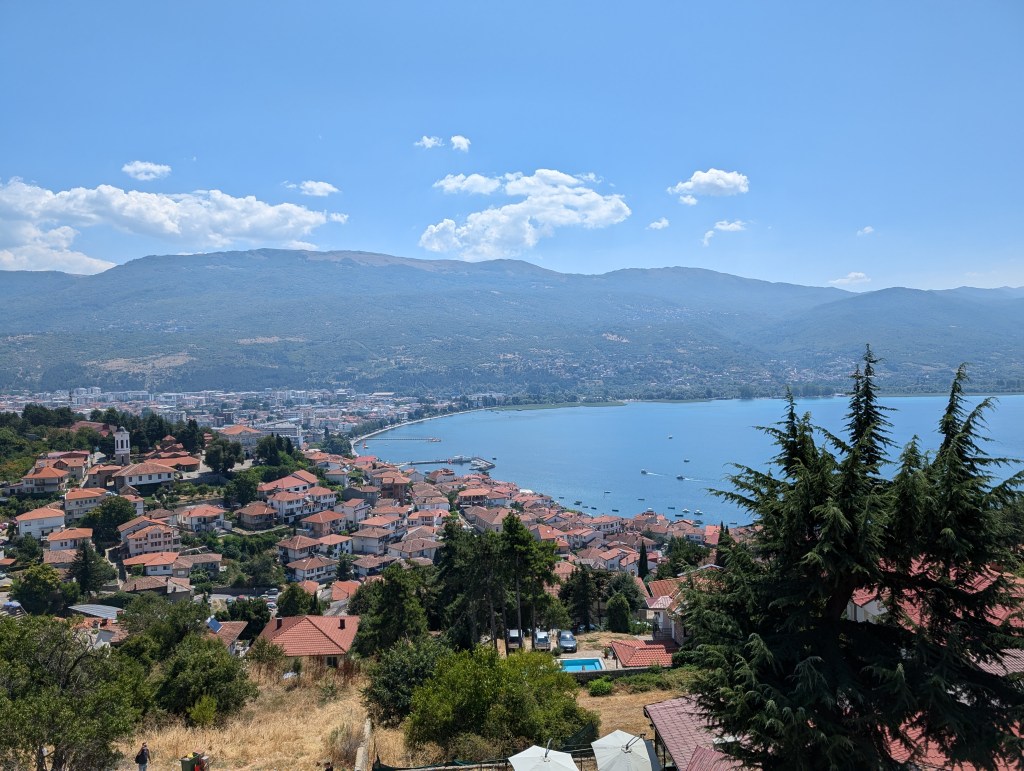
Ohrid lay upon a lake comparable in scale and appearance with the ever-popular ones in Italy. This was about where the similarities ended. Due to the significant Ottoman influence here, out was the pasta of Garda or the more Greek-inspired Albanian food. Instead, I enjoyed the city’s many streetside restaurants which churned out fragrant meat skewers, clay pots full of beans and fresh Shopska salad made from cucumber, tomato and grated feta.
The city looked further east than Albania ever did. I have always preferred eastern influences, spending much time exploring Central Asia or some of the other ex-Soviet states in Europe. It’s something of a hobby of mine. Ohrid was perfect in satisfying this hobby – it felt colourful and exotic without being unfriendly or unfamiliar.
Much of Ohrid’s colour came from the streets which were lined, bazaar-style, with shops. Sure, some of these sold the standard fridge magnet tourist rubbish. Most, though, sold Ohrid pearl. These were not real pearls, more a mixture of ground up shells then coated with a secret emulsion known only to two families in the world.
“I was treated to the clear blue of the lake turning a blazing orange as the sun steadily set”
Even if these “pearls” were not real (but could have fooled me), they made the shop fronts glint in the sun, matching the clear blue glistening lake. At certain hours, it gave the lakefront streets an ethereal, magical feeling.
This was coupled with the similarly beautiful call to prayer. Like neighbouring Albania, North Macedonia had no issues with religious openness and acceptance. This was most obviously on show when the various Imams at mosques dotted around the old town called their faithful to pray, momentarily harmonising in doing so. I always looked forward to the five times this call rang out across the city, pausing every time and letting it wash over me.
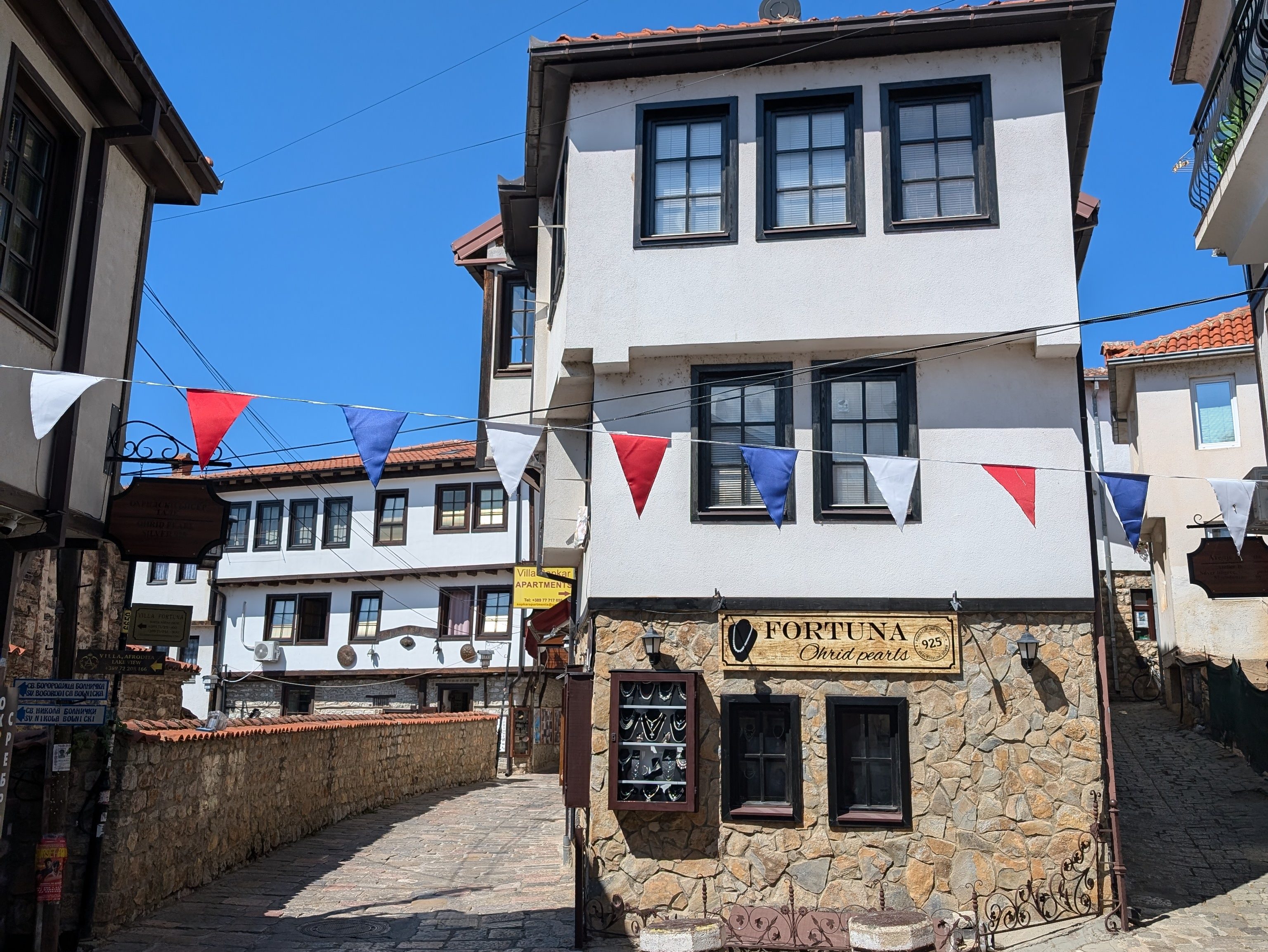
There are very few cities I have visited where you can first experience such an open display of Islamic faith and then head around a hundred meters and sunbathe undisturbed on one of the many white pebble beaches. Ohrid, though, was one of them. In the heat of the day, the tourists who had found their way here decided to take up the sunbathing side of this bargain – welcome respite from absorbing all the culture and spirituality around them.
As I’ve never particularly been one for sunbathing I carried on by making my way up to the city’s hilltop fortress, proudly carrying North Macedonia’s red flag emblazoned (appropriately) with a yellow sun. This structure was fairly unremarkable, similar in many ways but smaller than those of Berat and Gjirokastra in Albania. What these Albanian fortresses lacked were the surroundings of Ohrid. All around were craggy white hills, cliffs and, as the centrepiece, the lake stretching out for miles in front of me.
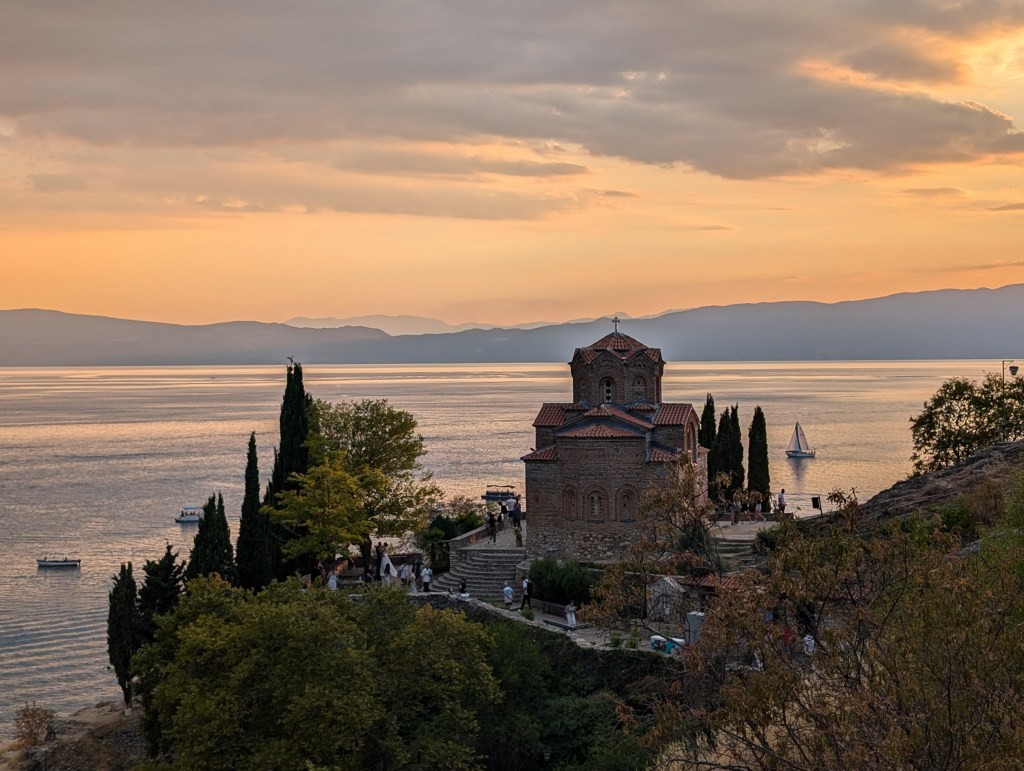
Just below the fort lay the Church of Saint John at Kaneo. This cliff-top building was accessed by weaving through the narrower streets of the old town, occasionally dipping down to the lake where a boardwalk was installed over it to avoid the obstacles of the surrounding cliffs.
Having navigated there in time for sunset (not a mean feat), I was treated to the clear blue of the lake turning a blazing orange as the sun steadily set over the Albanian shore. At the same time, the pleasant smell of incense wafted occasionally from the ajar church door before being whisked off onto the lake by the gentle breeze.

If Ohrid had an Instagram spot, or at least one that had been discovered already, it was here. There were some crowds on the terraces surrounding the 13th Century church. Even so, this was nothing compared to what you could expect at any point during the day at Albania’s nearby Insta-tourist hotspot of the Blue Eye outside Saranda. It was more of a general and quiet buzz rather than a bare-knuckle fight for the perfect photo.
Another day, I decided that I should finally take a much closer look at the lake that drew me here in the first place (and also one of the things which made this area a UNESCO World Heritage Site).
I was quick to find a local man to take a group of us out onto the water in a boat large enough for perhaps six people. We were encouraged to swim in the clear lake water between stories of the area. Diving in at regular intervals through the trip meant a welcome chance to cool off from the sun beating down upon the uncovered boat.
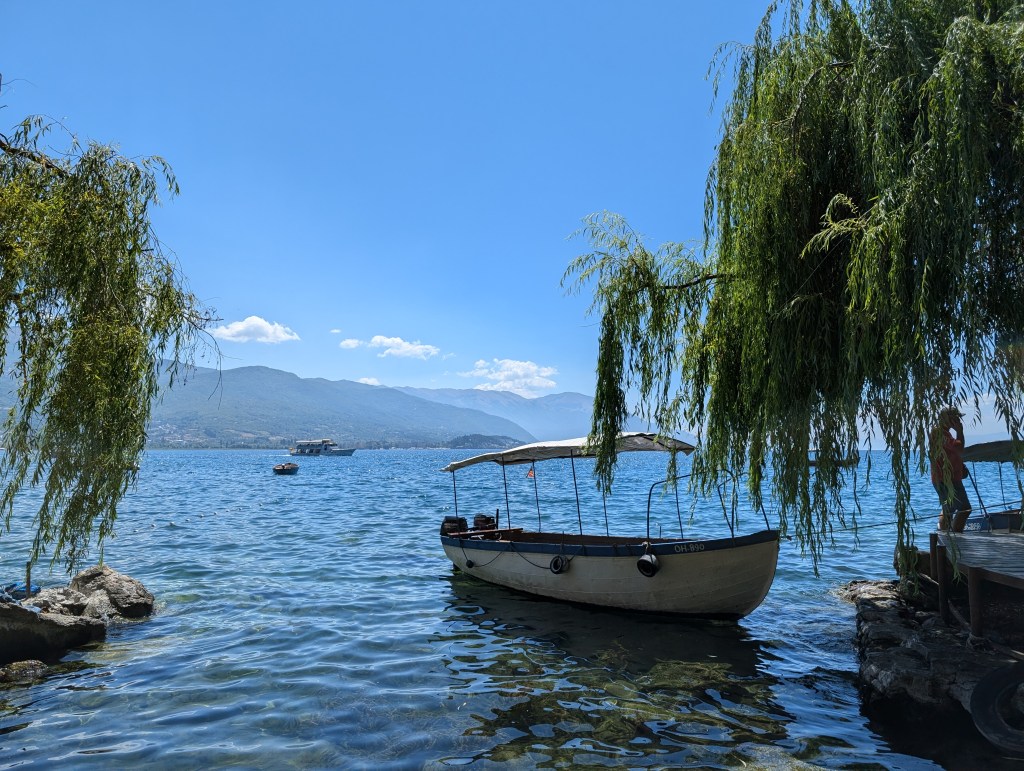
The objective of this trip out onto the water was not purely to swim though. Passing an official residence of the North Macedonian president, Gordana Siljanovska-Davkova, we made our way along one of the lake shores. This was on the way to the site that represents the area’s archeological significance: the Bay of Bones.
There was nothing to see of the original settlements, dating back around 8,000 years (putting them among Europe’s oldest). In their place was a reconstruction of the small stilt houses of mud and timber used in the Bronze Age. Lake Ohrid is one of the world’s oldest, dating back as far as five million years and I enjoyed this small window into the area’s immense history.
The history of the area was more than neolithic or geological. In reality, a lot of it was extremely recent, demonstrated by the frequent displays of patriotism by locals such as the flying of the country’s flag on various monuments or our boatman’s insistence that he was a proud “Macedonian” (noting the lack of “North”).
This was a state at pains to establish its identity on the world stage. A long disagreement with Greece forced a name change in 2019, adding the confusing “North” label. This satisfied Greek politicians who were concerned of cultural appropriation, with both countries claiming characters such as Alexander the Great as their own. Even so, this new name was largely unused by the local population and showed the underlying tension in the Balkans that has existed since the fall of the Berlin Wall.
It was perhaps the country’s confusing name or general obscurity that had put people off visiting. Even so, those in the know and intent on visiting may have been hard pushed by the lack of flights. Though there was an international airport, only TUI flew from the UK (from Manchester with Gatwick flights coming in 2026). These flights were also mostly seasonal which meant that a flight to either Skopje, North Macedonia’s mad capital, or Tirana was necessary to get to Ohrid.
“Ohrid demanded patience and an appreciation of the present”
This, however, was not a taxing journey. Bus connections were regular, timetabled and cheap. Most journeys took around four hours which, I think, was a small sacrifice to explore what was by European standards, unexplored.
The transport issue actually highlighted to me the sort of person that Ohrid wanted to attract to its shores. This was not a place full of quick thrills, booming music and teenagers spilling out of clubs into the early hours. Though it was not stuck in the past, it did not look entirely to the future either.
Instead, Ohrid demanded patience and an appreciation of the present. In return, it gave me a sense of deep relaxation that I rarely find in any place yet covet intensely – the sort where time stands still and, just for a fleeting moment, you feel a purpose but no pressure to rush towards it. I may never find it in a beachside all-inclusive but here I did.
I wished I could have stayed longer to continue to wander the streets of the city, taking in the delicious smells of grilled meat and the sound of the melodic call to prayer for the city’s Muslim population. This was a multi sensory city; pleasurable and balanced in every way I perceived it.
Unfortunately it was not possible this time. I was happy though to have experienced Ohrid before its inevitable tourist influx as the influencers realise slowly that they’ve run out of coastline and drag the masses with them from across western Europe and beyond. After all, if you run out of sea, is the next best thing not a lake?
 Into The Elsewhere