For many, Bosnia is a war rather than a country. In the 1990’s, Serbian forces surged into the country’s east, almost reaching its capital, Sarajevo, which lay under siege for around four years. Nearly a full 30 years after this bloody conflict ended, I visited to find out whether it was a country still defined by its gruesome past. Was Bosnia still just a war or was the world missing out on something greater?
Setting foot in Bosnia (or Bosnia and Herzegovina to give it it’s full name), I was taken aback by how unequivocally the old town was split in two. It sounds absurd but quite literally one step took me from a city with every Ottoman influence you could imagine to somewhere so utterly Austrian I was expecting someone to step out and offer me Sachertorte on the spot.
“There was no semblance of segregation – mosques, synagogues and churches were all close by”
I was naturally drawn to the Ottoman side and, in particular, the Gazi Husrev-Beg Mosque. With its large minaret and dome, this was an obvious landmark. The courtyard in front of it served as a meeting place for the myriad walking tours and worshippers alike and, with its central covered fountain and leafy green trees a welcome break from the sun and the constant thrum of the busy main street just the other side of the tall stone wall.
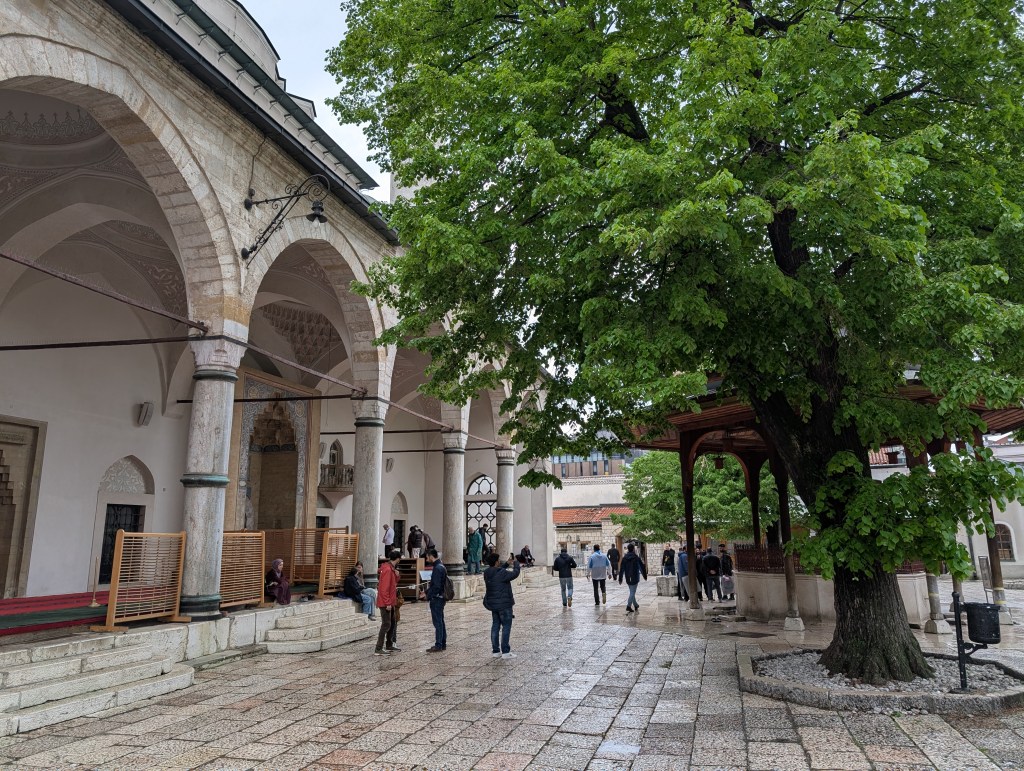
The interior of this building was no less pretty than the exterior yet somehow understated in equal measure. Where some mosques would be covered head to toe in gold and other precious metals, this one favoured a largely plain white interior with painstakingly intricate painted details around archways and its dome. This reflected the city as a whole; it may not have been the largest, most spectacular or groundbreaking example of an Ottoman-style city though it was extremely pretty and an excellent, tasteful example of the style.
Occasionally, the line drawn across the old town blurred. Whether it was cafés in Austrian-style buildings with windows crammed with sweet baklava or the odd wine bar or pub in the Turkish side, this proved the acceptance and openness which ran throughout the city. There was no semblance of segregation – mosques, synagogues and churches were all close by and left peacefully to their own devices.
I enjoyed wandering the streets here, where my senses were at times overwhelmed with the the sweet smells of hookah bars, the gentle tapping sounds of the coppersmiths working on new pieces to sell or the taste of juicy, freshly barbequed cevapi (meat sausages served with fresh bread).

In fact, the food was generally excellent. Bosnia had its own food identity, similar yet resoundingly distinct from it’s Balkan neighbours. Highlights included Bosanski lonac, a slow-cooked meat stew with potatoes and Bosnian coffee. Though the coffee seemed very similar to its Turkish counterpart, I was repeatedly assured it was different and, at the very least, it wasn’t something I’d seen much in other Balkan states even if the Turkish coffee debate wasn’t fully settled.
The Austrian inspired side of the town was perhaps best known for one of the most consequential moments in 20th Century history: the assassination of Franz Ferdinand, heir to the Austro-Hungarian throne. This killing set in motion the First World War. Though there was little besides a few pictures in a window and some footprints in the pavement to denote where Gavrilo Princip, the Archduke’s assassin, stood as he pulled the trigger, it was difficult not to contemplate the enormity of this event. In fact, it could be argued that Sarajevo is just as famous for this single event as it is for the war which occurred later on in the same century. Even so, an immense sense of history dating back far before this event echoed through the streets – this was a city of stories.
As a whole, the rest of the Austrian side was fairly unremarkable in the face of many of the other cities nearby which use the same architectural styles, such as Budapest. The main attractions here all seemed to point to one thing: the 1990’s.
This was an extremely dark time in Bosnian history and, to this day, the genocide against the Bosniak people is the only one to have officially occurred in Europe since the Second World War, according to the UN. Upper estimates have placed the numbers murdered at 33,000. Unlike WWII, though, this was a much more recent event and it was clear the scars were still keenly felt.
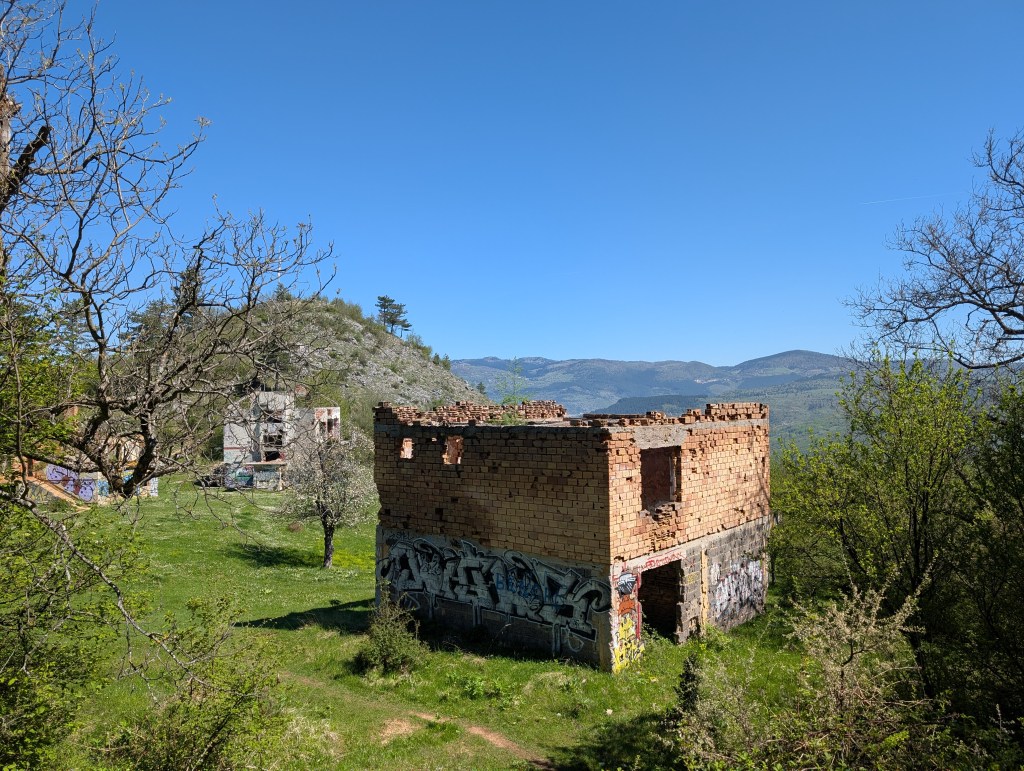
They were often still visible. Many buildings outside the city centre still showed the signs of conflict as bullet holes had been left unrepaired in apartment blocks, houses and shops. Even the bobsled track from the 1984 Winter Olympic Games was used as a defensive structure by the Serbs as they besieged Sarajevo – the holes that they cut out of the banking for their snipers to use were still present in places.

Walking back down the mountain from the bobsled track, the enormity of what happened was brought sharply into focus as I passed through a cemetery. The stark, white headstones were all inscribed with the years the deceased lived and died and, though the birth years were widely varied, the years of death ranged solely from 1994 to 1997. Looking across the city at this moment from this one small cemetery, I saw several other cemeteries, all neatly packed full of identical clean white tombs. I could only imagine that the dates of death in these cemeteries may have been very similar to the one I was in. The scale of loss was vast.
There was more than just physical scarring across the city; it became clear how the war and its after effects were still felt by the Bosnian people. The clearest representation of this was the number of museums dedicated to the conflict in the Austrian side of the old town and beyond. Though I only visited the City Hall, the Gallery of 11/07/95 and the War Childhood Museum (all of which brought the suffering of this race into sharp focus and were excellent memorials to those killed), I counted at least a further three across the town.
“Perhaps the trauma was still too recent”
Of course, I understood that a conflict and genocide like this must be remembered and that it was of extreme importance that people are educated on events like those in Bosnia in the 90’s. As the philosopher George Santayana said, “those who cannot remember the past are doomed to repeat it”. It was important that these museums existed and people should visit and learn about what happened in Sarajevo by going to them.
However, the events of 30 years ago clearly made the nation question its identity in a way that it never had before. No country, let alone one in the Balkans, is ethnically uniform and Bosnia was (in the 90’s and also when I visited) no exception. When one ethnic group (the Serbs) sought the eradication of another (the Bosniaks), people questioned their safety in their own lands and, no doubt, paranoia and distrust set in and became ingrained into citizens’ psyche.
Exploring the city, I felt that the country stood at a crossroads. It had an opportunity to encourage tourism through its vibrant culture, dating back to Roman times and including beautiful structures like the Gazi Husrev-Beg Mosque. It accept itself as the city of stories that it so clearly was. Alternatively, it could focus on its recent and extremely bloody past.
This would be a difficult decision to make and perhaps Sarajevo and the wider country was not in a position to make it yet. Perhaps the trauma was still too recent.
Even so, I felt that the museums and monuments to the genocide dominated the city from a tourist’s perspective. As someone who is very keen to learn about a place’s entire history, including the positive and negative chapters, I saw a part history. The remainder wasn’t censored but was difficult to access.
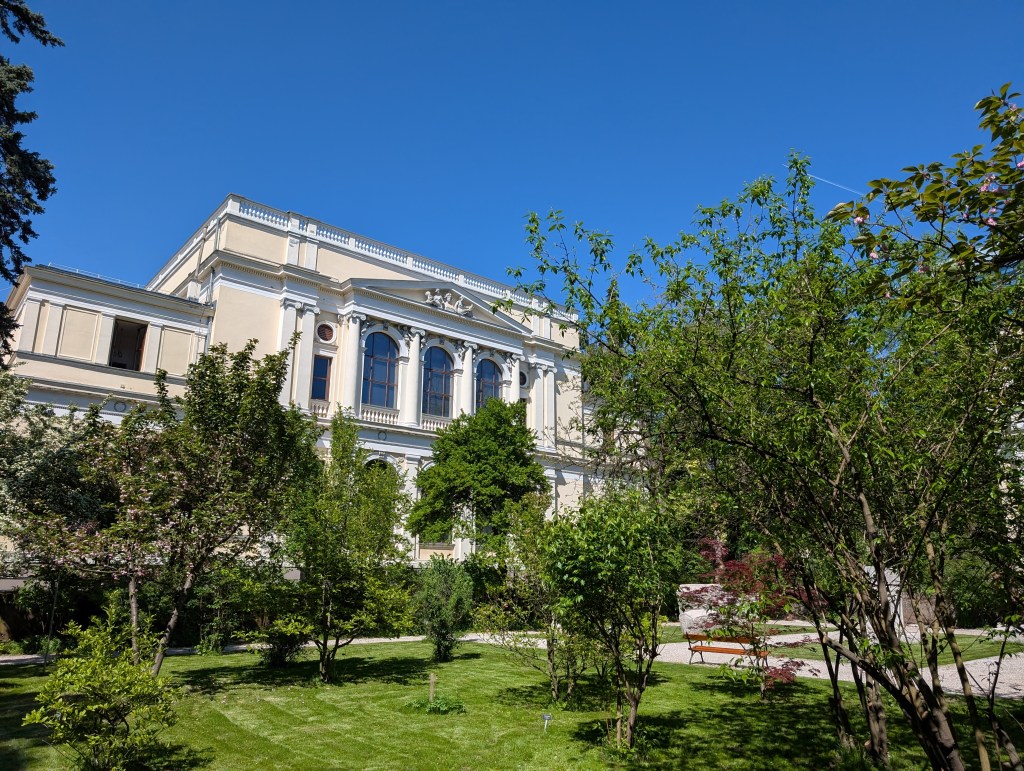
Only when I travelled on the tram out of the old town did I come across the National Museum which housed some masterfully intricate and colourful Roman mosaics and other artifacts dating from long before even that period. The museum had been hidden out of view, away from the centre and not as openly advertised as all those focussing on the events of the 90’s. Though some of the exhibits were explained as well as those in the central museums, it was clear that the National Museum was not the priority. This part of Bosnia’s rich history was not as relevant.
This led me to the question I began this article by asking: is Bosnia and Herzegovina still just a war? In a word, yes. Perhaps understandably, it was still coming to terms with the recent past to the detriment of any other history. The war-focused central museums were excellent, though the sheer quantity of them, to the detriment of anything else, spoke to me of a country with emotional scars that were yet to fully heal.
The frustrating thing was that there was a greater reason, beyond learning about the genocide and war, to visit Sarajevo as a historic, storied city. I just wasn’t sure that Sarajevo had fully embraced it yet.
 Into The Elsewhere