Samarkand has an almost hypnotic effect on people; even the mention of its name evokes images of far eastern merchants travelling from unknown cities in caravans of camels, mixing with their European counterparts and trading in precious stones, gold and spices. It is a city synonymous with the Silk Road, the legendary west-to-east trade route that echoes through time.
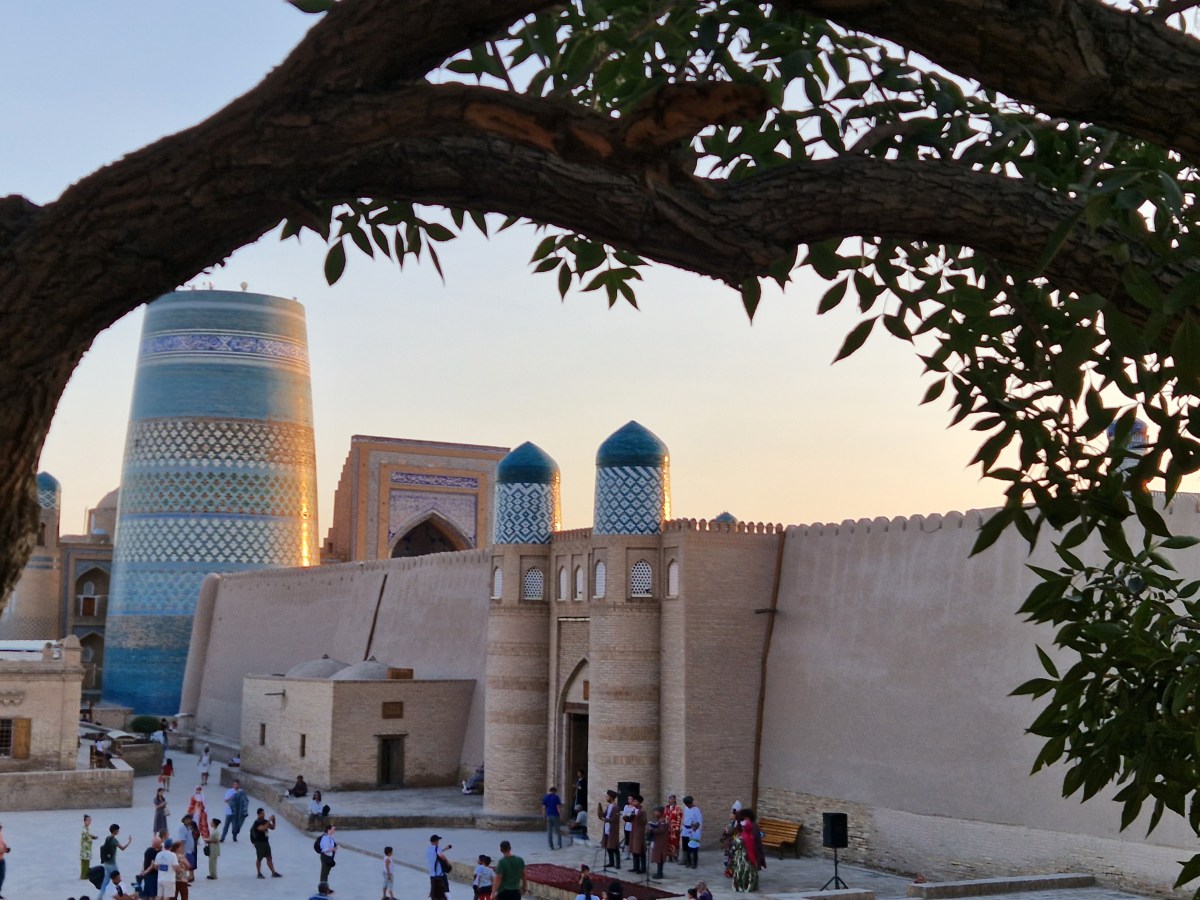
Visiting Samarkand only reinforced this legendary and extremely evocative reputation. The city, one of Uzbekistan’s largest, was awash with ancient mosques, madrasas and mausoleums, all covered in the unmistakable blue and turquoise, hand-painted majolica tiles of the Central Asian region. It is a collision of west and east, yet also feels distinct from both in carving its own, awe-inspiringly beautiful, path.
Explore Uzbekistan further and you will enter the city limits of Bukhara and Khiva, both of which had an equal ability to take my breath away as I walked around their historic, other-worldly streets.
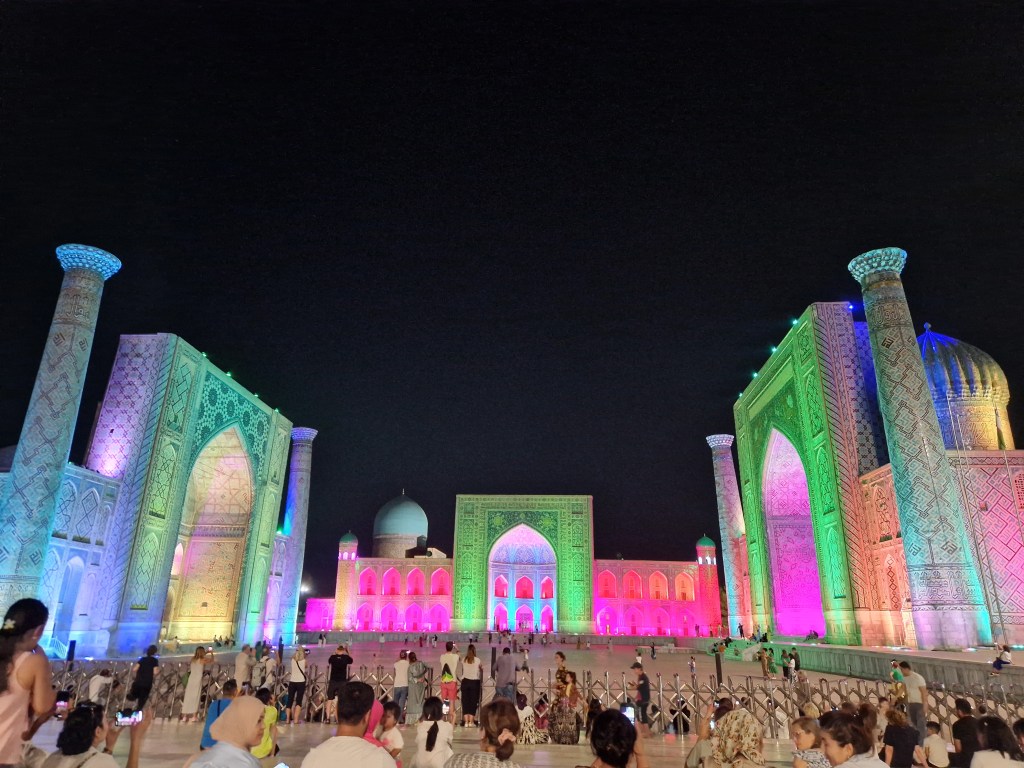
Throughout Uzbekistan’s history, Samarkand, Bukhara and Khiva have all, at times, risen up as the country’s dominant force and its primary trading post. These Khanates were magnets for the wealth of the Silk Road, accumulating untold riches and knowledge from as far and wide as China, Japan or Spain.
Even today, they dominate Uzbek tourism and draw by far the largest crowds to their streets, though these are still comparatively small to what you may expect in Europe’s top destinations. Even so, the government has lent heavily into this opportunity, transforming all three to be more friendly to tourists by pedestrianising streets, blocking off pathways to undesirable areas and introducing tourist attractions such as garish evening light shows.
Tourism will continue to build, if not explode, as a result of this plan, though I was left wondering what I was missing as I walked the pedestrianised boulevards past UNESCO World Heritage sites lit up in bright pink and green and set to frantic music. I wanted to escape, chasing the Silk Road experience of yesteryear instead of the modern Disneyland version of it.
“I was greeted immediately with intricately ornate rooms that were a riot of colour”
In the past, only one other city has challenged this trinity. The Khanate of Kokand rose up in the early 18th Century, having established independence from Bukhara. However, Kokand was fundamentally different to the others before it: its placement in the Uzbek east, within the fertile lands of the Fergana Valley, was in stark contrast to the desert cities in the west.
This difference endured when I visited the city as, while the three desert cities have become well-known in their own rights, attracting increasing numbers of tourists from some of the destinations which used to trade through them centuries earlier, Kokand seemed to have been left behind, a relative unknown to Westerners and precisely what I was searching for.
I began my time in the city by visiting the Khudoyar Khan Palace, which sat resplendent in the city centre. I admired its squat façade and flanking towers covered from top to bottom in majolica tiles forming geometric patterns and Arabic inscriptions as they glinted slightly in the morning sunlight. Though this palace was not quite on the same scale as potential counterparts in other cities, I felt the relatively few tourists and quiet, contemplative atmosphere made up for any lack of grandeur.
Any perceived deficiencies around the palace’s exterior were also quickly compensated for as I made my way inside. Here, I was greeted immediately with intricately ornate rooms that were a riot of colour. There was suddenly extensive use of gold leaf and rich, earthy reds. No surface was safe from this treatment, even the elaborately panelled wooden ceiling were covered.
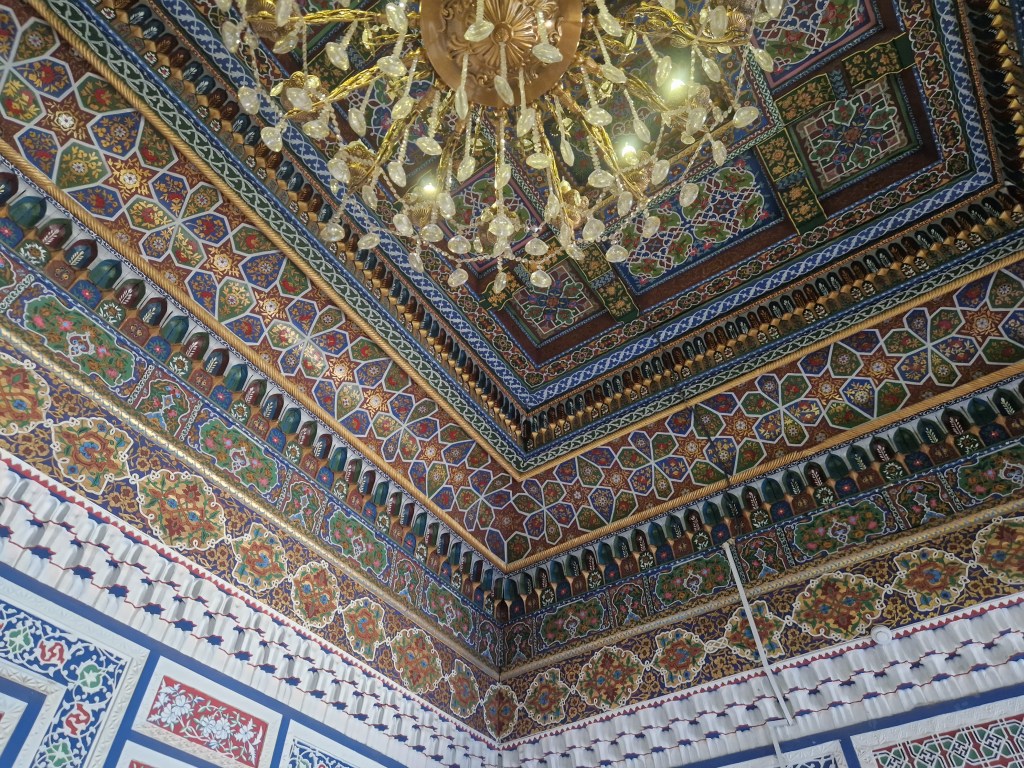
This was unsurprising when I considered the history of the Fergana Valley, which may be termed as Uzbekistan’s economic engine room. During Kokand’s high point, the region was famous for its crafts: ceramics from Rishtan, silk from Margilan and carved wood from Kokand itself all fetched good prices in trades with merchants passing through the area.
However, it wasn’t just goods which passed through the region, but ideas. As Islam spread through the region in the 8th Century and became dominant, mosques sprung up in all major towns and cities. In Kokand, a mosque was built around this time, though the one I visited was built nearly a thousand years later on the same site.
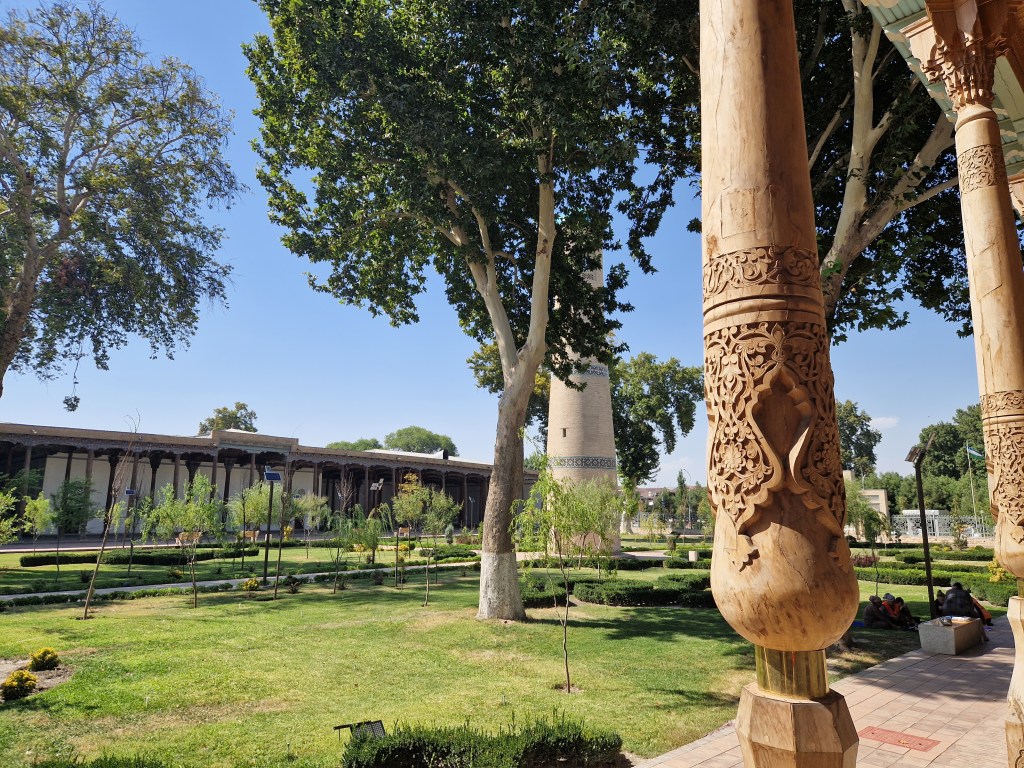
This was unlike any mosque I had previously seen, as the minaret stood in the centre of a large grassy and tree-strewn courtyard, surrounded on two sides by craftspeople’s workshops housed in what were once classrooms for students of Islam and on a third by a fence to block out the world of blaring car horns and street sellers outside. On the fourth wall was the mosque, open to the courtyard. This was a reflection on the fertility of the region – the growth of trees this size or the maintenance of grass in a desert city like Khiva would have been all but impossible.
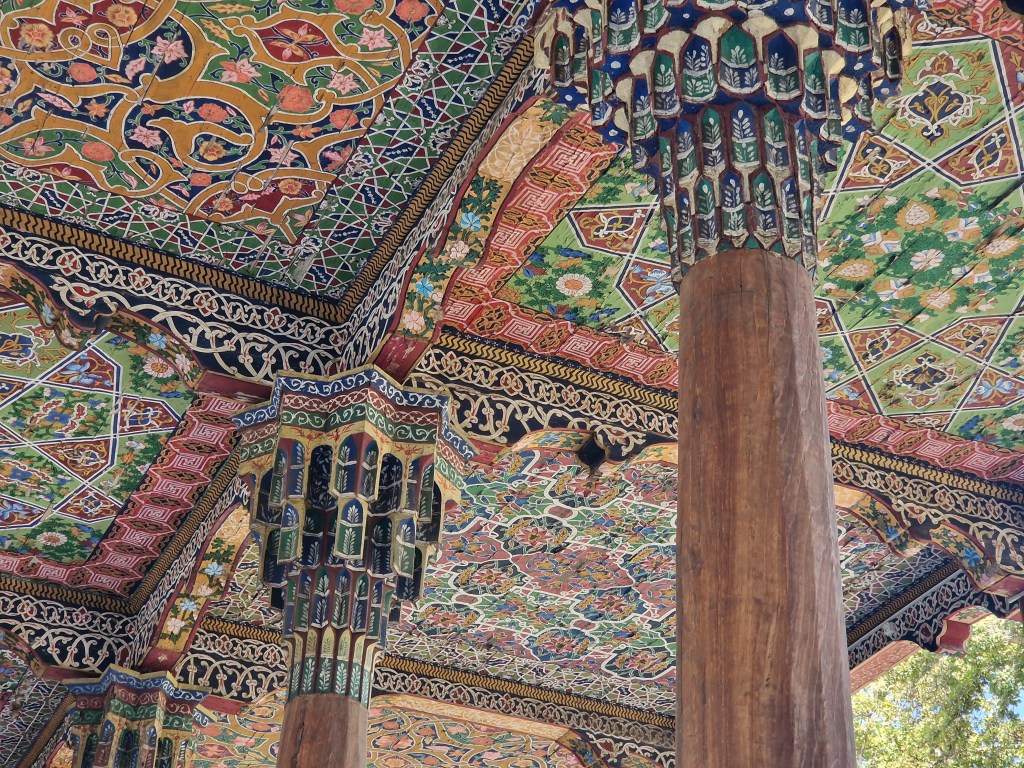
The ornately-painted roof was supported by seemingly hundreds of impossible-looking carved wooden columns. Thin at the base, before bulging outwards and tapering back in at the top, I marvelled at the elegance of their design, which made them feel as if they were floating, hung from the roof rather than supporting it.
Through my time in Kokand, I constantly found myself questioning why there were far fewer tourists here than in, say, Samarkand. Certainly, the city’s provenance was no less interesting and its sites only marginally less spectacular.
Kokand also did away with some of the Disneyland feeling of Samarkand in particular. Where the other “big three” have all been redesigned by the government for tourism, in a way that keeps tourists trapped within certain confines like some bizarre Vegas casino but with genuine medieval monuments inside, Kokand was undisturbed. There were no walls blocking off the bits you weren’t supposed to see, that so often actually positively define a place’s character.
Dare I say it, this was the “real” Uzbekistan. At least it was a version without recent alteration by the country’s higher powers, meaning it could be experienced in a way that was much closer to how it was intended back in the days of the Khanates.
“The riches brought by the Silk Road in the 17th Century will prove to be a double-edged sword for Kokand”
The authenticity of the experience stretched beyond the government forgetting to add a few walls to shepherd tourists in the right direction. This was the only part of the country I visited which felt like it hadn’t experienced the hordes of western tourists streaming through its gates. The chance of people speaking English was low, leading to me randomly pointing at items on menus in the vague hope of a warm meal and something to drink to stave off dehydration courtesy of the ever-present sun.
Almost certainly, one contributing factor to the lack of tourism is the recent levels of instability in the Fergana Valley. As an oasis in the centre of largely barren mountain ranges to the north, south and east and deserts to the west, this has proven in the past to be desirable territory, not just to Uzbekistan but also neighbouring Tajikistan and Kyrgyzstan.
A glance at a map of the area betrayed how ethnic and national tensions have, at times, boiled over here. The borders were a mess of (I could only assume constantly shifting) enclaves and exclaves, a relic of the days under the USSR, where the borders were nominal at best, with at least local free movement permitted.
As I visited, free movement couldn’t have been any further from reality, leading to the UK’s Foreign Office to warn against regular military skirmishes as countries tried to further their claims to the valley’s fertile and valuable ground. Couple this with unrest in the Uzbek part of the valley, which culminated in a brutal government massacre and crackdown in the city of Andijan in 2005, and it possibly is less surprising that growth in tourism is down in the Fergana Valley compared to Uzbekistan as a whole.
Even so, as I visited and crossed the border from Kyrgyzstan into Uzbekistan, I couldn’t help but feel that the tensions in the region have, at the very least, come to a convenient halt for all countries involved. Each of them was experiencing an increase in tourism more generally, though numbers were still limited and fragile, to the point where any tension may change a person’s mind on whether they go or not. Put simply, it was not in the wider interest of any of the countries involved.
This took me back to Samarkand as it is only a matter of time, as Uzbekistan’s fourth great city, that Kokand experiences the same fate as its better known neighbours, especially as past international tensions fade into memory. The riches brought by the Silk Road in the 17th Century will prove to be a double-edged sword for Kokand: they will lead to an increase in interest in the city and many more tourists flocking to its palaces and mosques, though it may also lead to the destruction of its deeply-entrenched Uzbek culture and atmosphere, which made the city so memorable to me.
 Into The Elsewhere