“Yeeeeaaahhhh!”, Roger Daltry’s voice screamed out over the Land Cruiser’s stereo, “Meet the new boss, same as the old boss”, followed by Pete Townshend’s closing guitar segment to the Who’s rock anthem Won’t Get Fooled Again. I relaxed into my seat, watching the bleak landscape speed past the car window.
Before travelling to South America, I had heard of the Salar de Uyuni, the uninhabitable salt flats in the country’s south, perched at an altitude of around 3800m. I knew that I had to visit the moonscape-like vistas and see the enormous skies. That said, I had some reservations, questioning whether there was more to the place than just an opportunity to get quirky Instagram photos that play with perspective.
“The distant mountains beyond the Salar never budged an inch on the horizon”
Less than fresh from an overnight bus from La Paz, I arrived in Uyuni town at around 6:00am and, stepping out of the bus station, was shocked at the complete transformation in the landscape around me. The mountains and hustle and bustle of La Paz had been replaced by wild-west-style single and double storey buildings, all of which felt temporary, as if they’d been thrown up in a hurry with the builders knowing that they wouldn’t be occupied for more than six months. Short of tumbleweed and people riding down the streets on horseback, I had stepped into a film set.
Having checked in with the tour provider for the two night trip, been shown the Toyota Land Cruiser that I’d be travelling in and met those I would be travelling with, we set off. The group was hardly diverse, coming from the UK, USA and Ireland. The driver, Grobert, seemed unsurprised though, an indication of the tourism levels in the area. We may have been about to set off into one of the world’s least hospitable places but we were hardly off South America’s beaten track, thanks to the social media fame of the salt flats.
Though the Salar de Uyuni featured highly on any traveller’s itinerary in Bolivia, the vast expanse of the flats quickly consumed the many separate tour groups. It was as if the landscape had been deleted from beneath us as we drove across a blank canvas of bright white salt. The only discernible features were the irregular hexagonal boundaries around two metres across which denoted the boundaries between the salt plates.
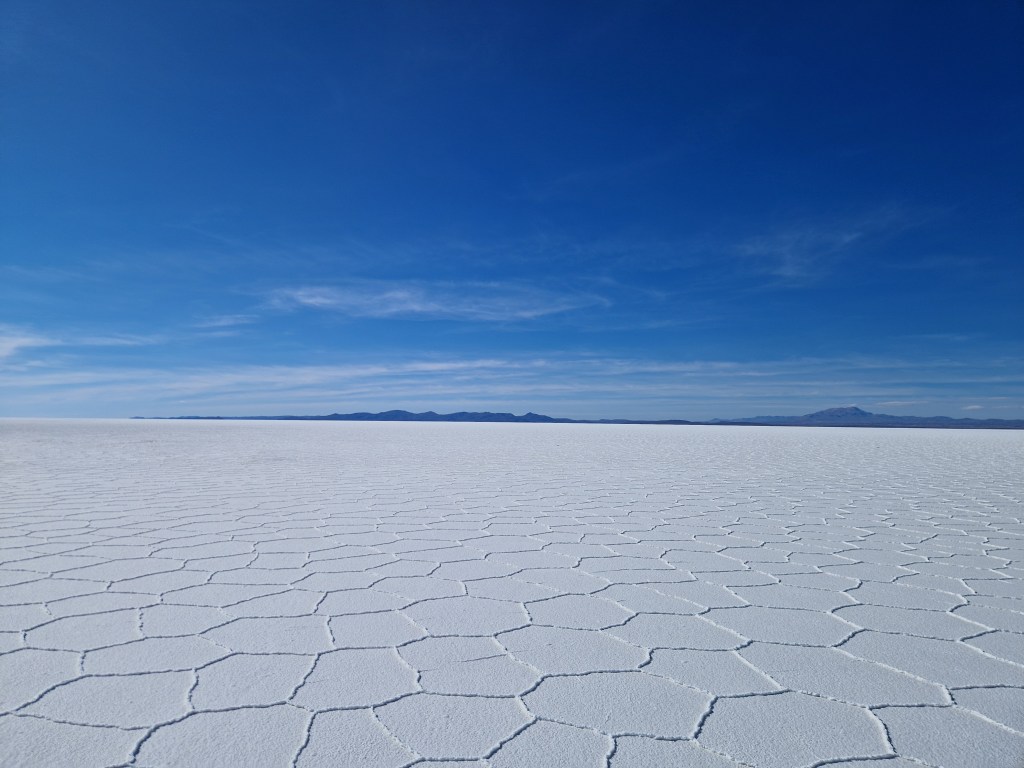
Until recently, the world’s toughest off-road race, the Paris Dakar, crossed these very flats as it snaked its way around the South American continent. I wondered how, with the ability of the flats to warp a person’s perspective, distorting any sense of distance, speed or direction, the drivers were able to successfully navigate such a barren landscape.
It only seemed to be the droning of the Land Cruiser’s engine which gave any sense of speed and even then the distant mountains beyond the Salar never budged an inch on the horizon. This was the experience I was expecting when I had initially looked at visiting.
Grobert knew this all too well and soon encouraged all of us out of the car and onto the salt. His aim was to get some of the now famous perspective photos which have peppered travel feeds worldwide. We all stood awkwardly as we pretended to walk out of drinks bottles or be shrunk and picked up by one another. It was as if my fears were slowly coming true at this moment; perhaps there was little more here than just a vast expanse of salt.
That is not to say it wasn’t eerily beautiful in a very unique way. At sunset, where I would have expected the sun to colour the sky deep orange, here there was more of an effect of someone flicking a switch to turn the lights out. Equally bizarrely, it was the salt which turned orange rather than the sky, causing a strange and unexpected reverse sunset effect. It felt like I had been transported to another planet as the temperature again plummeted and I felt the salt crunch beneath my feet.

As an experienced guide, Grobert knew how to make the best of this situation as he turned to me in the seat beside him, grinned and, in a thick Spanish accent, made a demand, “Music!”. Before I knew it, an antennae sprung up from within the ancient Land Cruiser and a Bluetooth signal appeared from nowhere on my phone. As we cruised along in the dusk, we cycled from Led Zeppelin to Pink Floyd, which I thought was befitting of such an extreme and other-worldly landscape.
This short episode transformed the experience. Suddenly I understood the appeal as the salt flats were transformed in my mind from barren to epic – wild west fantasies befitting of Uyuni town rushing through my head as the sun gave way to a crystal clear night sky.
“I was free … to appreciate the peace and beauty that was promised to me on social media”
To my delight, the second day was much more varied than the first as we exited the salt flats and entered the world’s driest desert, the Atacama. Surrounded by the high Andes mountains which form a natural barrier to rainfall, I was told by Grobert that it only rained once every seven years.
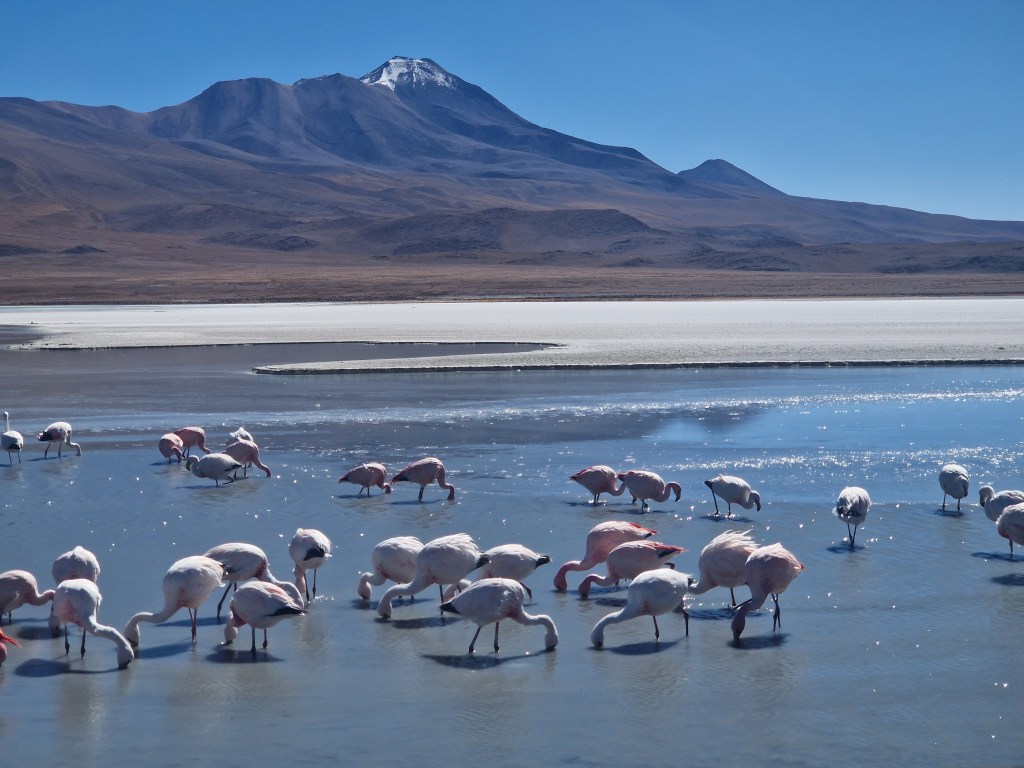
I was therefore astounded to learn of the species which call this totally inhospitable environment home, somehow making use of volcanic spring water and otherwise travelling long distances to eat or drink. Chief among these animals was the flamingo as we watched several flocks in the high-altitude lakes. The alkalinity of these waters formed an ideal habitat for the birds, where they could breed and feed on algae, giving them their unmistakable red colour. This was in stark contrast to the greys and browns which the white salt flats had given way to.
However, as can often be the case when it comes to wildlife tourism, I couldn’t help but feel that some of the animals we saw were almost entirely sustained by the human populations which have started to frequent the area. Nowhere was this more obvious than when we were driven to a cluster of boulders, to see vizcacha, a usually shy rodent somewhere between a rat and guinea pig.
It was clear that constant exposure to tourists and their endless food supplies had changed the behaviours of these vizcacha beyond all recognition. The crowds surrounding them were able to get within arm’s reach of the most tame of the bunch. As an experience, this only served as a reminder to me as to how fragile human relationships with the natural world can be. In that moment, the whole trip slipped back from adventurous exploration of unknown landscapes to an Instagram-biased photoshoot.
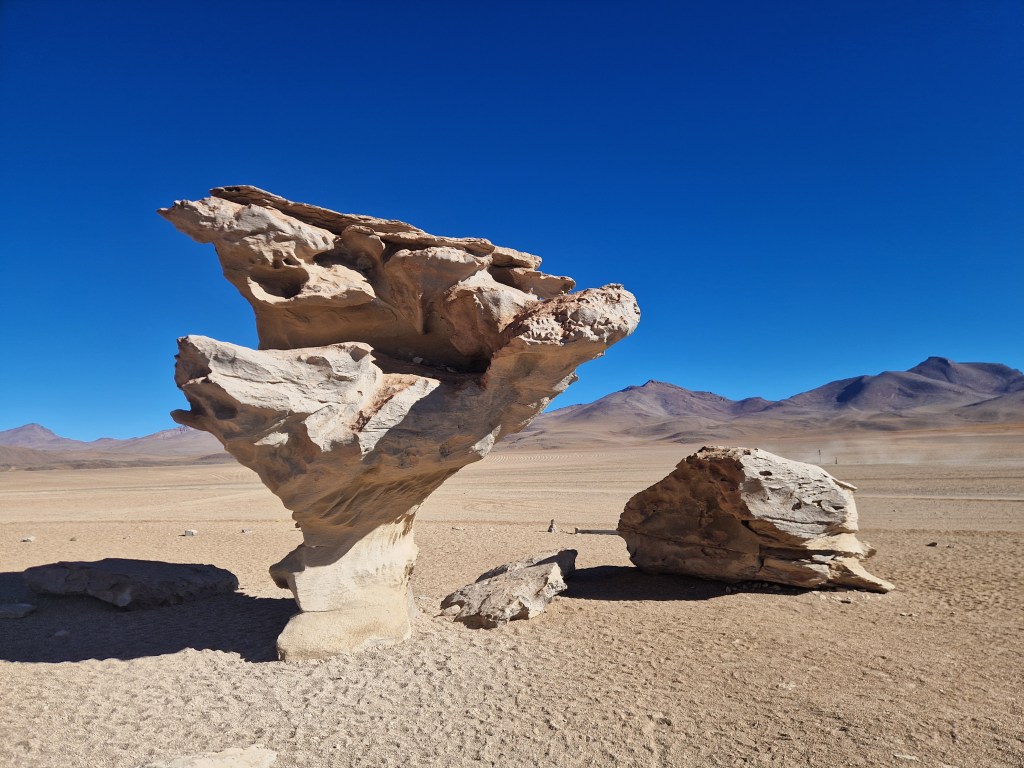
The rest of the expedition see-sawed in a similar fashion, with moments of magic as I felt transported back in time looking at the weather-beaten rock formations, carved into beautiful and exotic shapes. These feelings were then crushed by over-full tourist hotspots, as all the tours stopped at the same café for lunch.
No single location encapsulated this feeling better than Isla Incahuasi. This rocky outcrop was once an island in the saltwater lake which preceded the salt flats and, with its legions of tall, lop-sided cacti springing up on some of the unlikeliest of surfaces, it was an obvious place to look out over the vast, flat expanse below.
The view was stunning in how featureless it was, though I couldn’t help but realise the small army of off-road vehicles which had pulled up below to one side of the island, safely away from the best of the camera angles. I never expected to have such a well-known place to myself, though I was still surprised at the sheer, unregulated numbers which had joined me.
Towards the end of the trip, most travellers crossed from Bolivia into Chile via an extremely remote border crossing, though I had made the decision to return, driving around four hours, to Uyuni. I initially regretted this decision, passing up an opportunity to experience Chilean culture and custom.
However, as I parted from most of the crowds (leaving me in the car alone with Grobert and the Rolling Stones), it gave me an opportunity to experience how special this area would have been before its tourism boom. About halfway through the drive, we pulled to the side of the road and I was invited to explore what transpired to be an old lava flow, a sign of the volcanic nature of the Andes.
Climbing with Grobert among the folded rock formations and between the streams and ponds, I was free of the tourist trail and able to appreciate the peace and beauty that was promised to me on social media. Where there were many cars parked out of shot at Isla Incahuasi, there were perhaps three here.
This left a bittersweet feeling in my stomach. I knew that I had driven through and been lucky enough to admire one of the planet’s most unique landscapes, perhaps before it was destroyed further by more extensive tourism. At the same time, I couldn’t help but wonder how much the human factor was harming the area and slowly destroying what made it so unique.
 Into The Elsewhere