Nowhere is the term “concrete jungle” more applicable than Bucharest. At first, only the imposingly wide boulevards provided some respite from the endless and identical communist-era blocks adorned with oversized advertisements, now for western brands such as Coca Cola or McDonalds, and air conditioning units clumsily stuck to their walls.
This brutalist dystopia was the brainchild of Romania’s one-time dictator, Nicolae Ceauşeacu, who ripped the historic Bucharest to pieces, diverting rivers and remodelling the Ottoman-style streets completely to recreate it in his image, using the excuse of an earthquake in 1977 to do so. At the centre of all of this was his masterpiece, the People’s Palace.
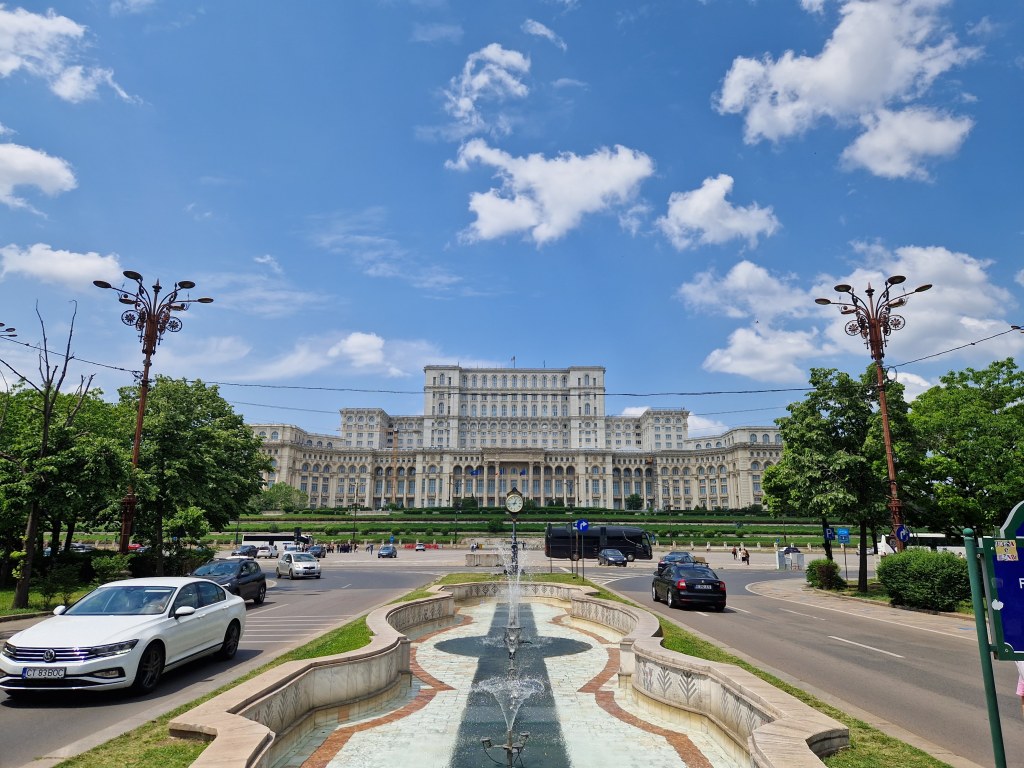
Never had I seen a building on the scale of this palace. Of course, the world has taller buildings, though very few were larger or built to feel more imposing to those looking up at it from the streets below. Inside, the sheer weight of marble used was causing the whole structure to sink six milimetres every year.
Even if Ceauşeacu never actually saw his palace completed, it was clear to me as I looked on from the outside that this was a man who, like many of his contemporaries leading other states behind the Iron Curtain, was megalomaniacal in the extreme. The contrast between his marble-laden, monumental palace and those drab concrete blocks which he forced his subjects to inhabit was striking.
At this moment I wondered to myself what made life worth living for ordinary people in communist-era Bucharest, in the face of a project like this. What, if anything, remained of the city’s rich Ottoman history and how did it sit in the face of such extensive brutalist architecture? Could beauty be found in the concrete jungle?
“This was … a white elephant that you would perhaps expect from a Roman emperor”
Though there are some that admire the total use of concrete and hard lines of brutalist architecture, I do not count myself among them. To me, the boulevards only served as a representation of a time of suffering, where there was little opportunity for average workers in the face of brutal dictatorship and limits on freedom of speech.
Equally, as much as it was impressive in how it imposed itself upon the remainder of the city, I found no beauty in the People’s Palace. This was a building that was constructed largely using forced labour, with some estimates on the number of deaths during construction stretching into the thousands.
Whole communities were also relocated and a hill levelled to make enough space for the palace’s vast footprint. This was less a marvel of 20th Century construction and more a white elephant that you would perhaps expect from a Roman emperor (though here with an additional deep-level nuclear bunker).
Besides its bloody past, the building’s façade, though impressive, somehow failed to be beautiful. My reaction to it was more akin to seeing a supertall skyscraper such as Dubai’s Burj Khalifa than the Taj Mahal. My mind was wowed but only by the scale of the construction but once this had worn off, I felt no need to stick around and continue to admire the minor details of the building. It was uninteresting beyond being absolutely vast.
One advantage of the almost comically wide streets which criss-crossed the city and ran past the palace was that it was easy to navigate by bicycle. This was something which I took advantage of as I cycled along streets occupied by pedestrians, cyclists, trams, cars and grassy central reservations with Ceauşeacu-approved water features with room to spare.
The apartment blocks which lined these streets aside, there was almost a Parisian feel as I rode around. This was to the extent that, at one intersection, a close replica of the Arc de Triomphe had been erected, again at the whim of Ceauşeacu.
However, it was not the triumphal arch which revealed to me a different side of the city, but the park situated behind it. The King Michael I Park was centred around a large lake, one of a series which cut through the northern edges of the city. Its tree-lined pathways strongly reflected those within the city proper, though, without the drab concrete just beyond them, the trees seemed less as if they were trying to mask architectural scars and more an effort to enhance the beauty and serenity of the surroundings.
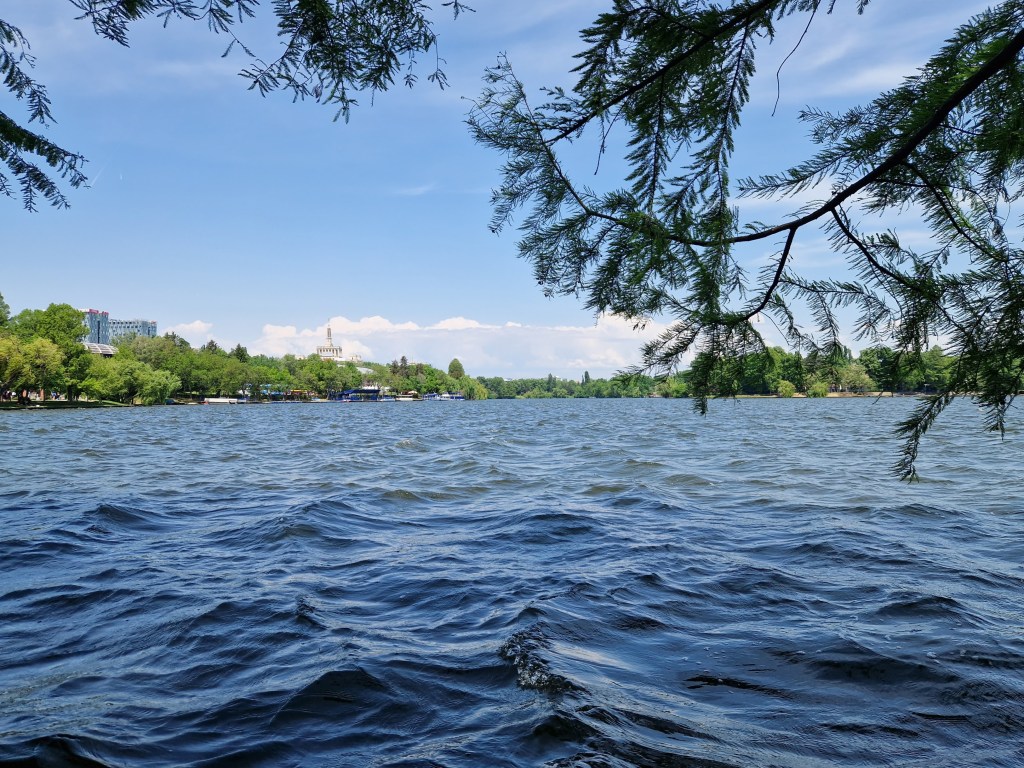
It was clear that this was a place enjoyed by Bucharest’s locals as well. All around was the gentle hum of people having conversations as they walked with families and friends, using the many trees to shade themselves from the heat of the day.
Perhaps unsurprisingly this was where Ceauşeacu himself chose to live while his city-centre palace was still under construction. His house, which seemed extremely modest in the face of what was set to replace it, blended into the surroundings with its leafy garden and courtyard which had been modified to become home to a café. Even so, it was not sparse, containing a swimming pool and so many artifacts from leaders as diverse as Castro and de Gaulle that it eventually was impossible to keep count of who had given him what.
As much as I enjoyed the park and its surrounds, it felt like a slightly fraudulent success in looking for beauty amongst the concrete. Rather than finding what I sought within the jungle, I had chosen to escape it entirely. I thought I should dig deeper, heading back into the city and away from the peaceful, leafy refuge.
I reasoned with myself that, if there was to be a part of the city which was any better than the identikit apartment blocks, it may well be the old town. Upon initial inspection, things were hardly promising as there seemed to be more strip clubs and tourist bars than examples of architecture which predated the 1977 earthquake and subsequent erasure of most of the city.
This was until I arrived at the doors of the Stavropoleos Monastery. Though some of the buildings which made up the site had not survived the test of time, being demolished in the 19th Century, the ornate exterior of what remained, with its intricate iconography and carved, twisting pillars, was impressive even if it did not have the monumental scale of the People’s Palace just down the road.
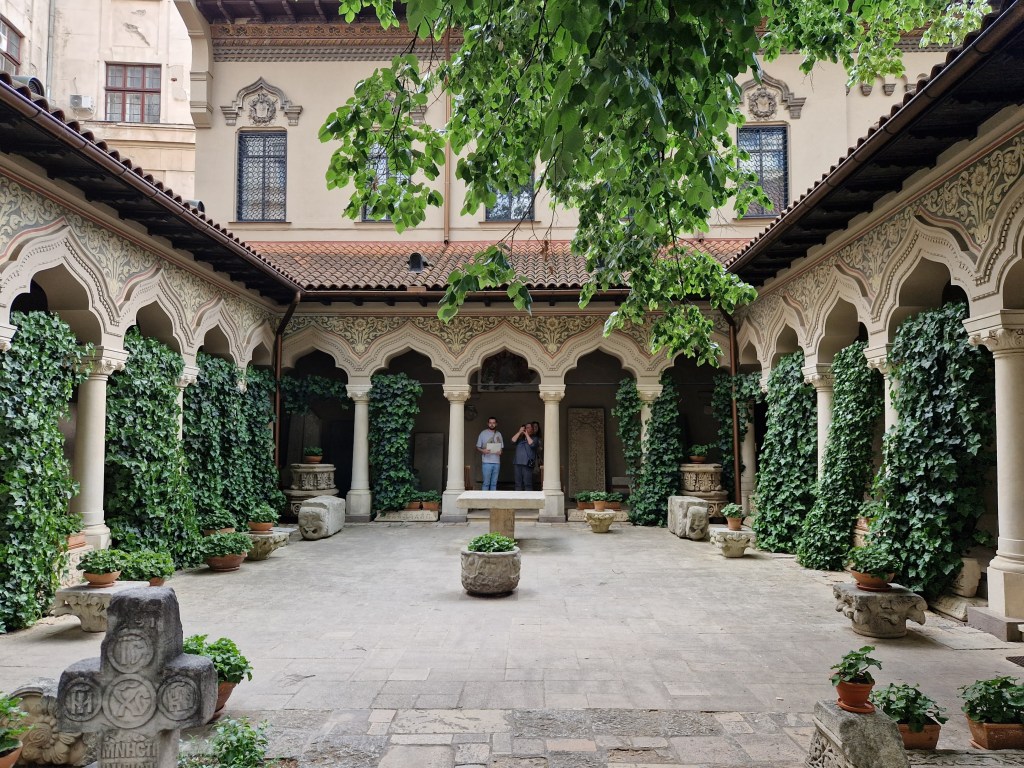
Inside the building was no less impressive. The site was centred around a colonnaded courtyard, rich with plants climbing the walls and columns as they wove their way up towards the light. Here the outside world seemed to melt away, instead replaced with a sense of peace punctuated only occasionally by the ringing of church bells.
Though this was an excellent (and truly beautiful) example of a church which has survived the remodelling of the city in the 1970s and 1980s, it was perhaps less surprising than some other examples which I stumbled across outside of the old town.
“To move such a large and brittle object without it cracking or completely breaking was extremely difficult”
On the face of it, there was very little of any religious significance amongst the apartment blocks and wide open streets of the new city. This was a very deliberate choice of Ceauşeacu’s when he oversaw this grand remodelling as it fitted in well with the anti-religious communist ideology. However, as a leader he was not immune from outside influence.
A civil engineer by the name of Eugeniu Iordăchescu looked upon these historic structures, at that point earmarked for demolition, and wondered if they could somehow be preserved without leaving them situated in the middle of roads or underneath apartment blocks. His solution was radical.
Iordăchescu proposed lifting the churches as one whole structure onto rails with the aim of then sliding them into a less conspicuous location so that they wouldn’t disturb the uniformity of the buildings demanded by his leader. Remarkably, in some cases, Ceauşeacu agreed to the proposition.
During the 1980’s around a dozen churches received this treatment, thereby saving them from destruction. These weighed as much as 900 tonnes and were moved as far as 245 metres – a feat that would be considered impressive in the west today, let alone behind the Iron Curtain, with limited budgets and technology.
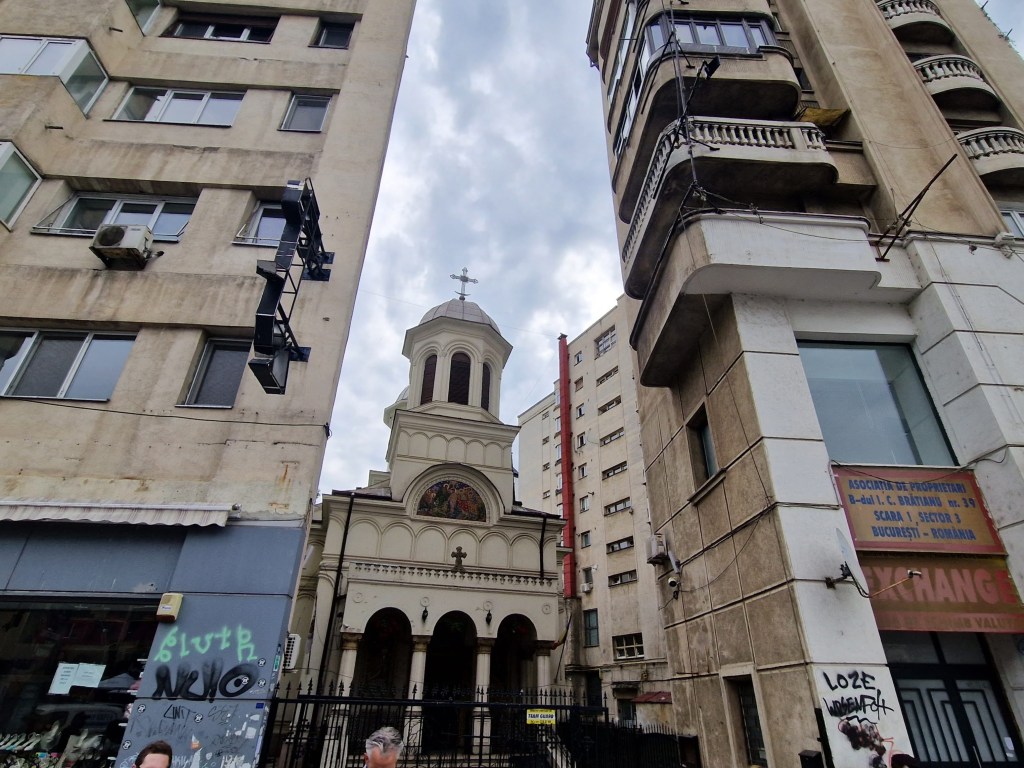
Visiting these churches which have remained in tact to this day, I found it remarkable how well preserved they were. To move such a large and brittle object without it cracking or completely breaking was extremely difficult and required months of planning in each case.
Today, I felt that this was the purest expression of Bucharest’s beauty, not just in the obvious intricacy and skill of the frescoes and other artwork inside and outside these churches, but also in how one man made it his mission to ensure that they were saved from the creation of the concrete jungle.
That they could still be enjoyed by tourists and locals alike and serve as oases, providing respite from the poorly built and even more poorly designed blocks that populated most of Bucharest’s streets, was an example to me of more than just superficial beauty. Where I admired the beauty of the Stavropoleos Monastery, I loved the story of these churches.
I wasn’t expecting much when I arrived in Bucharest besides finding cheap food and drink and the odd cultural experience. Instead, the stories of the mobile churches revealed to me a city which, although largely less than pretty at surface level, was beautiful in how it existed, rather than what existed within it.
 Into The Elsewhere