There are some routes that, by many accounts, should be flown rather than taken by bus. As my alarm urged me to get up at 5am I first began to understand why the journey between Kyrgyzstan’s two biggest cities, Bishkek and Osh, fell firmly into that category. I had signed myself up for a very long day indeed.
Being British, it’s often difficult to understand how travel between two major cities could be so difficult. Take, for example, London and Birmingham: connected by multiple rail lines, the reasonably direct M40 and frankly too close to even make flying worth doing. It was far too easy to imagine the journey between two major cities in any country being just as simple.
Equally, as part of my trip to the region, I had two options to ultimately get between Bishkek and Tashkent, the capitals of Kyrgyzstan and Uzbekistan respectively, to then catch my flight home. The first was back through Kazakhstan and Almaty, which I had already visited. The second? Osh (the Kyrgyz second city) and the Uzbek Fergana Valley – a proposition too interesting to turn down.
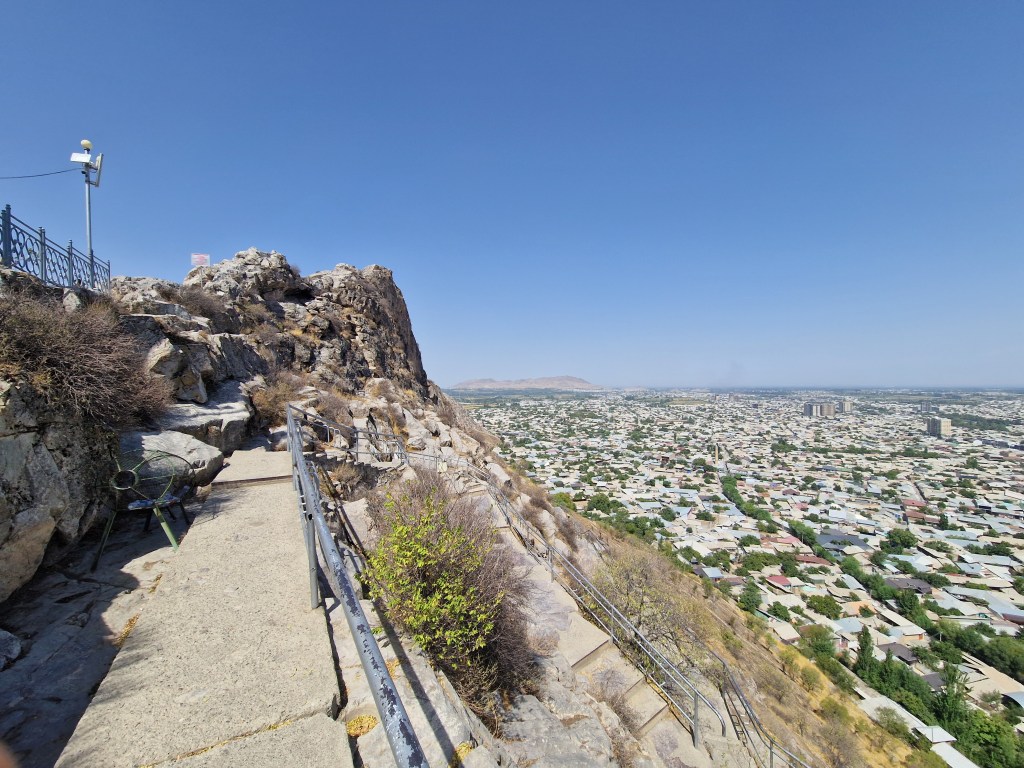
Frantic Googling ensued in Bishkek around how to travel south to Osh, a holy city in the eyes of Islam and perhaps Kyrgyzstan’s liveliest destination. An obvious favourite emerged: to fly.
This was not without major issues. All airlines from the country had been blacklisted by the UK and EU on safety grounds. Knowing the extremely mountainous nature of Kyrgyzstan, I imagined that flying would be a risky business and, considering the potential consequences, it wasn’t something I was going to engage in.
Besides, the best way to see a country is from the ground, right?
Looking online, there were whispers of dangerous mountain roads, poor driving standards and Soviet-era tunnels. I felt a mental pull back towards the assumed safety of aviation, though at this point I was committed to my plan.
Compounding my anxiety over the journey, there was no timetable for the buses. In Central Asia, these “buses” were more commonly known as marshrutkas – often set up informally by one-man-band-style businesses, where the driver is paid directly for the trip as the owner of the vehicle (usually a minibus). Instead of a timetable, they simply left when full, thereby maximising the driver’s profits.
Due to this leave-when-full policy, my only hope was to start very early and hope to get a seat in Bishkek before anyone else. I set an alarm for 5am, though sleep was difficult with the idea looming over my mind that this whole exercise may be in vain and that I would turn up to the bus station only for the marshrutka to have left half an hour before I arrived.
“Reaching for my seatbelt … I realised that it had been removed”
Walking, zombie-like, across the bland concrete expanse where marshrutkas picked up their passengers outside the more formal Bishkek bus station, I was perhaps too tired to feel nervous. Even so, I noted how few people were around at the time. Perhaps the omens were good and I would get a ride on one of the many beaten up white minibuses dotted around me, seemingly organised approximately by destination.
There was no marshrutkas. With my large backpack and western-style clothing clearly singling me out as a tourist, the odd driver called out to me, asking in stuttering English where I was headed. My answer would then be greeted by a dismissive shake of the head, no doubt coupled with confusion as to why I wouldn’t just fly.
Continuing to look for a marshrutka displaying Osh (which looked like “Ow” in the Cyrillic script) as its destination in its windscreen, I found out where I was going wrong. One of the drivers approached me, saying that there was no connection between Bishkek and Osh, the country’s two largest cities, and that I would in fact have to change in a place called Jalalabad.
I had never heard of Jalalabad and was extremely incredulous that there wasn’t direct land connection between a country’s two largest cities. Even so, this was the only marshrutka of the day and, looking inside, it was already half full at half past five in the morning. Another ten minutes and it would leave.
I paid and boarded the old Mercedes minibus that would be my transport for the next eleven hours. Being tall, I grabbed the single seat by the sliding door at the side of the bus to maximise my legroom. Then, reaching for my seatbelt to protect me against all the perils the internet had warned of, I realised that it had been removed.

The minibus soon filled and I thanked myself for setting such an early alarm to be able to bag a seat. As we pulled away from the other massed marshrutkas, I hoped that I would have the same luck connecting later that day in Jalalabad for a further two hours south to Osh.
I knew, though, that this may be an issue. The effect of the first-come-first-served system was that departures were pushed to earlier and earlier hours. Few connections were possible between any cities and towns by the early evening as demand outstripped supply and all drivers departed for their final destination only to leave latecomers stranded.
The road quickly climbed out of Bishkek and I quickly realised why I had been able to bag what I thought at the time was one of the best seats for the journey. As we snaked upwards, with the drops becoming increasingly perilous, I was thrown out of my seat by hairpin corners or as the driver slammed on his brakes as we followed anything from overladen trucks to tractors.
“I felt my pulse rising in the face of the possibility of being stranded for the night in a strange city that, until that day, I had no idea even existed”
As the bus was unairconditioned and so had been fitted with curtains across the windows to block out the worst of the sunlight, I was often unable to anticipate and brace against anything coming my way. Praying that the road may eventually straighten out, I tried to wedge myself, stretching my legs into the step used for boarding in front of me. Combined with the early wake-up, it was an exhausting experience.
After a while, the road seemed to even out and the bus suddenly lurched to a halt. There were a few buildings dotted around what seemed like a car park, though it was clear this wasn’t a rest stop. Ahead, the road disappeared into a gaping black hole.
The tunnel was constructed under the USSR, who had gone some way to modernising transport connections around the generally impenetrable, mountainous terrain of Kyrgyzstan. Even so, this form of road building was extreme, both in its basic nature and surroundings. We were at an altitude of 4000 metres where, clearly, it had been too difficult to transport all the services I would usually expect around a tunnel. There were no lights or ventilation systems – the best way to describe it was as an enormous hole through the side of the mountain.
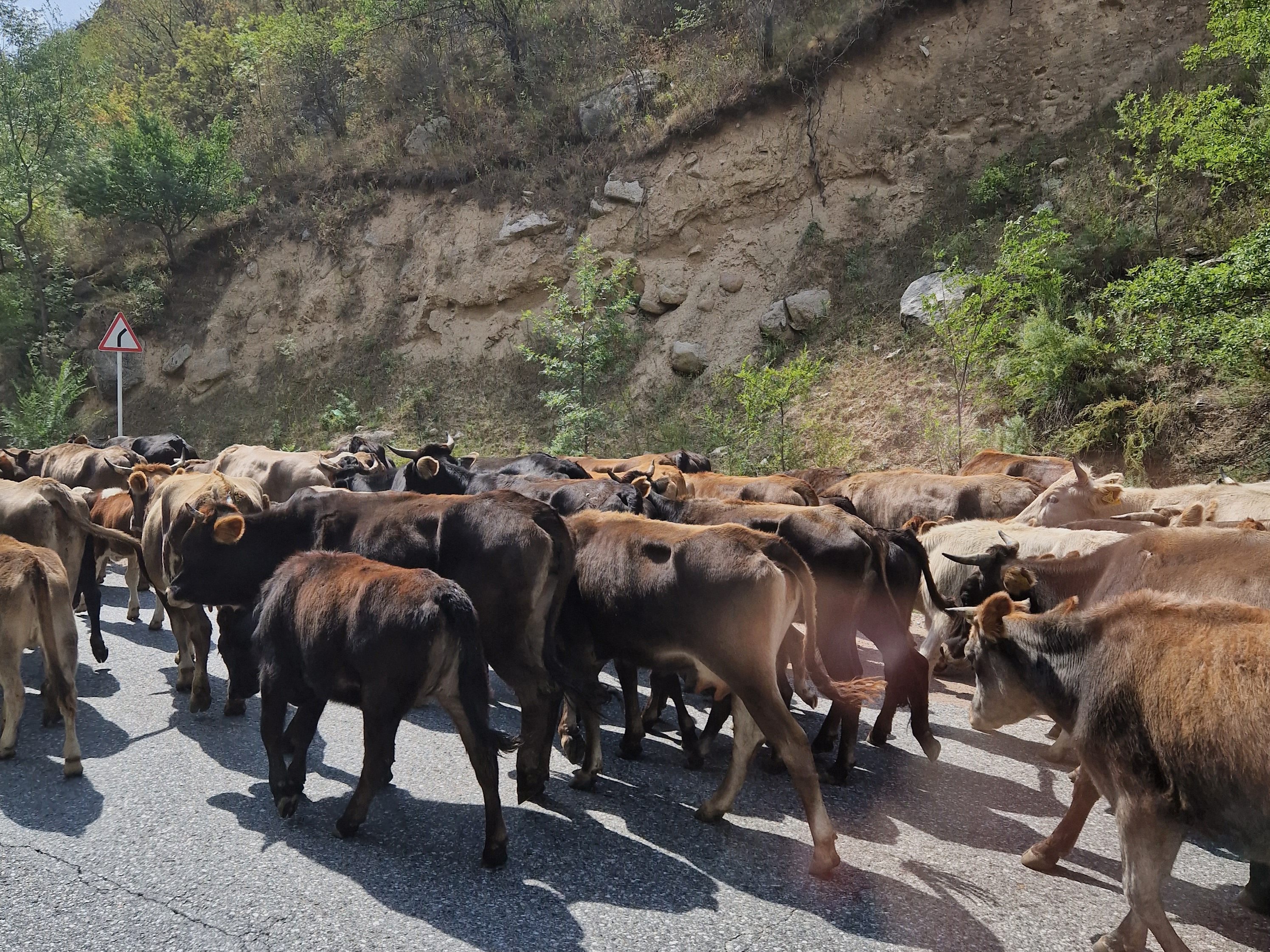
The marshrutka waited seemingly for ages, with the only relief being that the door could be opened to let some of the mountain air in to replace the increasingly stale and oxygen-deprived air inside.Eventually, the cause of the delay became clear as a herd of sheep emerged from the gloom. Any remaining impression of this being similar to the M40 instantly evaporated from my mind.
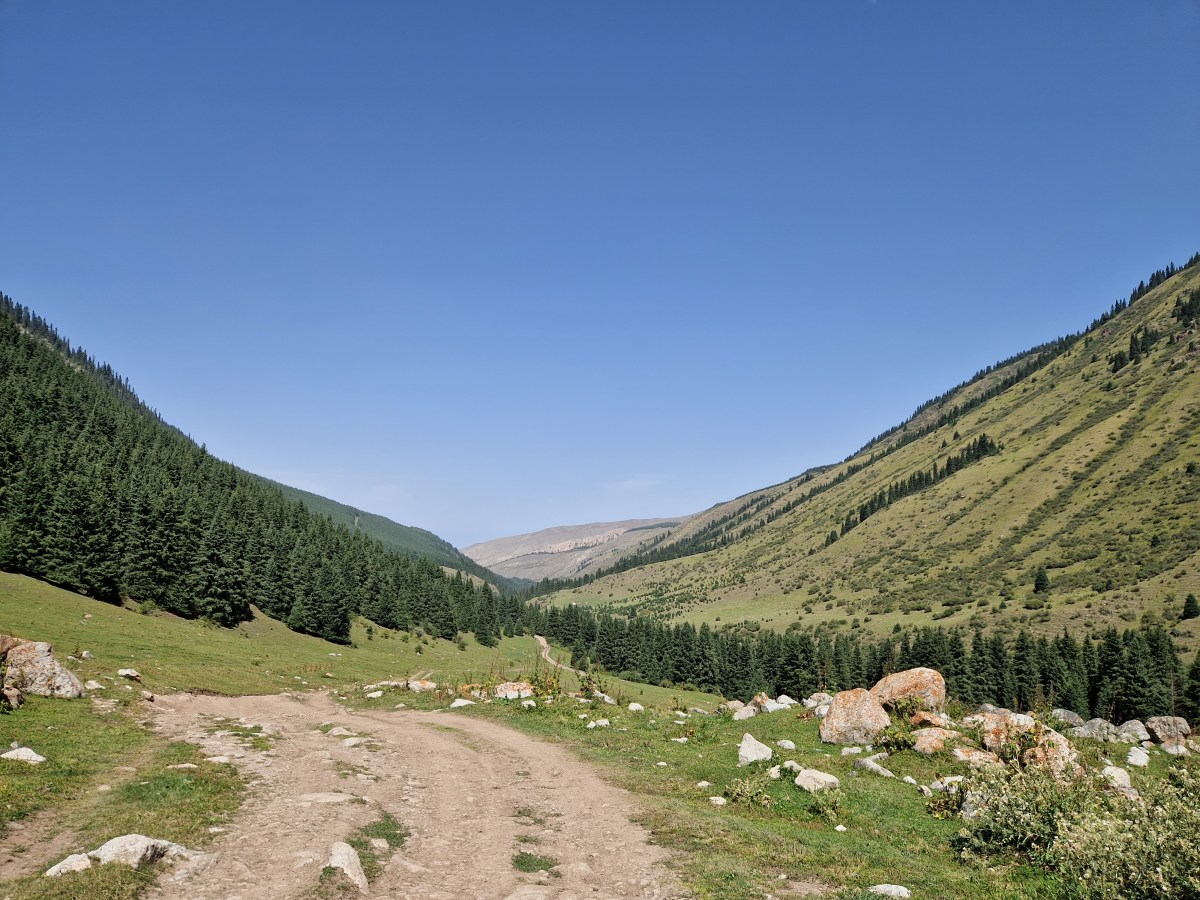
The scenery surrounding the road also marked this route out as vastly different to the road connecting the UK’s two largest cities. Upon stopping for some food at around midday, my neck was immediately straining as I looked upwards to the surrounding mountains either side of the road as it stretched down a valley. I had rarely stopped somewhere so beautiful for lunch as I wolfed down a couple of scaldingly hot somsa before it was time again to leave.
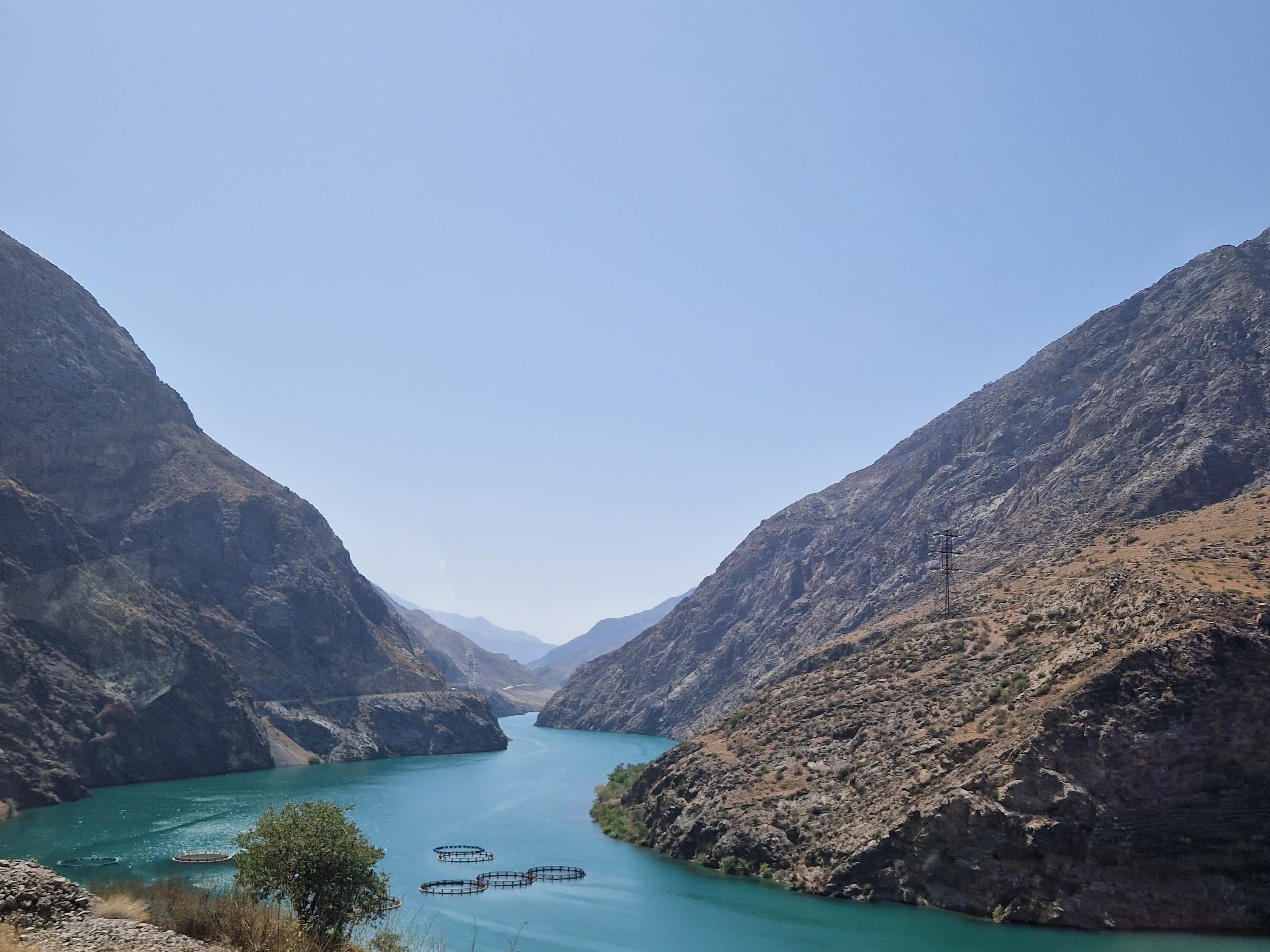
Approaching Jalalabad and as the road ran alongside a long, almost artificially blue lake, I felt my pulse rising in the face of the possibility of being stranded for the night in a strange city that, until that day, I had no idea even existed.
The mountains suddenly gave way to the flatter expanses of the Kyrgyz side of the Fergana Valley and we arrived at an almost identical expanse of concrete to the one we had left behind in Bishkek. I was relieved to have an opportunity to stretch my legs as I jumped out after eleven hours of bumpy and uncomfortable travel.
Immediately, it was clear that the onward connection wouldn’t be an issue as I was confronted by a number of drivers, each in front of their marshrutkas displaying the “Ow” sign in the windscreen that I had searched for fruitlessly in Bishkek. Keen to get the journey finished as soon as possible, I found the next one to leave.
I shoved my backpack into the small luggage compartment under the rearmost seats, carefully avoiding any damage to what looked like a piece of scientific equipment which was being watched over by its student owner. This reminded me of how these marshrutkas are often the only way to travel around this country for anyone, whether a student or businessman. The thought of repeating the journey I had completed between Bishkek and Jalalabad on a regular basis (as some would do), was exhausting.
After a further two hours of bumpy travel at the back of an extremely cramped second bus, we rolled into Osh. Though weary and definitely acknowledging that the plane would have been easier (and likely no less dangerous), I was happy to have taken the overland option.
By flying, I would have failed to appreciate what ordinary life looked like in Kyrgyzstan, be that livestock passing along roads between major cities or the anxiety-inducing marshrutka system. Though neither of these could have been described as either comfortable or convenient, they are the sorts of things which make a place unique and memorable. In short, did I enjoy the journey? No. Would I do it again? Of course.
To hear about Osh, come back for next week’s article, published on the 6th July.
 Into The Elsewhere