The sun beat down on my back as I steadily made my way up the mountain, following in the footsteps of countless others before me. The difference was that I wasn’t in Osh for the reason so many others visited.
The story of Osh as a city began in the days of the Silk Road, similar in almost every way to so many others in the Central Asian region. Famous for its wide-ranging bazaars and useful as a gateway to China, it was a city steeped in history. This is a city so central in the Silk Road story, it was considered the halfway point – the crossing between east and west.
The city was dominated by a single mountain. Sulaiman-Too was actually composed of five peaks rather than one and stood out in stark contrast to the surrounding flat lands of the Kyrgyz Fergana Valley.
The mountain has been considered sacred for generations, even by religions likely lost long ago to the human subconscious – petroglyphs still existed in some of the caves that punctured the mountain’s flanks. Now though, it was most holy to Muslims.
This link to the Islamic faith was established by Solomon, a prophet documented in the Qur’an who was said to have been buried on the mountain. In the wake of his burial, many mosques sprang up, clinging to the steep slopes and offering salvation (often for a price) to weary travellers passing through the city for any potential ailment or issue they may have developed on such an arduous journey.
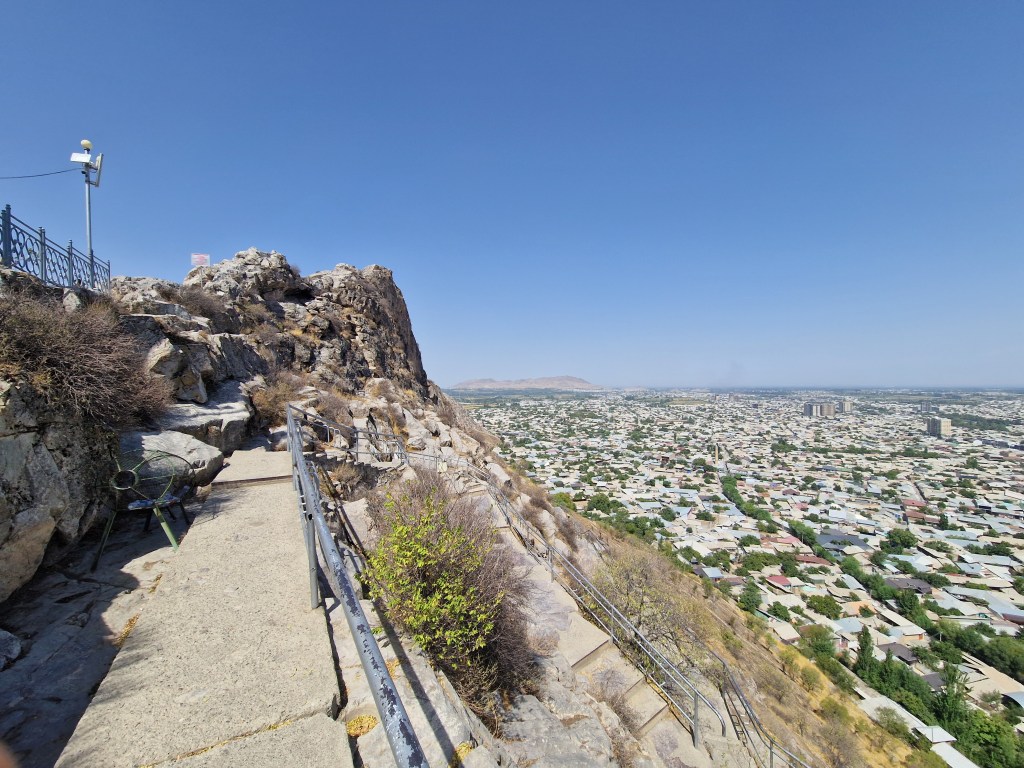
When I trudged, tired from my own journey to Osh from Bishkek, Kyrgyzstan’s capital (which can be read about here), to the foot of the mountain, I was grateful that I had the foresight to bring plenty of water with me as, even in the morning, the heat of the sun made the climb an oppressively hot experience, especially with the total absence of shade as I traversed past at least three of the five peaks.
Besides the heat, this was not a challenging climb. In fact, the “mountain” label may have been slightly overdoing it for an outcrop with only measured 200 metres high. The idea of this being a mountain was more around how it dwarfed the surrounding city, which I appreciated as I admired the panoramic views the path up provided.
However, I did not feel the religious significance of such a place. As I passed a cave which women were supposed to climb through to ensure their children were healthy when they were born, it felt more gimmicky than religious.
“It sometimes felt like I’d been transported to India rather than southern Kyrgyzstan”
This was the same as when I passed the fire gate on the mountain’s other entrance. Supposedly this was a structure which cemented the site’s religious significance. However, all I saw was a fairly modern structure, perhaps put in place to try to stop the religious (or otherwise) significance of the mountain slipping away entirely.
It could be argued that I simply didn’t connect with this well-trodden pilgrimage route as I couldn’t claim to particularly understand the Islamic faith. Even so, I would say the monumental architecture of the Vatican or the peace of the Dalai Lama’s temple in India’s mountainous McLeod Ganj somehow had greater religious significance to me, despite me being neither a Christian or a Buddhist as much as I’m not a Muslim.
So if Osh wasn’t a religious city to me, what was it? If the city was ever home to mosques and madrasas similar to those in Samarkand, they were long gone, leaving little of historical significance which would normally attract me to a place.
The only “monument” in the city was the Soviet answer to making Sulaiman-Too a better tourist attraction, as they had converted a large cave system halfway up the mountain into a museum, complete with mediocre taxidermy and little to no English explanation of anything.
Worse than the contents of the museum was the way it had been shoe-horned into the city’s best known and most important monument (whether it resonated with me or not). A large white saucer-like plug had been placed over the cave entrance in a way which totally opposed the natural shapes and crags of the mountain.
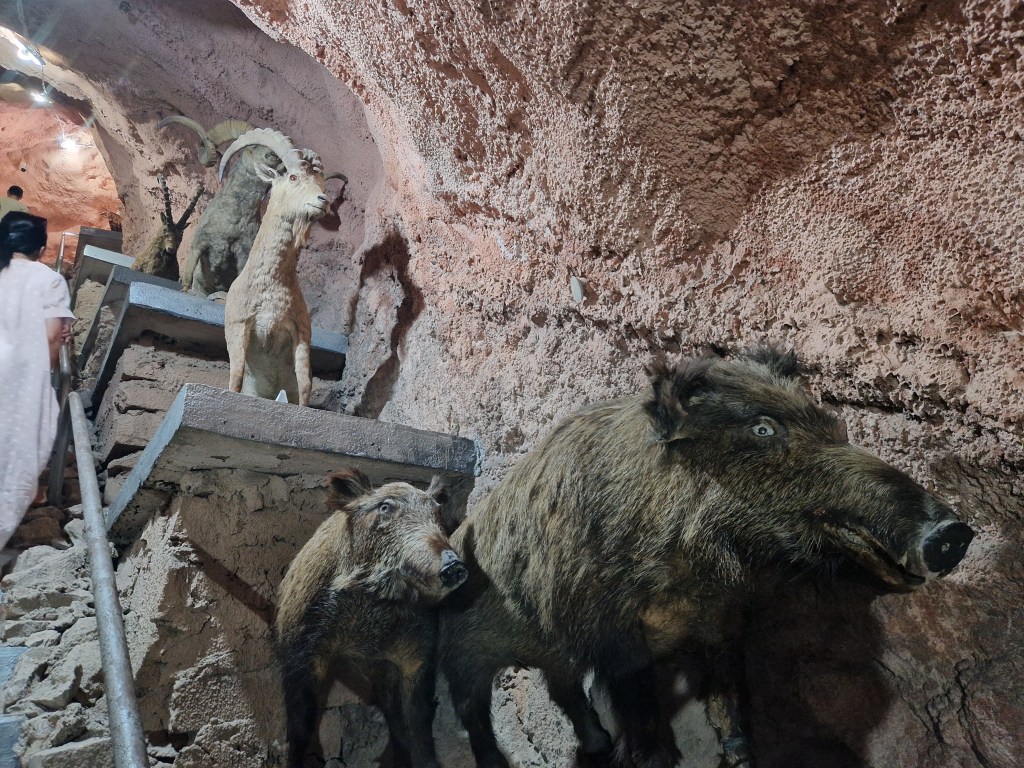
It was clear at this point that, if there was a purpose for visiting Osh (and making the thirteen hour bus journey there worth it), I would have to step away from Sulaiman-Too.
At dusk, I was astounded by the number of people on the streets through the city centre. It was clear that this city existed for a very different purpose within the Kyrgyz conscience. Few people were bothered about the city’s religious provenance. Instead, people thronged around stalls selling somsa, meat parcels not dissimilar to samosas, and borsok, deep fried bread parcels.
The smells from these stalls, particularly of deep frying bread, was tantalising and, if I wasn’t already full of plov (mutton cooking with rice and carrots in oil) from earlier that evening, I’m sure I’d have been unable to resist.
Among these stalls, there were buckets of colour coming from lights streaming out of restaurants and light-up helicopters being thrown into the air by vendors to tempt children into demanding that their parents part with their cash. Between the screams of the children as they noticed these toys, music played from shops and stalls alike.
Osh seemed, in that moment, more a place for pleasure than pilgrimage. The atmosphere of the street I wandered down that evening was easily the most electric I had experienced anywhere in Central Asia. It was so different to anywhere else I’d been in the region, it sometimes felt like I’d been transported to India rather than southern Kyrgyzstan.
“It was clear that people were happy to live side-by-side”
This general party atmosphere seemed to translate into the city feeling less typically Central Asian than other places. The next morning, instead of making do with a breakfast of bread and fruit with some coffee if I was lucky, I was able to head straight for one of the city’s many excellent cafés, selling anything from omelets to french toast. Though I would usually be one for sticking with local food at every opportunity, after nearly a month away this was a very welcome respite.
Nowhere could this collision be seen better than at the vast bazaars that track the Al Buura River through the city. Indeed, this was probably the only remaining evidence of the old Osh, centred around trade and religion.
The chaos under the ramshackle corrugated iron and canvas roofs as I had to weave between sellers of anything from bread to shoes while simultaneously dodging the food carts piling up and down the main gangways and selling pots of fruit or cold drinks to anyone who needed refreshment was a brilliantly raw experience.
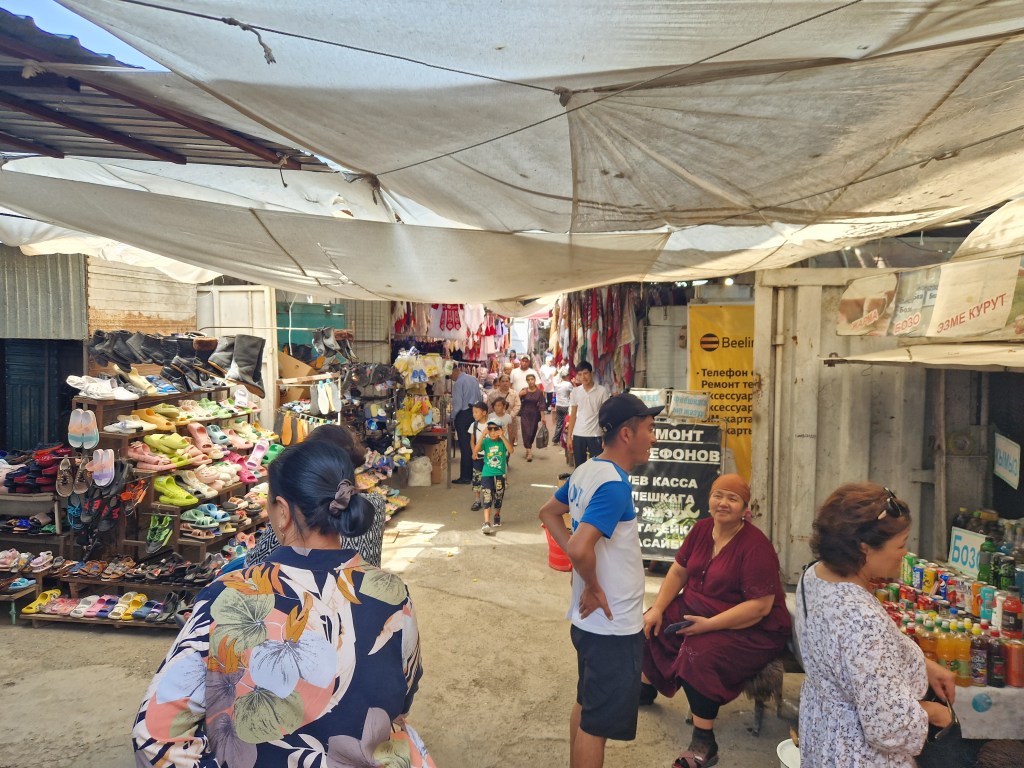
Though this was a full-on, again almost Indian-style experience, there was also a feeling of relaxation as I walked by the stalls. As I would have expected elsewhere, here nobody tried to sell me a new belt, football top or lunch. Instead, everyone seemed content to sit back and take life as it came.
With the bazaars seemingly stretching on into eternity, I decided to turn around and walk back downstream, exploring a park which had some Soviet-style quirks, including a 12D cinema and several ancient fairground rides. That said, these were still being enjoyed by the many people who had come out with their families, with the greenery all round being a perfect way to stay out of the heat of the day.
Again, I was struck, with all that was going on around me, with an usual sense of peace. Though there was the predictable chaos of a fairground, it didn’t seem acrimonious in any way. It was clear that people were happy to live side-by-side.
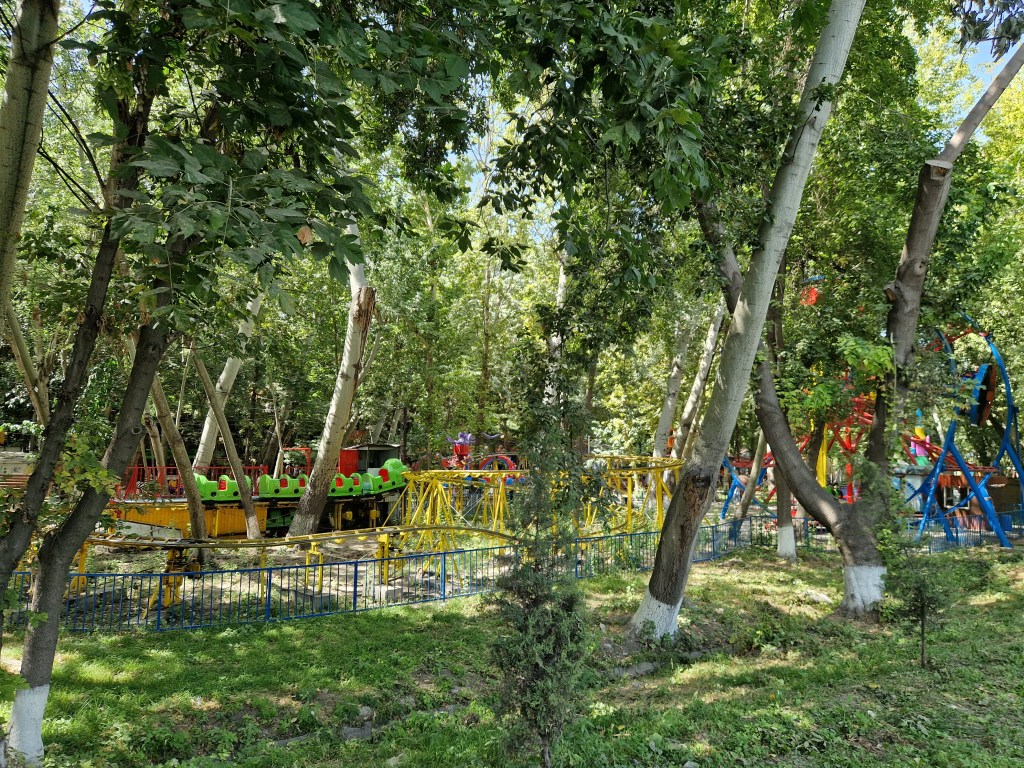
The peaceful nature of Osh city was a better advertisement for the notion of mutual coexistence and kindness that is often preached across any religion than the mountain which towered over it, complete with Soviet museum.
It made me wonder whether perhaps the pilgrims who came to the city were actually looking in the wrong places for what they sought. If religion was supposed to be the mechanism by which we each learn to find peace, both with ourselves and others (as we have so often been taught), those seeking pilgrimage were far more likely to find it in Osh’s cafés, bazaars and parks.
Though it would be simple to dismiss these places as anti-religious shrines to capitalism, it dawned on me that they were more peaceful and in a more meaningful way than the mountain above them.
 Into The Elsewhere