Sometimes, despite my best instincts, I feel I should go to a tourist spot regardless of whether I think it’ll be worthwhile or, more likely, a complete waste of time. One of the most memorable of these instances was in Albania, as I made a pilgrimage to the most Instagrammable place in this small Balkan state: the Blue Eye.
Starting in the early hours, I found myself at the edge of an improbably large car park. The black tarmac stood out awkwardly against the verdant background, courtesy of the stream I was there to see as Albania was otherwise searingly warm and dry during the summer months I visited.
It sounds ridiculous to say it but, when I say that I was standing at the edge of the tarmac expanse just to see a stream, in many ways that was no exaggeration. The Blue Eye was a spring situated within the woods in front of me, just the other side of a lake I would be required to walk around.
“It was a place of fleeting moments of beauty, marred by over-tourism and commercialisation resulting from viral videos”
It seemed equally silly that there were ticket gates. Still, I paid and set off, largely alone aside from my girlfriend in tow, carrying with me my water and a large lump of personal skepticism.
My impression of Instagrammable travel locations is that they can be fleeting, in that, when posting a video online, you need just a couple of stunning 2 second camera shots and then the job is done. The hastiness with which a viewer will flick onto the next video effectively mandates this as a maximum length of time once the creator has factored in some explanation and a few shots of how to get there.
As such a place requires no lasting appeal. This is what I feared as I ambled along the concrete track, complete with a lane for golf buggies: would this be a place that was fleetingly beautiful for ten minutes yet have no lasting appeal to make the round trip worth it?
As we approached our final destination, as evidenced by the café which appeared from between the trees on the shores of the lake, I knew I would soon have an answer to my question. The omens up to this point had been good; the track, though clearly catering for thousands, had maybe tens of tourists on it. Equally the scenery was undoubtedly improving.
Amid the greens of the trees, we finally saw a large, deep blue mass in the middle of the stream which fed the lake. Crystal clear water sprung up from beneath a small cliff – this was the Blue Eye itself.
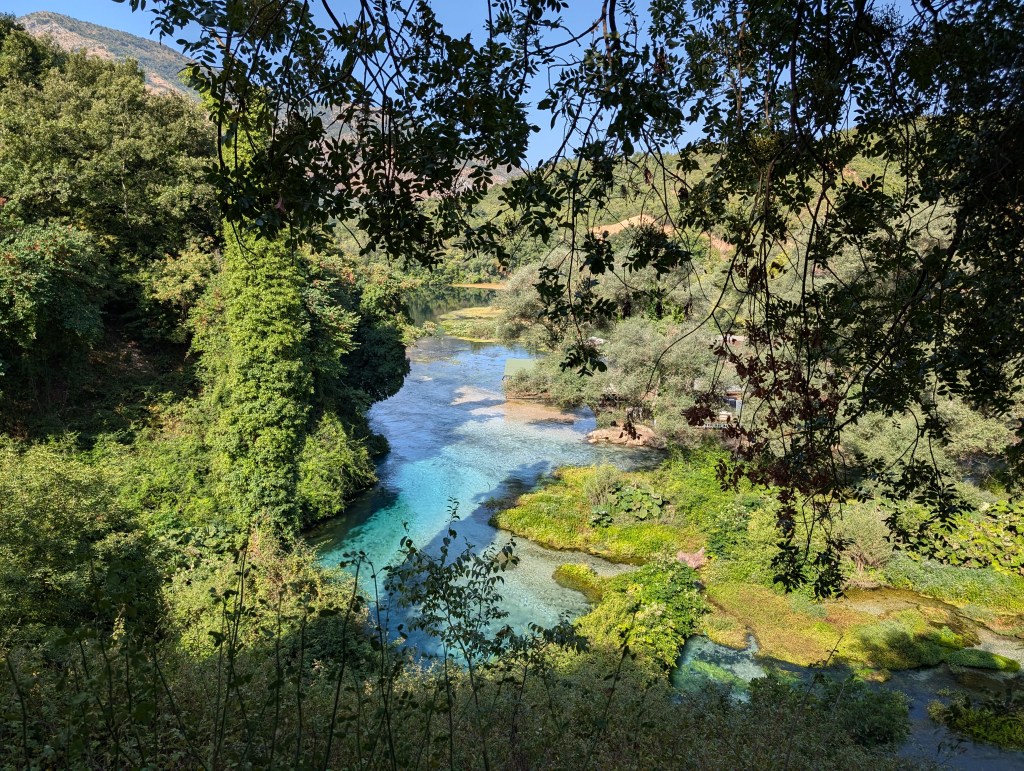
It was undoubtedly beautiful, though I couldn’t help but notice the small but growing crowd of tourists on the far bank, each playing chicken with each other as they edged closer to the water’s eddies and currents to get the perfect shot for their social media. This, when coupled with the influencer on our bank with a full tripod and lighting set up, I felt somewhat spoiled the serenity of the surroundings.
Instead, as I expected, it was a place of fleeting moments of beauty, marred by over-tourism and commercialisation resulting from viral videos taken by the people I was standing beside. I was perhaps three years too late and, as a result, behind the curve; only seeing the beauty of the Blue Eye after its popular discovery, meaning many others had too before me.
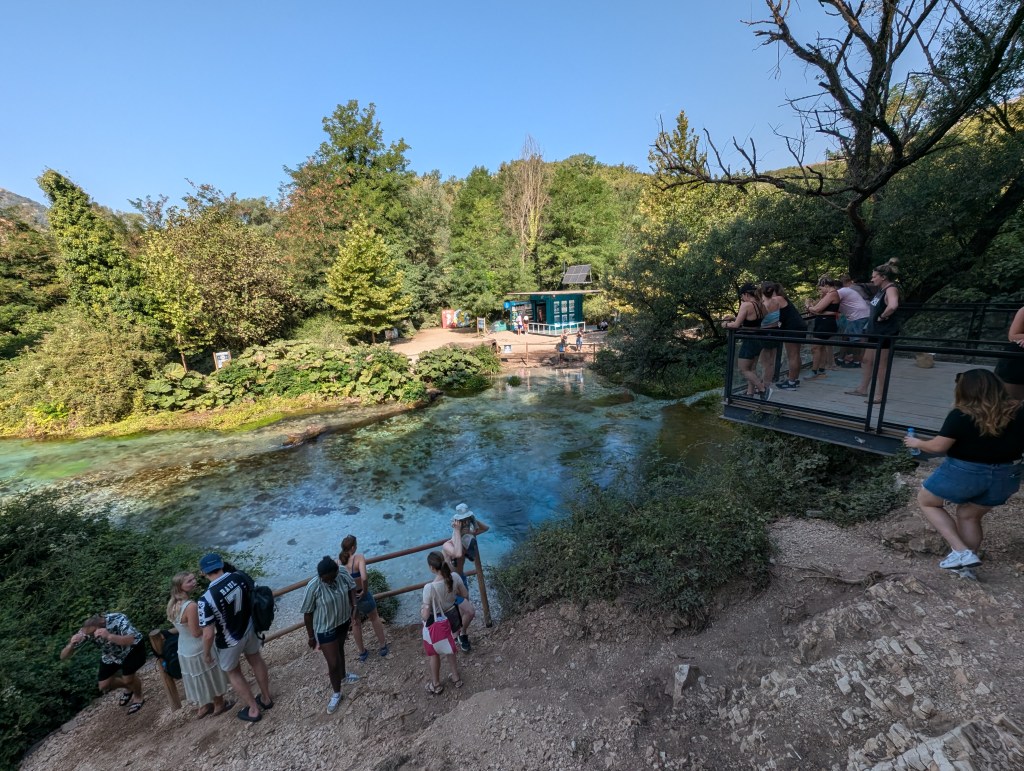
Walking round the other side of the lake and back to the road to pick up the bus away from the Blue Eye, I wondered what it would have been like to be the first tourist there and the sense of excitement and awe which must have accompanied that trip, yet was largely absent from mine.
We eventually returned to the now half full car park, with large white coaches funnelling people from the nearby coastal town of Saranda through the ticket gates and almost inevitably towards an even more sore disappointment than I had suffered as the crowds around the spring grew exponentially through the day.
I was happy to have been to the Blue Eye and to have given it a chance to shine despite my skepticism. Even so, I was happier still to remind myself that I wouldn’t be returning to Saranda like so many others, but instead to Gjirokastër, a town which suffered from few of the same issues as the Blue Eye.
Passing along the wide and flat-bottomed valley which, at its southern end, stretched into Greece, I was excited to return to further explore the bazaars, restaurants and fortress towering above it all.
Climbing from the bus station up through the new city to the old town would be enough to put many tourists off visiting at all. In the harsh, sun-bleached conditions of southern Albania, even completing the climb at a crawl was exhausting and sweaty work.
However, the twisting roads eventually gave up their secrets: tarmac became cobbles, concrete became whitewashed plaster and cars were replaced with pedestrians in the old town as it clung precariously to the steep valley side.
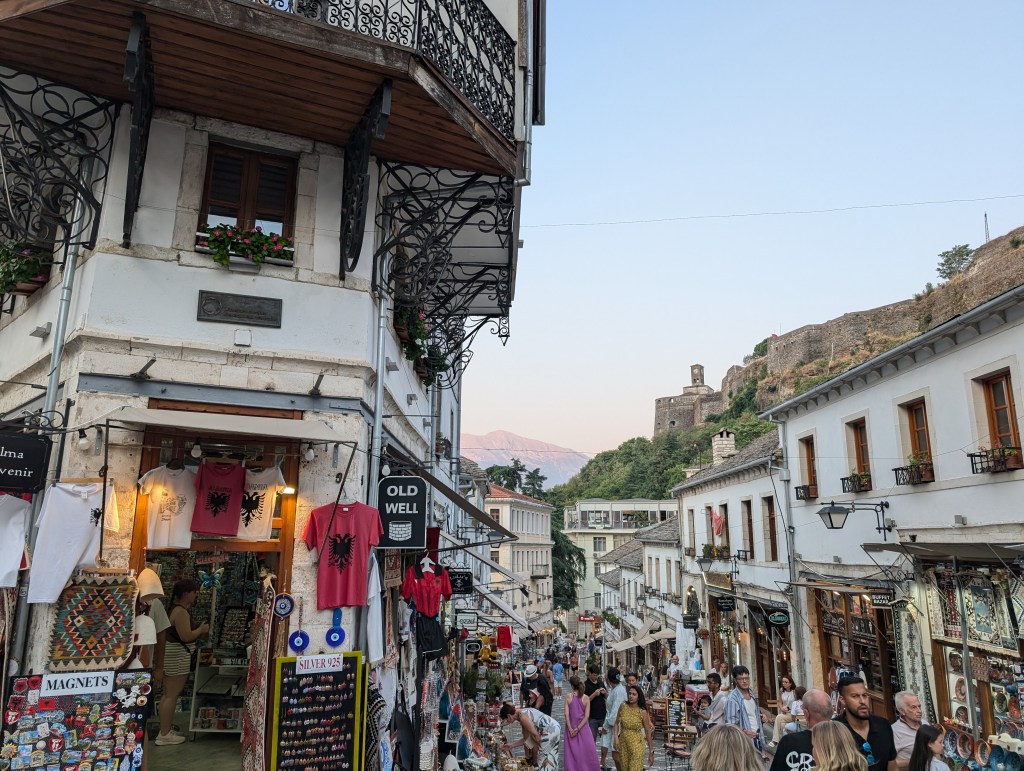
The placement of the town on the side of the valley was no coincidence – the fortress at one of the town’s highest points had almost total command of the valley below. Ultimately, the town sprung up around the fortress, which was built by the Byzantine Empire and modified by the Ottomans and, more recently, one of the town’s own, dictator Enver Hoxha.
This was more than could just be contained in an Instagram video. At every turn was a historic Ottoman house or communist installation, built to fight against an American invasion which never came.
“Gjirokastër … drew me in and allowed me to immerse myself in a new and unfamiliar place and its varied history”
To me, this communist paranoia was one of Gjirokastër’s most interesting features. Hoxha was known as a brutal dictator, determined to cling to power at all costs. This was to such an extent that he ordered thousands of mushroom-shaped concrete bunkers to be built across the country which would be used by the Albanian people to resist occupation.
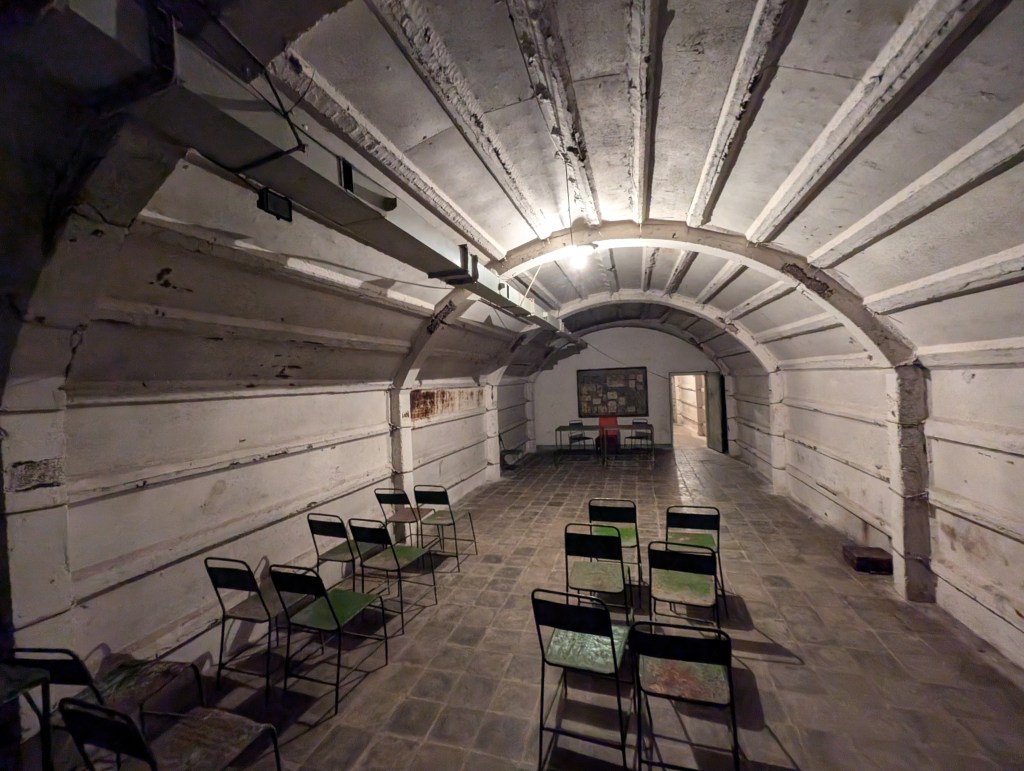
At the centre of the madness was Gjirokastër, which had a network of bunkers and tunnels dug underneath it to prepare for nuclear war. No fewer than 59 rooms were created for top officials and their families.
Descending into the tunnels, which were virtually untouched after they were robbed out upon the fall of the communist regime in 1990 was an eerie experience. It starkly demonstrated why Albania is still emerging onto the tourism scene after years of extreme isolation. Indeed, just 30 years ago, my whole trip to the country would have been virtually unthinkable.
The experience felt much more meaningful in comparison to the Blue Eye. Though there was almost certainly less social media coverage of Gjirokastër as a whole (and most tourists stuck rigidly to the coastal city of Saranda), I was happy to have decided upon a different path to many.
Rather than providing a single moment of fleeting beauty, Gjirokastër was more of a lived experience, where I was happy to stick around for a much longer time.
In the evening, wandering the streets we visited many restaurants and stalls serving Albanian specialities such as fërgesë (an Albanian stew) or burek (a sort of filo pie). Around this time the Islamic call to prayer always sounded, with the melodic sounds transporting me back in time to when the city was firmly under Ottoman rule.
From street-side bars we were also able to watch locals and tourists alike, either going about their daily errands, ensuring the many shops were well-stocked and the streets were clean, or exploring the city and enjoying the immersive experience it offered.
It was this level of immersion which set Gjirokastër apart from the Blue Eye. Where both were extremely photogenic in their own rights, the Blue Eye was greeted with initial curiosity but after just ten minutes that feeling was replaced with simple indifference. Gjirokastër, on the other hand, drew me in and allowed me to immerse myself in a new and unfamiliar place and its varied history – something which was always going to be impossible for what at the end of the day was just a natural spring (despite what an influencer may tell you).
Of course, over-tourism didn’t help the case of the Blue Eye and I suspected as I walked Gjirokastër’s narrow streets that it too would follow in time, especially with its proximity to Saranda, a tourist hotspot.
However, this enhanced my appreciation of the town, knowing full well that this was likely the last time I would see it before it appeared on the tourist map. It was unfortunate that I was not able to do the same at the Blue Eye and I’m sure that, if I had been just a few years earlier it may have been possible.
It went to show how tourism was and still is an extremely fine balance for so many of these places, particularly as they emerge into the mainstream consciousness. As for me, I was grateful to simply have grabbed my slice of Albania before I was forced to contend with that issue’s effects.
 Into The Elsewhere