Standing on the cold concrete beside all the buses parked outside Puno bus station, I was glad I had made the decision only to pass through one of Peru’s most visited cities. Grey-brown, non-descript structures rose around me, mainly thrown together using concrete columns and floors with the gaps then packed with bricks to form walls. As much as the areas around bus stations usually felt run-down in South America, this was the worst among them.
I was sure that there would be some who would argue that I had missed out not sticking around. Research had shown that Puno was not completely without merit – the city centre, though more modern than its counterparts in Arequipa or Cusco, was nice enough. That said, most didn’t go for the city centre. Most went to experience Lake Titicaca.
When mentioned in conversation, Lake Titicaca could easily be classed as one of the most evocative places on the planet. Key to much Incan mythology and, before that, having been home to people for thousands of years, it can have an air of mysticism and sometimes can feel like a place to learn long-lost stories of our earliest ancestors.
Puno did not fit that description. Founded by the Spanish just a few hundred years ago, it didn’t have half the history or mystery of the Lake. Some efforts had been made to recreate the magic, mainly in the construction of floating, inhabited islands off the coast, though these were there more as a tourist attraction than an indication of how people lived around the lake in modern times.
I boarded my second bus, bound first for the Bolivian border at Kasani. This was a very relaxed border town, without the typical barriers, hordes of people or hassle. Having switched to a third, much less comfortable, bus, I finally reached Copacabana, the Bolivian equivalent of Puno.
“Life here was slower, to the point where there were no cars to be found anywhere”
Formerly an Incan outpost, Copacabana was invaded by the Spanish around the same time as Puno. The main difference between the two places was the relatively diminutive size of Copacabana in the face of its much larger brother across the water.
This gave it a much more friendly and homely feeling, which was complemented by the many small but popular street-side restaurants selling trucha frita (or deep fried trout) which came fresh from the lake. These were the sorts of places which would never appear in a Lonely Planet guide; instead it was simply a case of finding the most popular and plonking myself down at a free table.
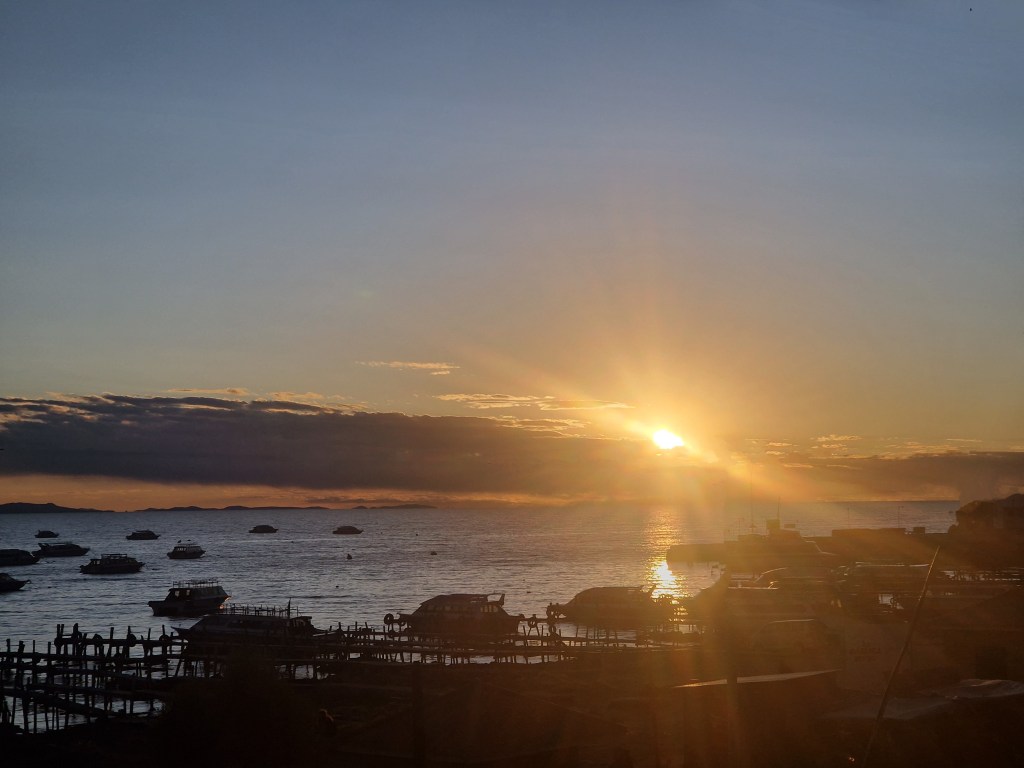
At the end of the day on the lake’s shore, the many open-air bars provided an excellent view of the setting sun over the water as Bolivians wandered along the waterfront, enjoying the vibrant atmosphere created by music from bars and street sellers.
At the same time, boats were being hauled up onto the beach or moored tightly to landing stages to prevent them floating away during the night. As much as I enjoyed Copacabana town itself, I knew that I was really here for these boats: there was one final destination to visit to try and better understand what it was that shrouded Lake Titicaca in this veil of mystery.
Just off the coast by Copacabana was Isla del Sol, which could be translated into the Island of the Sun. Inhabited for thousands of years, it was believed to be the starting point of the Inca people as Manco Cápac, known as the first Inca, was said to have emerged from the island before heading north to found Cusco.
I gained my first view of the island whilst sitting on top of the small ferry which was carrying around eight tourists across Lake Titicaca. Scorched by the sun, it had the appearance of a desert ridge with craggy sand-coloured cliffs and, rising above them, a series of hills along the island’s spine.
This appearance was somewhat unsurprising. Despite the lake, this was one of the driest places on Earth, not far from the Atacama Desert. Equally, at an altitude of nearly 4000 metres above sea level at its highest point, the force of the sun was immeasurable, indiscriminately cracking earth and burning skin alike.
Though there was an explanation for the name Isla del Sol given in what little we know of Incan mythology in modern times, I struggled to believe that the name wasn’t given to the island purely because of the perma-sun which it experienced.
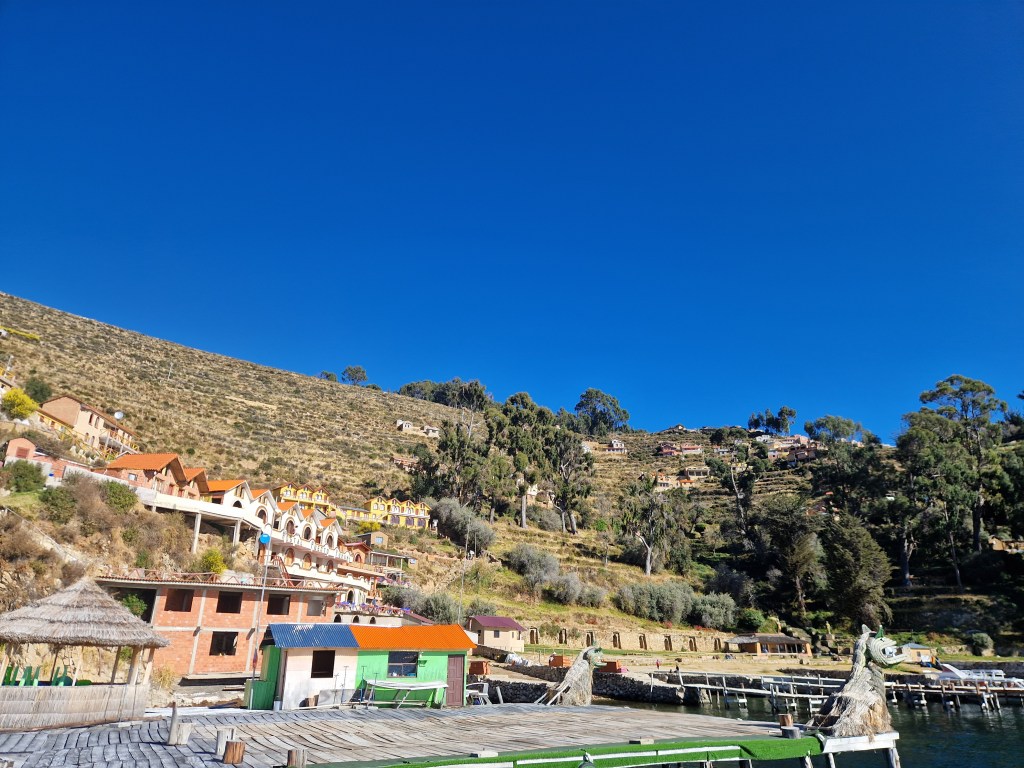
Stepping off the boat onto the rickety landing stage at Yumani, the island’s main village, I immediately felt the difference between the mainland and where I had just arrived.
Life here was slower, to the point where there were no cars to be found anywhere and donkeys were used to carry goods to the houses above the village, along rutted and broken dirt roads. The population was sparse and at least in part fiercely against foreign tourism, to the extent that there had been past warnings against venturing beyond halfway up the island for fear of attack from angry locals.
Despite the steep climb out of Yumami and the warnings of attack from locals ringing in my head, I decided to brave the ascent to get a better feel of the scale of the Isla del Sol and the surrounding lake. Breathless steps followed as I trudged, weaving between patches of shade afforded by walls and the very occasional and gnarled tree.
Beyond the edge of the town around the centre of the island, I encountered an abandoned viewing platform, complete with an incomplete building off to the side, no doubt at one time intended to house a shop or café for tourists who never came.
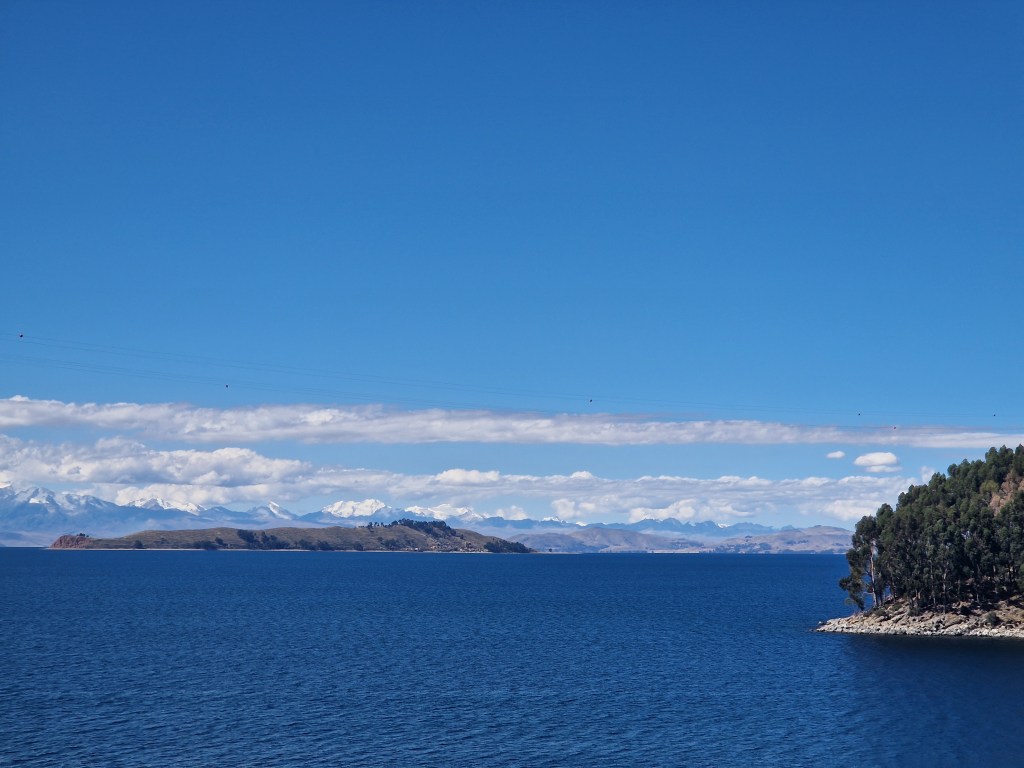
Standing on the platform, I stared out in all directions at the deepest blue water I had ever seen. Through this, the ridgeline of the island snaked back towards the mainland, seeming to reach out but never quite touch the corresponding headland with an almost symmetrical ridge of light brown earth and old, dry trees.

The combination of the shimmering water, dark blue sky and parched land between them both led me to first understand how this island held such spiritual value for the Incas. The vibrancy of the colours and the enormity of the view felt like they belonged less on Earth and more in some sort of perceived heaven, enhanced to the point where I struggled to believe I was still in touch with reality.
For someone who believed little in spirituality, especially in how a place could be considered sacred to anyone, I somehow understood the Isla del Sol and Lake Titicaca.
The overriding sense of solitude while hiking along the island was accompanied by a strongly peaceful feeling. Despite the rumours, I felt welcomed and, as much as it sounds horrendously clichéd, in tune with the chilled-out and steady nature of the people I was around and the land I was standing upon.
“Nobody knew the true Incan secrets and stories about the area”
There was a feeling of ragged beauty which contributed to this unique feeling – at one point the dusty ground around me was dry enough that it was beginning to smoulder under the harsh sun while I walked along, admiring the steep, craggy hillsides. Though amost anyone would find the surroundings attractive, details such as these gave the island a raw and transient feeling.
Heading back on the ferry, past the Isla del Sol’s sister island, the Isla de la Luna (or Island of the Moon), I couldn;t help but contemplate the significance of where I had just been. As the supposed birthplace of the Inca people, the island was a birthplace of a civilisation, akin perhaps to a Garden of Eden.
If this was the case then the setting seemed entirely fitting of such a place. Lake Titicaca, particularly from Copacabana, was the ideal launch pad from which to experience the island and to reflect many of its relaxed characteristics.
Though I am sure that Lake Titicaca would have demonstrated some of its all-consuming magic to me if I had visited from Puno on the Peruvian shore, it was right that I had decided to travel one step further to Bolivia and to a place much more in sync with the history of the surroundings, rather than somewhere merely trying to recreate it.
Lake Titicaca and the Isla del Sol retained this magic through their mystery. As I visited, nobody knew the true Incan secrets and stories about the area, most because the Incas as a people never developed a system of writing, using chiapas, made of knotted string instead.
This was a good thing. The idea of explaining the Isla del Sol fully would be to shatter the illusion and to dissolve the magic. Instead, the part-stories, passed through generations and somehow translated into Spanish, made the place so much more compelling. It allowed my imagination to run away, believing in myths that I made up in my own head as I walked and, in a sense, temporarily escape reality, entering into a spiritual realm oherwise unknown to me.
 Into The Elsewhere