Anyone visiting Uzbekistan will head to Samarkand and the Uzbek government knows it. The city, home to truly monumental medrasas, historic mausoleums and, at one point, some of the world’s most cutting-edge scientific discoveries, was, as I visited, a Mecca for anyone seeking the fabled Silk Road and its mysterious and ancient trading posts grown more recently into bustling cities.
The clouds of mystery which once cloaked these places are slowly being lifted. Tourism was, for the first time in living memory, being encouraged with people from the world over being welcomed with open arms into the many hostels and hotels which were scattered between buildings dating back hundreds of years.
Riding this initial wave of tourism, I arrived in the city by train from Tashkent, the country’s capital. What I found elicited a self-indulgent chuckle to myself: towering monuments still free of large crowds and covered, from the lowest foundation to the tallest minaret, in bright blue and green majolica tiles and intricately painted Arabic script.
“Not only was it at the centre of the world geographically but perhaps culturally and scientifically”
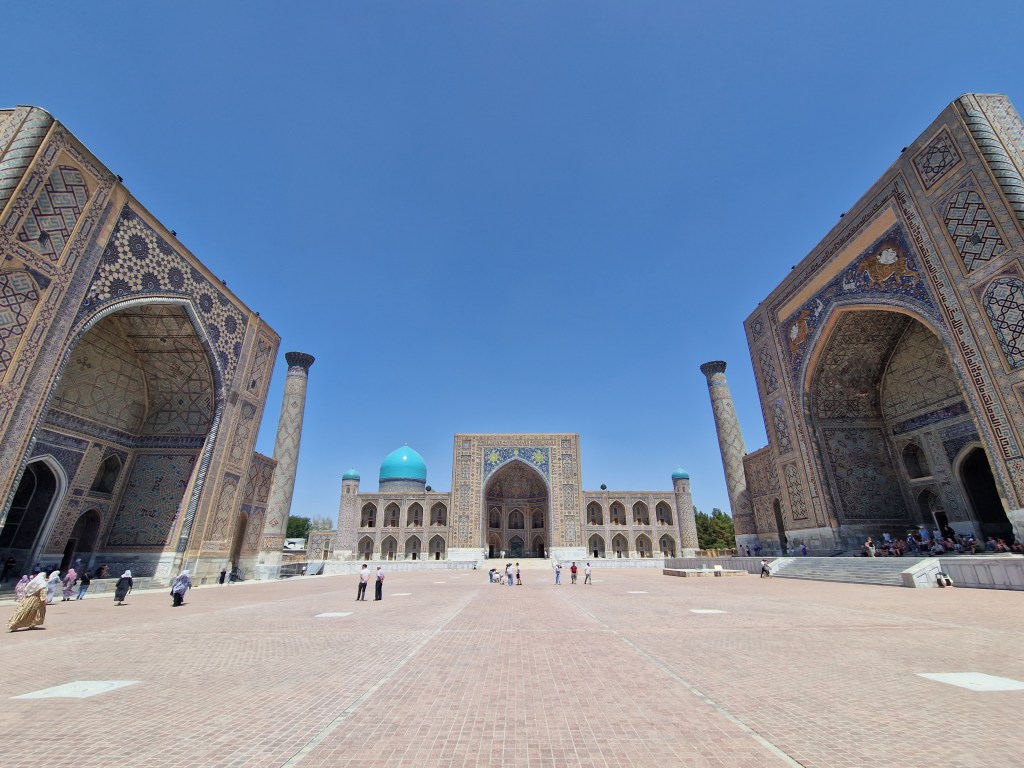
Within the three medrasas which surrounded the city’s main square (or Registan in local terms), were countless shops and stalls, each situated within their own individual alcove or small room which would once have belonged to a student or teacher in the days when the buildings served as religious schools, teaching the Qur’an.
These shops were tiny caverns filled to brimming point with countless examples of handmade, intricate filigree, silk suzani depicting colourful fruits such as pomegranates or finely carved wooden boxes and chess sets. The foundations of Samarkand, as a trading post, still lived on strongly in the city’s most modern iteration.

However, to say that Samarkand was purely a stop to pick up some of the region’s finest crafts would be to drastically undersell it. The city was home to Ulugh Beg, one of the 14th Century’s foremost mathematicians and astronomers – an Uzbek Galileo if you will.
On the outskirts of the city he designed and built his observatory from which he predicted the positions and movements of stars and other celestial objects with astounding accuracy. This was to the extent that he predicted the length of time taken for the Earth to orbit the Sun with a greater level of accuracy than Copernicus.
Visiting the observatory, still with the remains of its vast sextant visible and nearly as ornate in its own right as some of the nearby mosques, it became clear to me that this was a city which, at one point, was truly ahead of its time. Not only was it at the centre of the world geographically but perhaps culturally and scientifically.
The influences from all four corners of the world were never more clear than through Uzbekistan’s unique culinary identity. Where, on the one hand, samsa and plov (similar in some ways to samosas and biriyani) pointed towards significant Indian influence, manty (dumplings) felt more Chinese.
There was also European influence: shashlik (juicy and intensely aromatic meat kebabs grilled over white hot coals) had a distinctly Turkish influence. This amazingly broad range of options only enhanced my experience of Samarkand and, though of course there were some restaurants favoured by Western tour groups and so best avoided, there were plenty of places to sample the very best of it.
As much as Samarkand was a busy and living city, with taxis fighting for space on roads to find their next fare or streetside stalls, comprised of a simple bedsheet laid out on the dusty pavement vying for the attention of passers-by, perhaps its best attractions were in total contradiction to its surroundings.
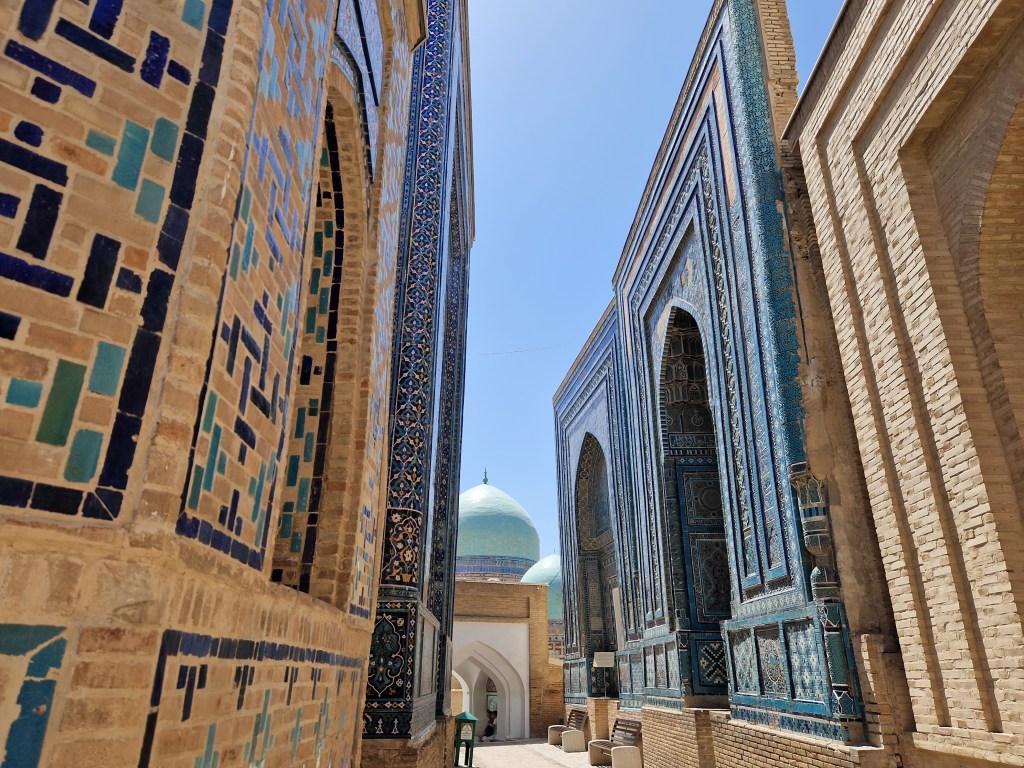
This was because Samarkand was not just a city defined by its living but by its dead. From the enormous Gur-i Amir complex which housed the tomb of Timur, Uzbekistan’s most feared conqueror who even drove back the Mongols, to Shah-i-Zinda, a narrow street of mausolea and other wildly ornate buildings leading to the tomb of Qutham ibn Abbas, a cousin of the prophet Muhammad.
These islands of peace, away from the chaos of the wider city, were the highlights of the Samarkand. Of course, the Registan, with its vast medrasas and nightly light show was spectacular yet these two resting places for some of the country’s most famous figures had a peaceful and contemplative atmosphere which couldn’t be matched by their larger cousins across town. What they sometimes lacked in scale they made up for in a sense of character.
The thought crossed my mind that actually, it may have been the smaller scale of these sights which, in recent times at least, had led to their rise as some of the city’s most unmissable highlights.
As I mentioned at the start of this article, the Uzbek government knows about the potential Samarkand has as a tourist destination. Already a UNESCO World Heritage Site and with a reasonably-sized international airport, the dollar signs would almost literally have been bursting out of the spectacular ancient structures in front of their very eyes as they visited.
This realisation quickly led to changes to some of the biggest attractions. As a government which could hardly be described as democratic, they weren’t looking to appease the public or win votes and, as such, it didn’t matter how many homes were destroyed, roads closed or communities cut off in the mission to realise Samarkand’s potential.
Really, this trend had started long before the current regime’s dramatic acceleration. Even in the days of the USSR, when an earthquake devastated Tashkent just a few hundred miles away in 1966, the medrasas around the Registan were also damaged and needed to be rebuilt.
“At times the tourist sites felt like a Disneyland attraction, sanitised with added light shows and no local culture or life”
This was completed somewhat creatively by Moscow – though I struggled to notice anything out of keeping with the centuries-old architecture, occasional domes were pointed out that had been added as part of the rebuilding process, no doubt to make the site more attractive to would-be tourists in an effort to help the city economically.
Though, somewhat predictably, the influx didn’t arrive after this particular rebuilding initiative, it seemed that the current government had been more successful. The most noticeable difference was the pedestrianisation of most of the roads between the Registan and Shah-i-Zinda.
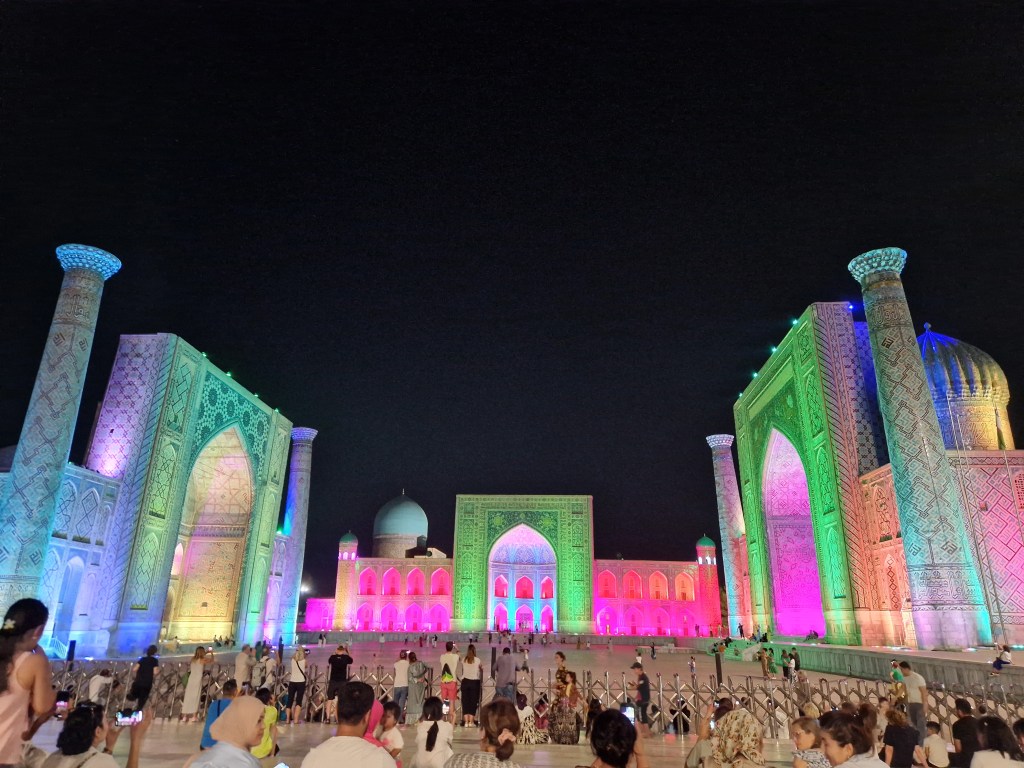
Many other changes had been made though: there was a nightly light show at the Registan, with the medrasas lit up in garish pinks and greens while loud and overly-dramatic music played in the background.
More concerningly, neighbourhoods which had clearly been considered “undesirable” had large walls built around them, with a limited number of entrances and exits hidden away from the main tourist routes to avoid the possibility of someone unknowingly having their illusion of Samarkand shattered by mildly run-down houses and unsavoury locals.
This ghettoisation of parts of the city was more than just a shame; I felt that, more sinisterly, it was designed to purposely hold parts of the city back, shielding them from any of the benefits of tourist money. Meanwhile, other areas could be freely explored, receiving this benefit in full as shops and hotels were created to cater for increasing demand.
Arguably, my hostel was in one of these walled-off areas. Difficult to reach by taxi, I was dropped off at a narrow and non-descript alleyway, with the driver simply pointing to demonstrate that the hostel was somewhere inside the maze of streets and that the taxi could go no further.
Instead of being a pest-infested, dirt-stained wreck of a hostel, it was perhaps the best place I stayed in while I visited Uzbekistan. Lively and in an area which felt far truer to the city before its remodelling, I enjoyed seeing daily life played out in front of my eyes as soon as I stepped out of the front door. It was scenes like these which make a city great alongside the many beautiful tourist destinations between them.
This was something which the government clearly didn’t see in the same way. Instead, at times the tourist sites felt like a Disneyland attraction, sanitised with added light shows and no local culture or life.
This was why some of the smaller sites were more appealing as they hadn’t been altered or messed around with by a government bent on making a tourist’s life as easy as possible, regardless of whether that meant almost lobotomising the city centre.
A city should be dirty, loud, slightly confusing to foreigners and full of experiences and sites which allow someone visiting to immerse themselves in a different culture, learning more about the world around them, connecting with other people and understanding different customs.
Samarkand, as much as the sites and associated history occasionally left me quietly chuckling to myself with delight, perhaps only ticked one or two of those boxes even though, with its position at the centre of the Silk Road (and therefore arguably the world), it should have had the lot.
The immensely frustrating thing was that I knew it did – I just wasn’t being allowed to see it in full.
 Into The Elsewhere