Knee deep in glacial melt water as it rushed beneath me and down the valley, I wondered whether this was a sensible decision to be wading across a river, carrying my worldly belongings on my back. Reminding myself that I had come to Georgia to seek adventure and challenge, I stumbled on, awkwardly passing barefoot between smoothed, slippery stones lying beneath the gushing flow.
As far as European travel is concerned, Georgia would be about as out-there as it’s possible to get before wandering headfirst into a warzone. I haven’t written this to suggest that it’s a challenge equal to places like Central Asia, though it certainly had hints of that region when I ventured outside the country’s big cities.
“Sipping a warm coffee while looking down at the valleys below, … I began to understand the attraction of Svaneti”
Having coupled the idea of an adventure with knowledge of brand new direct British Airways (and EasyJet) flights and I knew I had to visit one of the continent’s furthest outposts.
The question was then where? Where was best to visit to get the least European experience possible, while staying firmly within Europe? Research quickly turned up a leading contender: the Svaneti Trail.
Before I knew it I was making the arduous journey from Tbilisi to Mestia, where the trailhead lay. This involved a purgatory-like six hour train (at least allowing some rest and recovery after a terribly timed overnight flight). Then, if the train allowed me to sleep, the subsequent four hour marshrutka (effectively an informal minibus) very definitely kept me awake, fearing that I may never actually experience Mestia as we teetered on the edge of oblivion, weaving up the mountain roads complete with ever-present and precipitous drops.
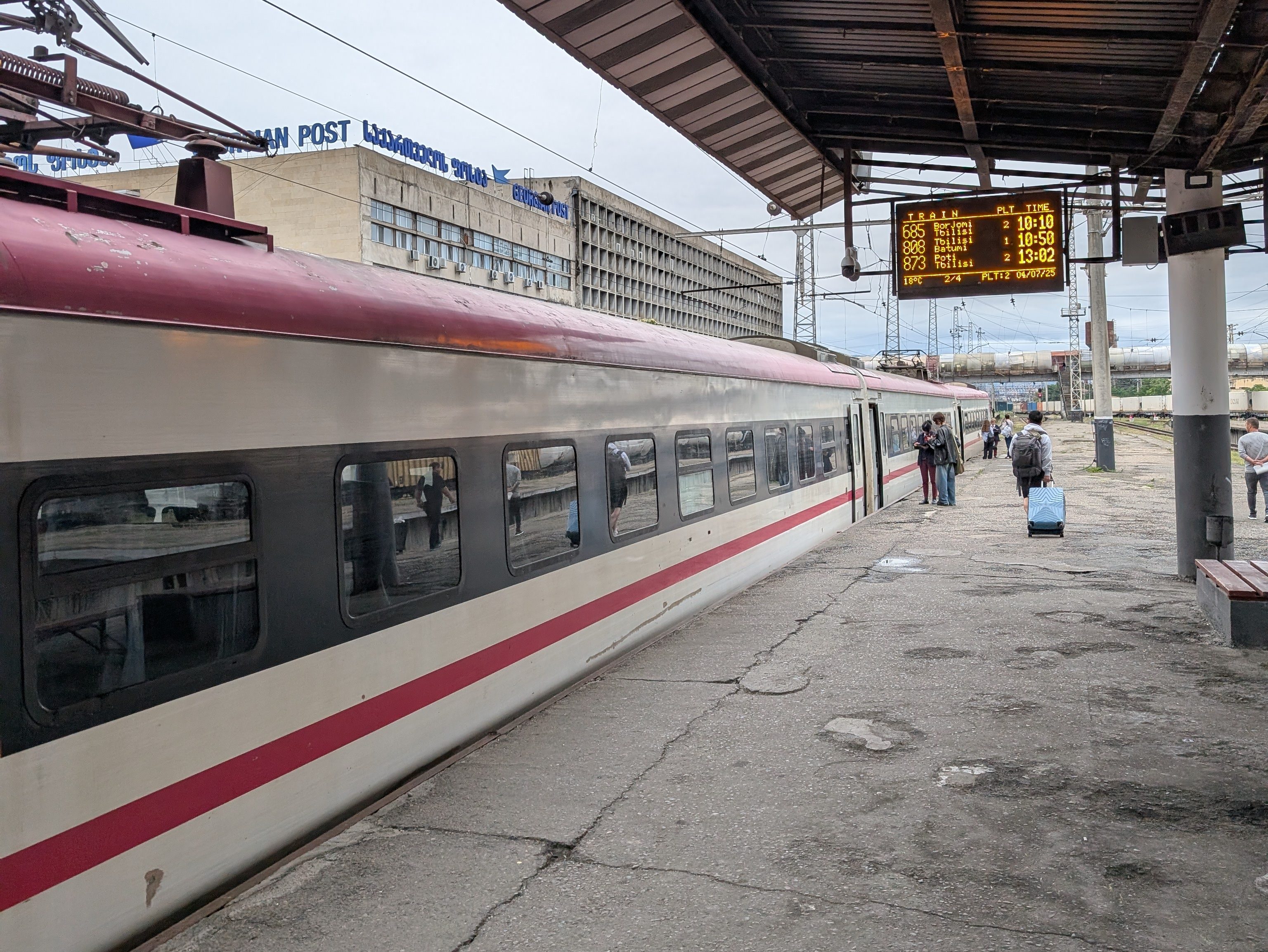
Exhausted from what felt like multiple near-death experiences, we screeched into Mestia. This was the main town of the Svaneti region and I could tell. Much of the charm had disappeared, replaced by generic, if Alpine chalet-inspired, hotels and restaurants. Though the journey had felt like it to get there, this was not the edge of Europe.
However, this illusion was quickly shattered as the town fell away and tall trees rose up around me. Apart from providing welcome shade from the sun which was already warm enough to prompt me to strip back to just a t-shirt and shorts, they obscured the view.
Only when they opened up into the occasional meadow or clearing was I able to appreciate the vastness of my surroundings. In a sense, the trees added to this drama as they prevented steady evolution of the scenery around me as I walked. Instead, they only occasionally relented, causing me to stop dead in my tracks and admire yet another stunning and unique vista.
At some of these points, locals had realised the increasing footfall along Georgia’s most popular hiking trail and set up small cafés there. Sipping a warm coffee while looking down at the valleys below, complete with hamlets dotted with 9th Century Svan towers, I began to understand the attraction of Svaneti.
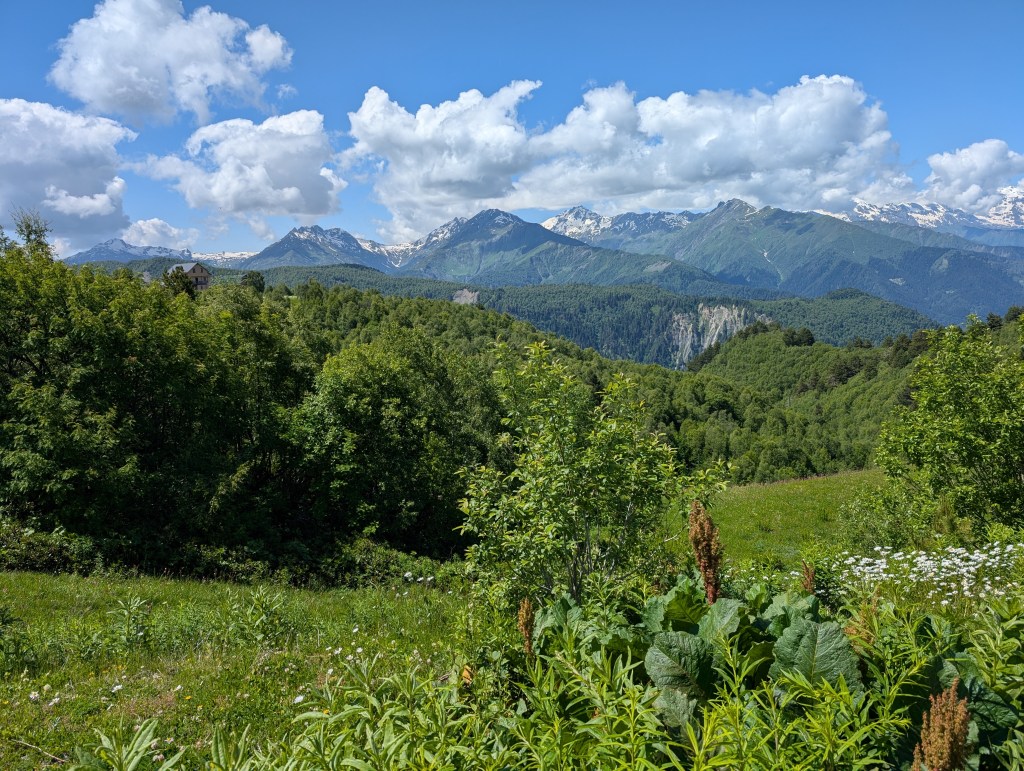
This was an area totally distinct, not just from the rest of Europe but even most of Georgia. Its secluded mountain location had protected it from invasion over the years while simultaneously shielding it from an increasingly globalised world.
The villages were unique, not just architecturally but also in how they immediately were able to transport me back in time. There were few cars and even fewer shops in many of them. Instead, agrarian life still prevailed, with cows wandering freely along mud tracks between the ancient towers.
“I could sense my toes losing sensation in the glacial melt water as my feet slipped and slid across the smoothed pebbles”
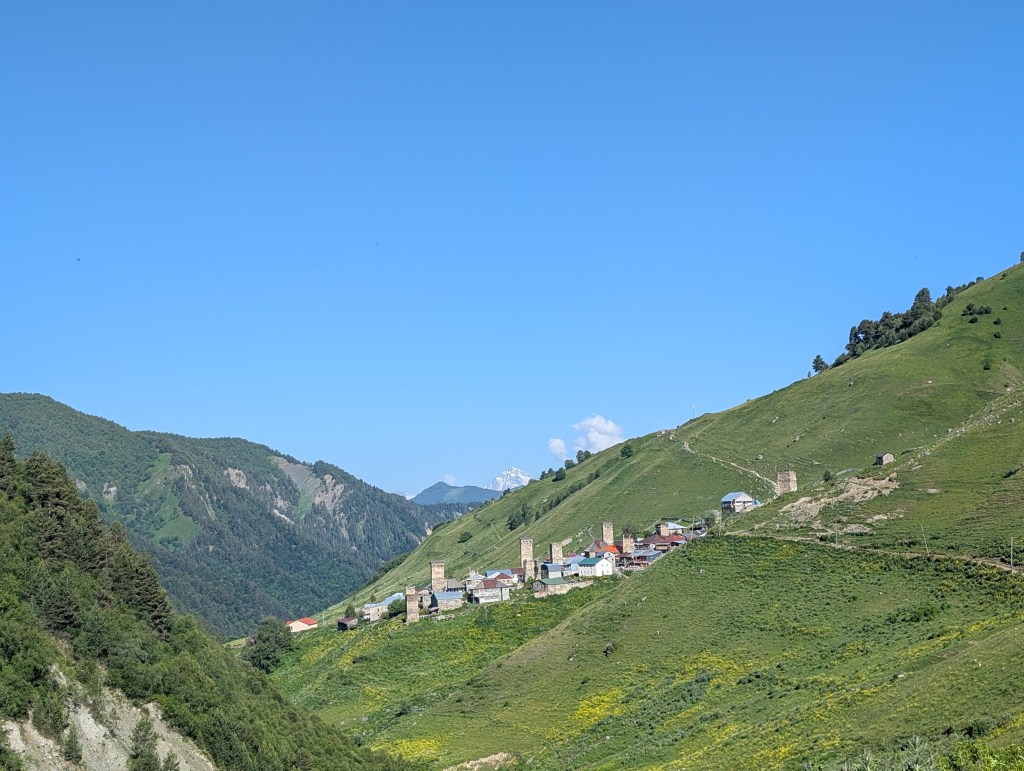
The most evocative of these on the trail was Adishi, a tiny hamlet which was where hikers tended to stay on their second night. Though, at times, it felt like it had fallen straight out of a Borat film, with young children playing in muddy and dilapidated farmyards and using whatever they could find in the house that day as a toy, it had an undeniable charm from the second it appeared in front of me as I walked the trail.
Where Mestia had been modernised, Adishi felt like it was stuck at the edge of the world. Without tourist income from the increasingly popular trail, this was a place that time would have forgotten.
Around the hamlet on all sides were the meadows full of wild flowers of every imaginable colour. From bright pink orchids to lilac-blue forget-me-nots and white oxeye daisies, I was astounded by the sheer variety and quantity of the plants growing around me as I walked.
The abundance of plant life had also led to a boom in the number of insects working to pollinate them. Keeping to the narrow dirt strip of the trail, my boots sent plumes of butterflies up into the air around me. Much like the flowers, these were of every describable colour and size. Walking through the wild flower meadows was a fantastical experience – a place which I never knew could exist on Earth.
The lifestyle of the locals who had called these villages home for hundreds of years was why this place wasn’t just confined to the pages of a scarcely believable fantasy book. Where most landscapes of this kind would have been littered with polluting plastics and chemicals which would prevent such extraordinary abundances, there was very little in Svaneti. The human footprint was generally very small – there were few fields for crops and people lived within the means of the land around them.
For me, this only served to enhance the charm of the area and confirmed to me that this was the ideal place to feel like I was escaping Europe without actually doing so. The idea of outdoor toilets, wonky floors and even electric cooking hobs mounted on the wall to provide heat during the cold nights made the experience an adventure.
Much the same attitude was in evidence during a river crossing at the top of the valley after leaving Adishi, where there was no bridge despite the numbers attempting to cross. This left two options: hire a horse to ride across on or brave the torrents of glacial melt water and wade.
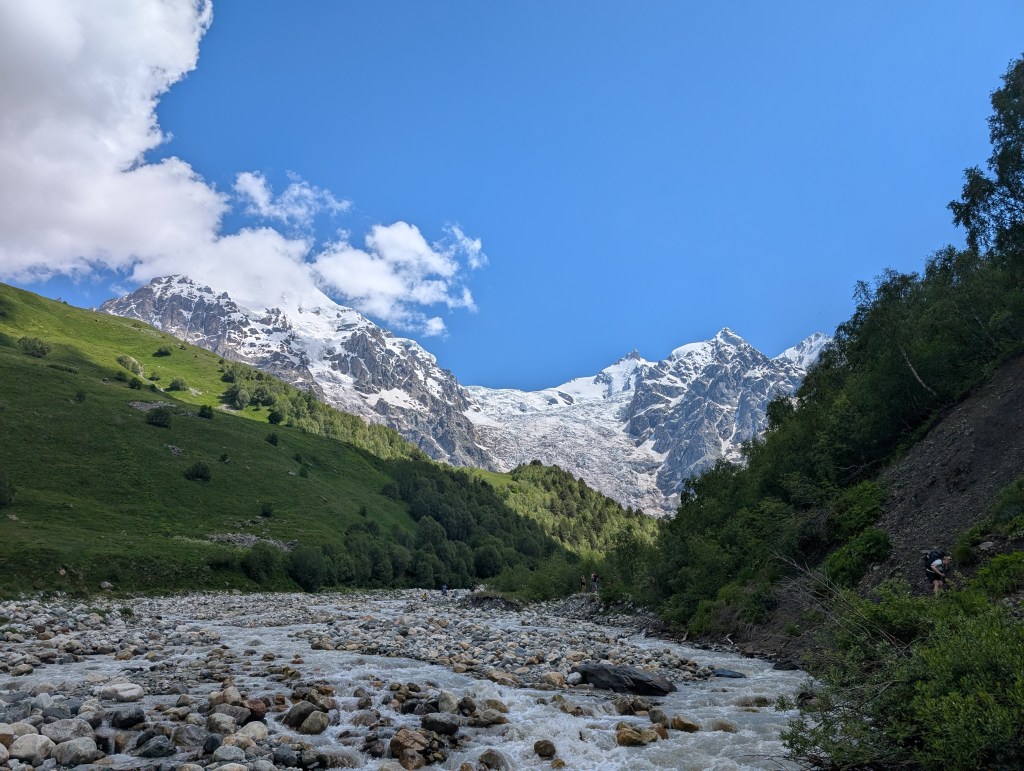
As someone who tends to be slightly allergic to horses and also opposed to the idea of locals price gouging tourists when there is no other apparent option to them when dealing with an inevitable obstacle such as a gushing river, I chose to strip off my boots and socks and waded into the bitterly cold flow.
Immediately, I could sense my toes losing sensation in the glacial melt water as my feet slipped and slid across the smoothed pebbles and rocks which made up the riverbed. Acutely aware of my heavy backpack which only served to impede my sense of balance, it suddenly occurred to me what the consequences of a misstep here may have been. With only very rudimentary dirt roads and no good hospital nearby (or first aid kit in my bag), perhaps the prospect of a slight allergic reaction from a horse wasn’t so bad after all.
Stubbornly I pushed on, crossing between islands in the river until I reached the point where the river was at its deepest and fastest. I stepped in. Quickly, I was knee deep.
Without any poles or a stick to aid my balance and counteract the backpack, which at this point was encouraging me to fall backwards downstream, I bent over double and fumbled around in the water, searching for a rock to hang onto and to provide some sense of stability.
Eventually, the flow eased and I found myself on the other side having crossed safely (even if it wasn’t exactly pretty). Drying myself off, I became glad for the experience. Despite the inherent danger compared to the relative safety of riding a horse, I had no regrets.
This single experience summed up my hike along the Svaneti Trail. This was a place which was extremely raw, especially by European standards. Though my hiking experience across the rest of the continent was fairly limited, I suspected that in most other countries a bridge would have been something which a hiker would have reasonably expected to be in place. In Georgia? Not so fast.
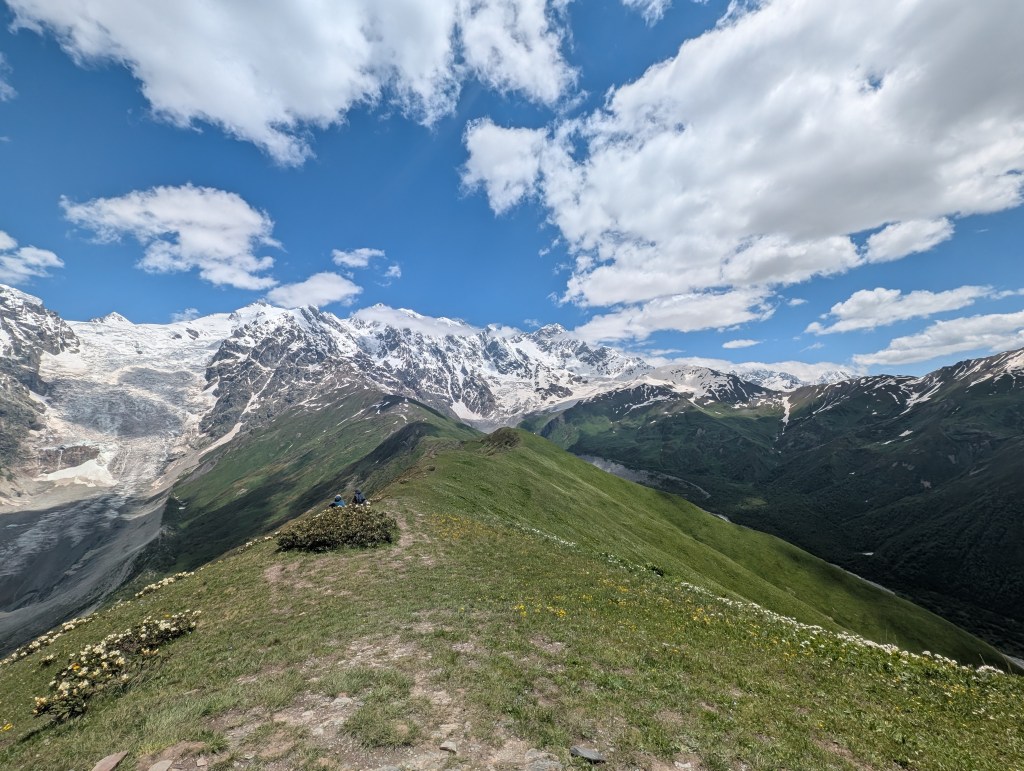
It was the reason why I came to Georgia in the first place and proved that it was possible to have a distinctly un-European experience without leaving the continent. It really was more akin to Central Asia in many ways, even down to the scenery being similar with stunning, snow-capped mountains complete with glaciers rolling down their slopes which, in turn, gave way to rivers like the one I had just crossed.
If I had come to the Svaneti Trail seeking some of the creature comforts which I am so accustomed to in my native UK, I would have been sorely disappointed and thoroughly uncomfortable. This particular region of Georgia was purely one for those seeking adventure and prepared to sacrifice almost everything else in pursuit of that aim.
Still, if I was seeking the creature comforts of home, I would have stayed at home. As it happens, I was extremely happy that I didn’t.
 Into The Elsewhere