Few tourists visiting Georgia know about the war. In 2008, Russian troops marched across the mountainous border and occupied the regions of South Ossetia and Abkhazia. A ceasefire was agreed but no formal treaty has ever ended what quickly became one of the world’s many frozen wars.
Though the reasons behind such a conflict are difficult to fully understand (and definitely beyond the scope of a travel article), travelling on the main road between Kutaisi and Tbilisi, Georgia’s bustling capital city, I stared into South Ossetia out of the bus window as the border ran along the highway, curious as to what life was like on the other side of this invisible yet very tangible border.
“There was abundant colour and vibrancy”
Foreigners and even many Georgians aren’t allowed into either of the regions – splitting families and the Georgian people into sections. Though South Ossetia looked much like any other Georgian region, filled with small farm plots, criss-crossed with poorly maintained roads and tangles of electricity cabling, it was a world away from the unoccupied territories surrounding it.
Indeed, Georgia has spent much of its modern existence fighting for a more independent path from its vast neighbour (and former occupier until the fall of the Berlin Wall) in Russia. Arriving in Tbilisi after walking in the mountains, I was interested to see how Georgia was forging an identity independent of Russia, escaping the hangover of being part of the USSR for decades and, even now, being partially occupied by its imperialist neighbour.

Certainly, there were some aspects of former Soviet rule which were still inescapable as I stepped off the battered minibus. Immediately I was presented with an enormous, entirely grey and brutalist structure, housing anything from a shopping centre to a gold market, a train station and a hotel which I was happy not to be staying at.
Its wide ramps and broad façade seemed to encircle me, dominating the square on one side with the scale of an airport terminal rather than a shopping mall and train station. On the other three, uninspiring tower blocks from the same era rose up. There was no vegetation to be seen, adding to the bleakness of the scene as the drivers of other minibuses tended to their vehicles to keep them running at all costs and maintain their income streams.
Diving underground to escape my surroundings, I jumped onto the next metro train into the town centre, hoping that this wasn’t a sign of things to come. My train clattered down the plain tunnels as it transported me into the city centre.
As I emerged back above ground, I quickly realised that Tbilisi was a city of two halves. On the one hand, the Ottoman-inspired old town was packed full of crumbling two- or three-storey houses which occasionally gave way to squares housing markets or bathhouses. There was abundant colour and vibrancy as tour groups followed obediently behind their guides, passing between Orthodox churches and statues of famous Georgian figures.
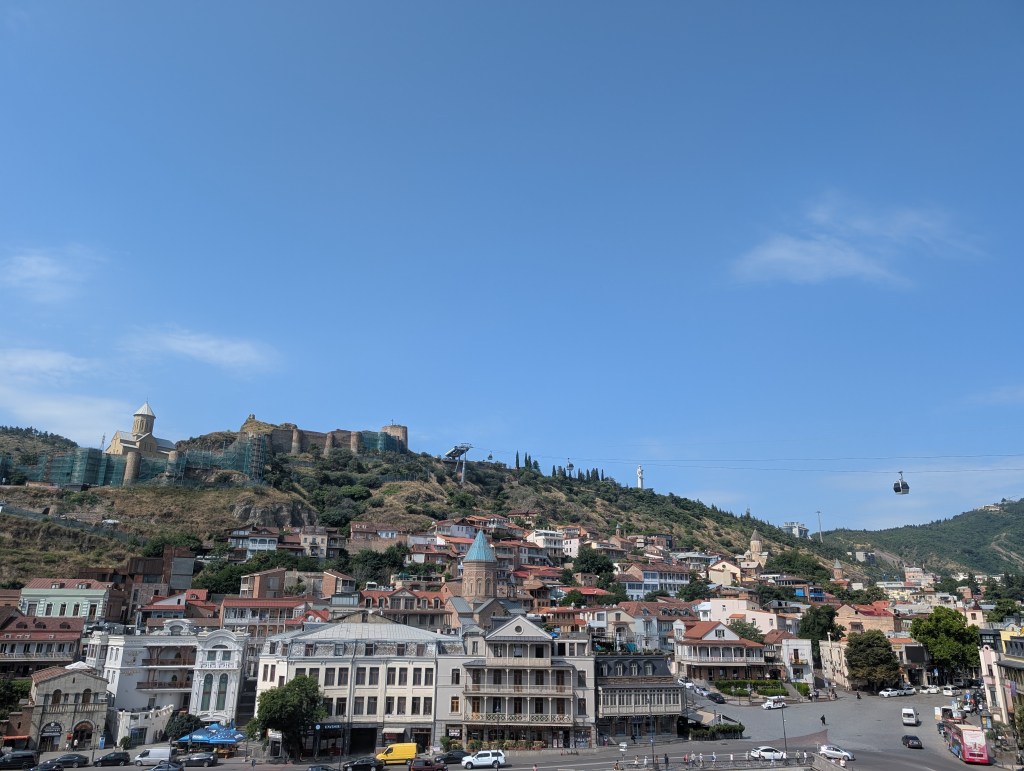
Altogether much less attractive than the old town was the myriad of arrow-straight streets, apartment blocks and municipal buildings thrown up during the days of the USSR. These closely mirrored what I had experienced as I stepped off my minibus to the city.
However, it would be unfair to say that the vast, often tree-lined boulevards were completely without merit. With far fewer tourist crowds and far greater numbers of locals, it had a grungier feeling – of people embracing the dilapidated nature of the buildings, using them as bars and music venues.
Nowhere captured this better than Fabrika – a converted factory outside of the old town. Though many tourists had discovered it and ventured there, mainly by virtue of there being a hostel in one of the buildings, it was the perfect mix of street art, plants growing out of cracks in walls and an infectious buzz which seemed to affect all that visited as they sipped beers in the main courtyard.
To me, this was one of the greatest expressions of a modern and independent Georgia. Instead of wiping its many years under Moscow’s influence off the map, it had embraced them in a new and creative way.
It would have been all too easy to demolish such a large and, on the surface at least, ugly block to create nondescript apartment blocks which wouldn’t have added anything to the surrounding area. Fortunately, Tbilisi had chosen the harder but much more interesting option of using what was already there.
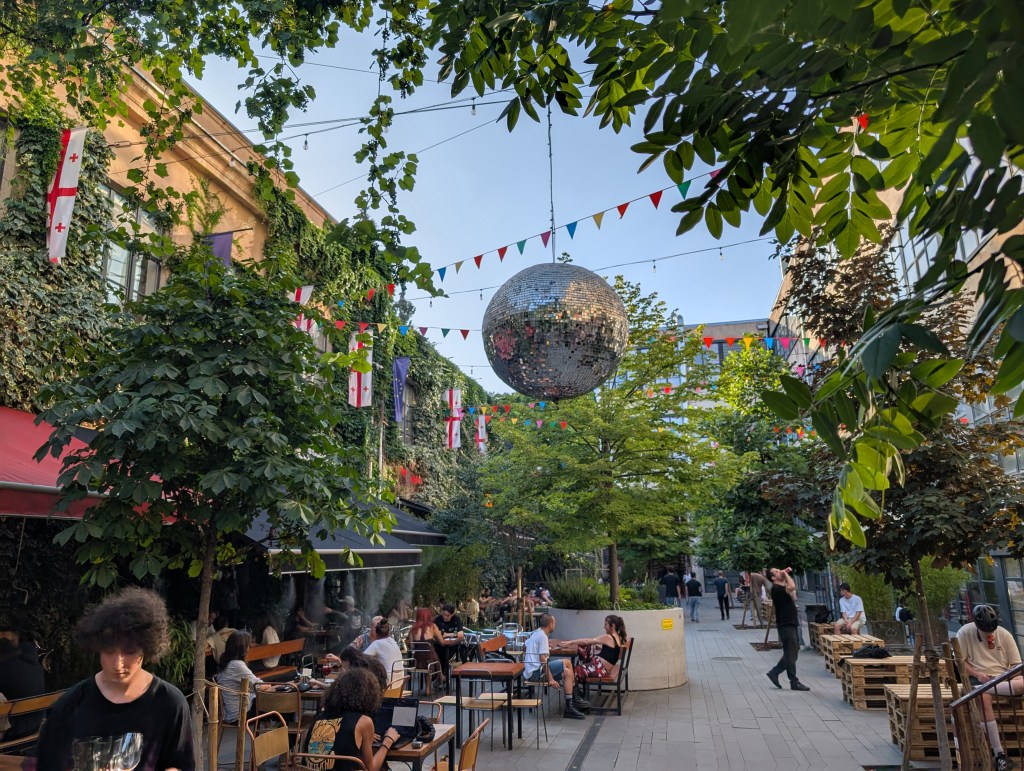
The whole venue also tapped into something which the whole city fundamentally did extremely well: party. Between the endless wine bars which lined many of the streets and the statue placed prominently in the middle of the old town that was devoted to drinking and partying, this was clearly a city which, if it had been hard done by on the entertainment front during the 20th Century, was eager to make up for lost time.
Many of the distinctions drawn by the residents of Tbilisi tapped into this party spirit and were cultural rather than physical. Any walking tour through the city would immediately and proudly declare Georgia to be the birthplace of wine as much as 8000 years ago. Equally, there was a greater feeling of openness and friendliness which would be difficult to find on the streets of St Petersburg or Moscow.
Perhaps the most striking difference was in food though. Where a traveller would be expected to sit down to a plate of stroganoff or borscht, Georgian cuisine was a world apart and relied mainly on bread and cheese.
Delicious creations such as khinkali (juicy meat dumplings) or khachapuri (bread filled with cheese) poured out of restaurant kitchens across the city and were enjoyed by locals and tourists alike. It was simple yet indulgent – the extensive use of Georgian cheeses giving it a homely feeling which I’ve experienced in very few other countries while sampling their food.
“Georgia had naturally taken on some Russian ways of doing things”
Despite the odd clear dividing line, that is not to say that, on occasion, Tbilisi had overstepped in its efforts to define itself. As I walked through a park alongside the river that was dotted with interesting sculptures and well-manicured flowerbeds, I couldn’t help but notice a couple of tube-like buildings sitting off to the side of the grass lawns.
At a later date, I found out that these tube-like structures, clad in silvery metal and with modern glass walls at either end, were left totally unoccupied. Though they had been designed by high-profile western architects and were situated prominently within the city centre, a use had never been found for them, to the extent that there were rumours that they were earmarked for demolition.
This confused me as a concept; though I was by no means against a modern addition to the city centre (just see how the Guggenheim transformed Bilbao’s fortunes in Spain), I couldn’t understand how they had been built without a use in mind or, at the very least, had one shoehorned into them as some of the city’s most interesting and prominent modern structures.
Worsening my understanding of the situation was the only large tower block in the city. Housing a hotel and having been built fairly recently, it felt like a throwback to Soviet Georgia, rather than the modern country which the tube buildings clearly suggested.
The building was angular, with sharp edges and a serrated edge up one side which reminded me a little of the brutalist train station building. The only aspect which stopped it from slipping into full-on brutalism was that it was clad entirely in glass.
It was a shame that this skyscraper dominated the skyline in quite the way it did – it was a reminder of a country struggling to escape from a bygone era rather than one looking forward to a new and exciting future.
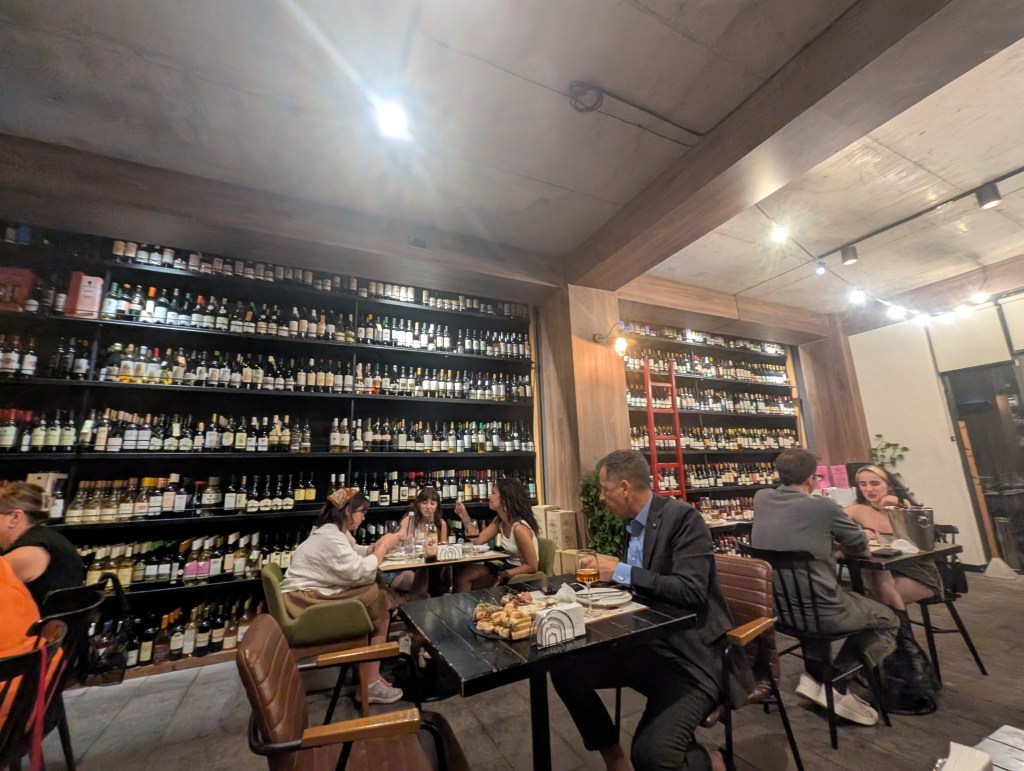
It felt as if Tbilisi had almost had one party too many and was suffering a bit of a hangover. Though there was a clear Georgian identity, in absolute defiance of any Russian occupation past or present, there were some ways in which the city still clearly looked more to Russia than westwards towards Europe.
Perhaps this was understandable – borders are and always have been porous. Even if they are physically closed, the transfer of ideas, trends and cultures still move freely between countries due to the globalised nature of our world. Purely by being in closer proximity to Russia rather than anywhere else in Europe, Georgia had naturally taken on some Russian ways of doing things, even if it is mainly just in its buildings rather than culture.
Though the inhabitants of a city do go a long way to define the place that they call home, as a tourist I couldn’t help but also notice the more Russified side of Tbilisi as I walked the streets between wine bars and hearty Georgian meals.
This experience placed Tbilisi on a crossroads in my imagination. It was a Russian city (with an Ottoman heart) that was trying fairly desperately to escape westwards. My feeling was that it never truly will and, at the same time, why should it? In doing so, it would turn its back on large swathes of its recent history, losing touch with its roots. Though it wasn’t perfect, the combination of dilapidated, drab Russian buildings and a much more vibrant culture was interesting and intoxicating at the same time. To strike that balance while under the constant threat of invasion was remarkable.
 Into The Elsewhere