All around me the pulsating streets of downtown Amman were thronged with people going about their lives. The evening had brought a slew of neon, pushy street sellers and some of the most unruly and noisy traffic I had ever witnessed. I was there for none of it.
A day of sightseeing had me hungry and, walking past endless shops selling everything from embroidered fabrics to Jordanian-style wooden boxes, I could feel a rising desire coming straight from the darkest depths of my stomach.
Throughout my trip to Jordan, I had tried the kebabs. In restaurants, these were usually extremely pleasant (something which could be said for most, if not all, the food in the country). Even so, these felt a touch fraudulent – proper kebabs weren’t served in restaurants that served other food.
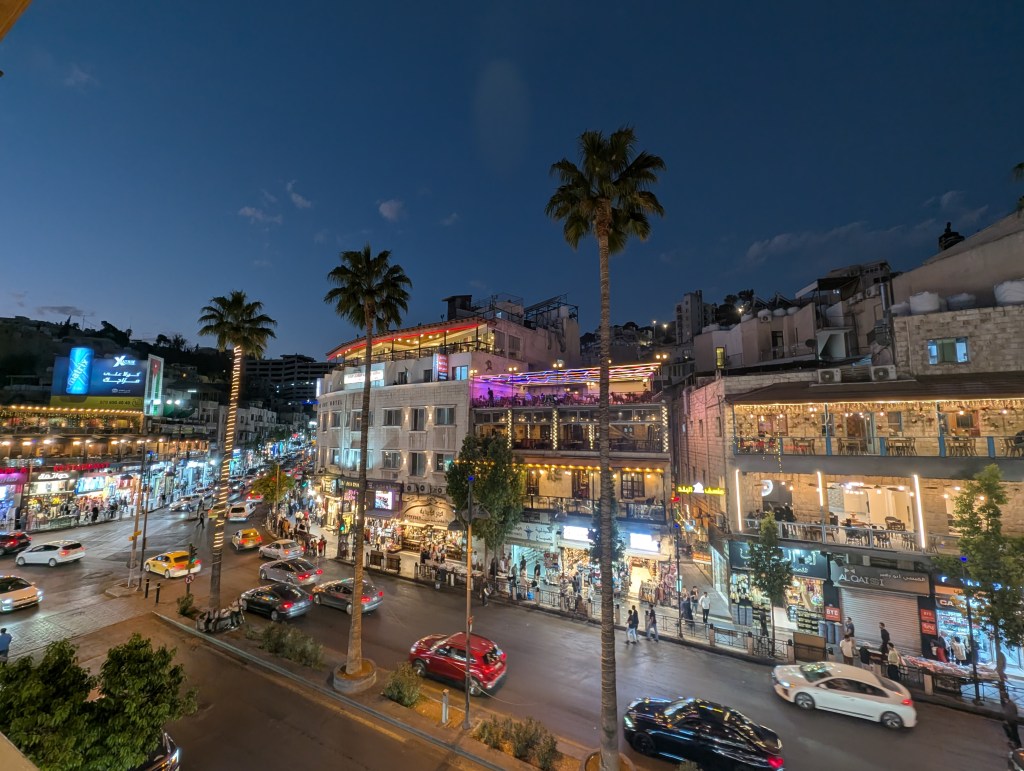
This led me to a friend who, having lived in the Jordanian capital city for a year, had the time and space to suss out the top spots to match my expectations and satisfy my deepest hunger. When he messaged me with recommendations of places to go, I was thrilled to see in pride of place at the top of the list: a place named Shahrazad. The description which followed was something along the lines of it being “Amman’s best food spot for kebab and not one to miss”. I was only too happy to oblige.
Finding it was a challenge. The layout of the streets, forking from one another as they slowly rose or dropped along hills made the route tricky to follow. The endless crowds, noise and chatter made concentration and the idea of actually following the route impossible.
“Though the food was apparently of high quality, the service was mostly aimed at … maximising the number of sittings”
Still, after a few stabs in the dark, usually concluding with dingy and largely empty alleyways, I found the entrance (with a bit of help from my girlfriend who had travelled with me).
That said, I use the term “entrance” lightly. Shahrazad spilled in all directions, extending down and out of the largely unmarked alleyway within which the bowels of the place lay. There was no welcome sign, partition to separate restaurant from pavement or even an entrance door. If it wasn’t for a waiter calling out to us, asking whether we were looking for the place we had just awkwardly wandered into, we would have been none the wiser.
Though there was little to visually distinguish this particular place from any of its neighbours, there were some sure signs that it was, firstly, a place to come and eat barbeque and, secondly, extremely popular.
Waved and hurried deeper into a labyrinthine series of rooms, my eyes struggled to adjust from the dimly lit exterior areas to the bright white, almost clinical lighting of the rooms we now found ourselves walking through. All around, every table was rammed with Jordanians enjoying vast platters of lamb and chicken, picking them up using torn pieces of large and freshly-baked flatbreads.
We were lucky to get a table. As waiters whizzed past, carrying all manner of goods from brightly-coloured cans of fizzy drinks to stacks of flatbreads taken straight from the ovens in which they had been cooked, they almost completely obscured a table in the middle of one of the rooms furthest into the Shahrazad maze. Beckoned over by a waiter, we grabbed it before anyone else did.
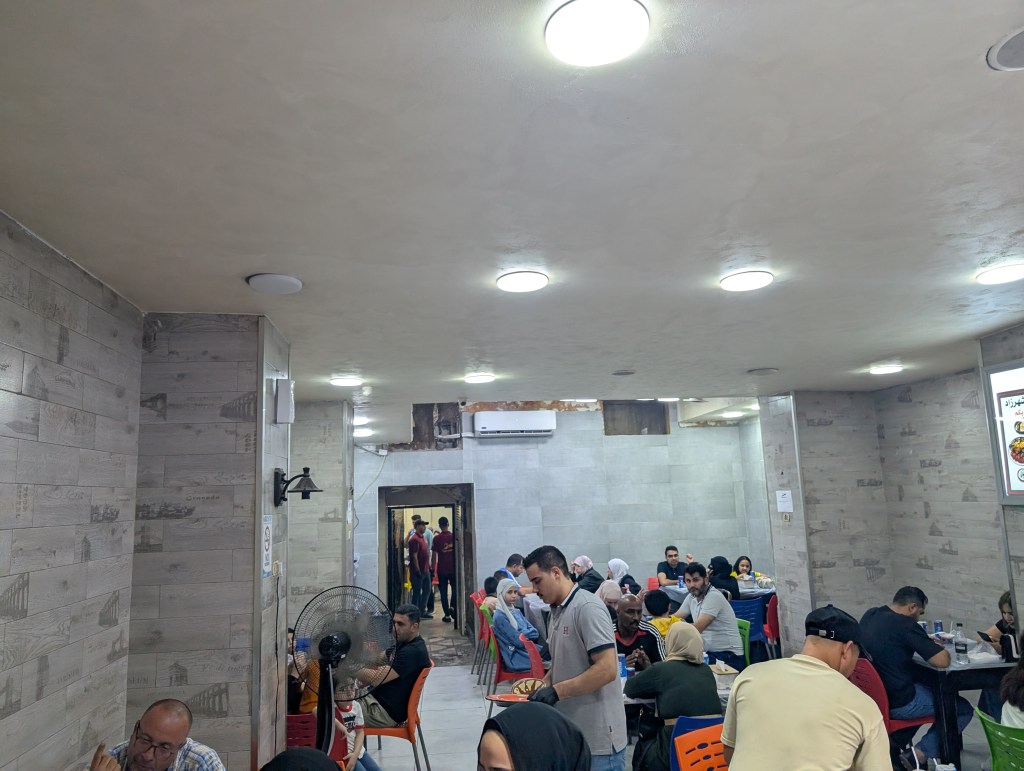
With speed which felt like it would have impressed Olympic sprinters, a plastic sheet was unravelled in front of us to serve as a tablecloth, closely followed by cutlery tightly rolled in white napkins and a small plastic basket of pickles. It was clear that, though the food was apparently of high quality, the service was mostly aimed at making sure customers were turned around as soon as possible, maximising the number of sittings.
Menus quickly followed. For my vegetarian girlfriend, there wasn’t much in the way of good news. When the single page of laminated but still battered A4 was unfolded, the entirety of the listings contained meat. As I rejoiced in how specialised this restaurant was (surely a sign of quality and an opportunity for me to have the blowout meal I was craving), she found the small salad section which clung to the very bottom of the menu and was seemingly an afterthought.
Out of the many people walking through the dining room, a waiter emerged to take the order. I went for a mixed grill which, as stated, weighed 840 grams. To this, I added arayes, a Lebanese-style meat pie.
In instances like these, hindsight is a wonderful thing. Without as much as a shrug, let alone the full state of alarm that my ridiculously massive order should have elicited, the waiter disappeared amongst his colleagues and started shouting to the cooks working the other side of the counter. Unknown to me, I certainly had ordered a blowout meal. Maybe even two.
When the kebabs arrived, at the bottom of a vast stack of foil-covered metal platters carried by a diminutive Jordanian, I soon realised the scale of my mistake. This was less a blowout for one and more a meal for a family of four.
Still, the smell of freshly grilled lamb and marinated chicken made my mouth salivate with anticipation. Despite Jordan’s national dish, mansaf, not even being on the menu at Shahrazad, this was the pinnacle of Jordanian cooking in my opinion.
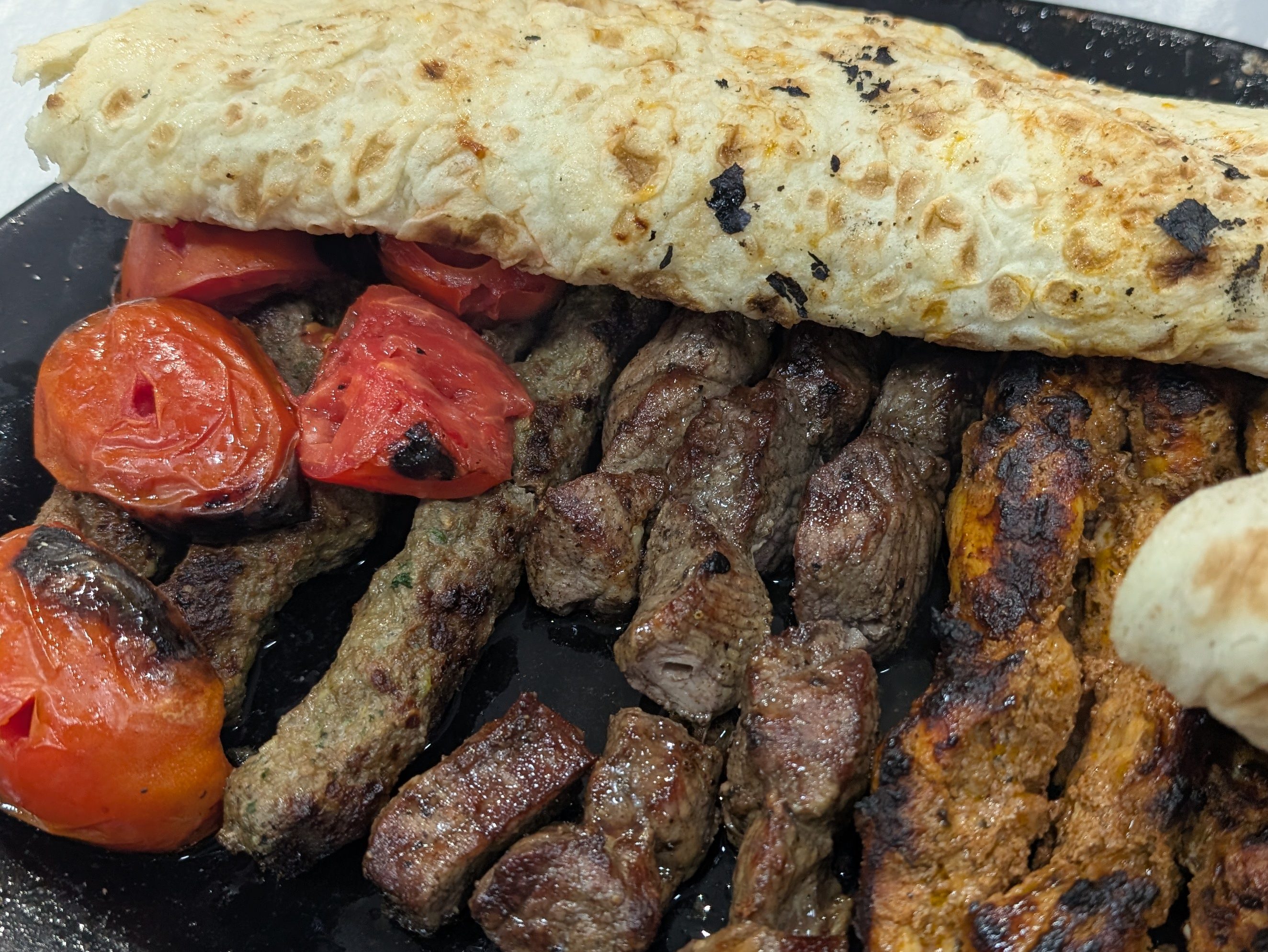
The whole arrangement was covered in a vast flatbread which was soon bolstered by the arrival of two more, unceremoniously plonked straight onto the plastic tablecloth by another waiter carrying a stack of them. I tore a piece off, wrapping a piece of lamb with the soft and warm bread as it still dripped with juices fresh from the charcoal grill.
Quite how so much flavour had been squeezed into such a simply-cooked and apparently plain cube of lamb was totally beyond me. Though the cooks behind the multiple counters dotted around the restaurant’s rooms and corridors were human, they may as well have been wizards to me at that moment.
It was a perfect balance of soft and tender while pleasantly charred on the outside. Though much of the juice from the meat had escaped to the platter, it was by no means dry. The delicious, savoury taste of freshly cooked lamb raced from my mouth into my brain and then around the rest of my body.
“Breakfast was not happening the following morning. Even skipping lunch was a distinct possibility”
Grabbing piece after piece, whether kofta, lamb or chicken, the result was equally exquisite. The bread was absorbent enough to soak up some of the juices left on the platter as I gorged on the best of what Amman had to offer, my vegetarian girlfriend looking on with her modest salad in a state of semi-disgust at such an overt expression of carnivorous instinct. I didn’t care.
Between the ten or so kebabs sitting in front of me and the arayes which arrived alongside, I was quickly at a point where I would have called it a day on any normal meal. This time I pushed on, mostly wanting to make the most of such deliciousness in front of me but also partly out of shame and also partly wanting to prove a point that, despite appearances, I hadn’t drastically over-ordered.
Only the aggressively beating fans, placed at intervals around the edges of the brightly-lit room prevented me from beginning to sweat as I gorged. I could feel defeat slowly emerging over the mountain of food which had been placed in front of me. It was clear I wasn’t going to finish, despite my best intentions (and eventual resemblance to some sort of horrendously vulgar eating competition participant).
I had no idea what the Jordanian waiters thought of such greed as they swept the platter away from in front of me and back into the melee of their shouting colleagues, small children playing and stray cats begging for offcuts. All that crossed my mind was that breakfast was not happening the following morning. Even skipping lunch was a distinct possibility.
Following the blinking exit sign which hung lop-sidedly above a doorway, I left Shahrazad exceedingly glad to have visited and experienced Jordanian barbeque. My friend was right; it certainly wasn’t to be missed.
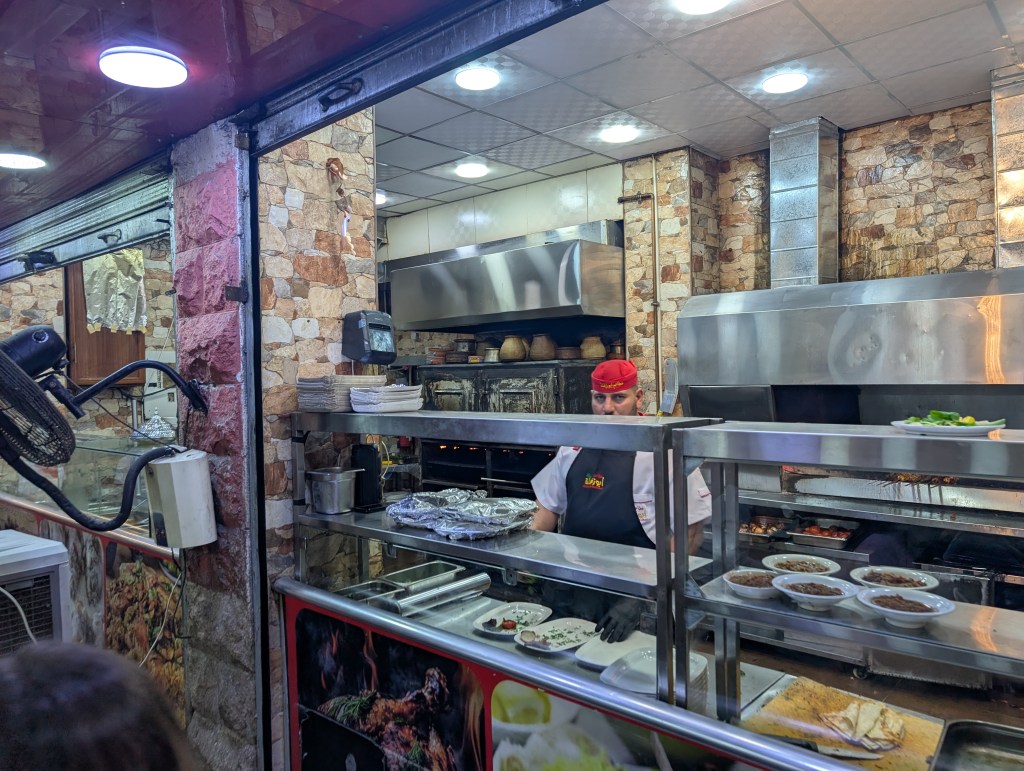
As much as it was an excellent location to have the large, meaty meal which I was craving earlier on in the evening, I felt that the episode had also served as a window into local life which can sometimes be so hard to find in a foreign country.
The unmarked and slightly informal feel of the restaurant was in stark contrast to anything which I was accustomed to in my native UK, yet was clearly completely normal on the streets of Amman. The culture of waiters shouting across dining rooms at snowed-under cooks or children running amok between the many tables would surely be a sign of failure in the Western world. Here, though, it was a sign of a successful and intensely busy establishment.
The no-frills approach of plastic tablecloths, clinically white lighting and a seemingly random arrangement of kitchens dotted around the place would have spelt a place that nobody would set foot inside in Europe. In Jordan? Despite the lack of formal entrance, they were queuing out the door.

 Into The Elsewhere