I’m not here to lecture you on Petra. I wouldn’t insult the intelligence of readers of this blog to the extent that I would make the assumption that they were unaware of one of the Seven Wonders of the World. Even less would it be in keeping with the purpose of much of my writing – attempting to shed light on roads less travelled. Millions have seen (and continue to see) the ancient Nabatean tombs and other buildings cut into the sheet rock faces.
Granted, it isn’t the Costa del Sol in terms of accessibility, tourism levels and general awareness within the British psyche. At the same time, it may not be quite as “elsewhere” as, say, Central Asia.
What if, though, things have changed? What if the Petra I saw wasn’t the subject of hordes of tourists descending upon the Treasury, ferried in using any number of electric golf carts, dodgy donkey rides and ropey, overpriced food?
No, I haven’t gone insane. This version of Petra exists. A Wonder of the World minus the people staring at it in wonder. Nowhere like Petra will ever be free of tourism but (and you’re going to have to trust me here) you can get within a hair’s breadth of having it to yourself. You don’t even have to wake up at the crack of dawn.
“This was a monument to man’s ability to shape the world around himself”
In fact, all you really have to do is go. Now.
Some context to my trip to Jordan is probably appropriate at this stage. Since the pandemic, tourism in Jordan has nose-dived and never recovered. First, this was because of COVID; more recently it’s been because of the war in Gaza making people uneasy about visiting in case the violence spills across the Israeli-Jordanian border.
Though I am not here to express opinions on the war (this being a travel blog, rather than a political one), it was clear to me that Jordan has become a further casualty of the violence which has spread across the region in the last two years. The European tourists which the country relied upon so heavily to stimulate its economy disappeared overnight.
When I landed in Amman, the capital of Jordan, I had no idea that this was the case. Arriving in Wadi Musa to be told that we were the first guests at our hotel in three months nailed the point home. It wasn’t just Petra which was empty, it was the country. Perhaps even the region.
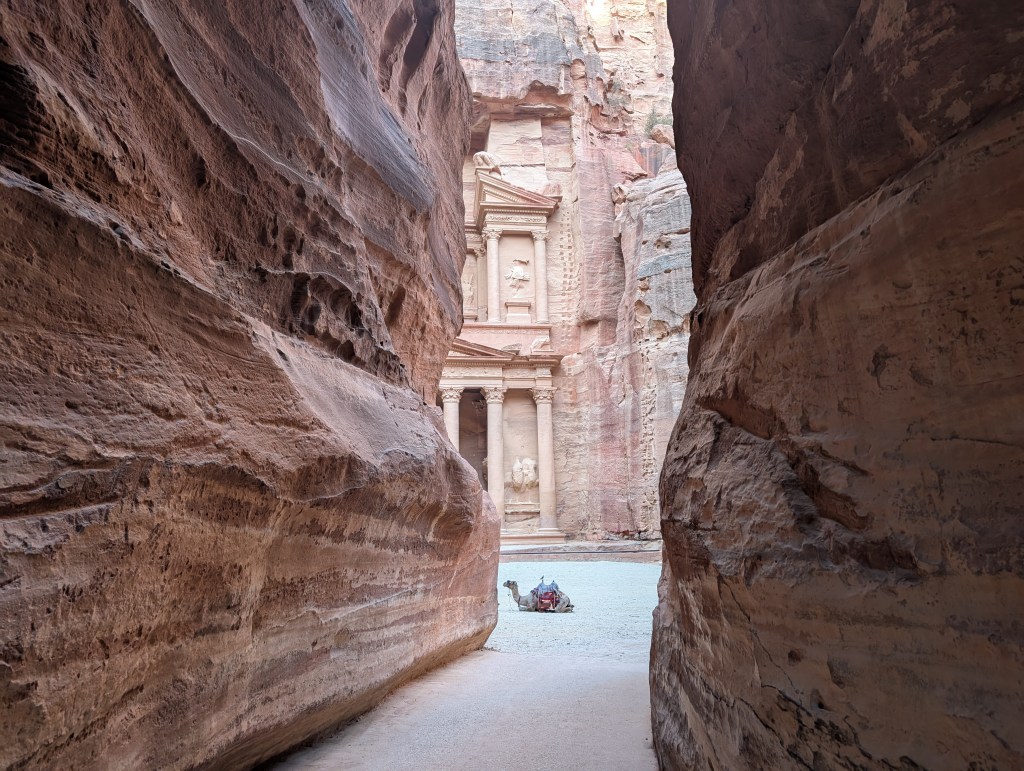
Descending through the world-famous Siq on my way to the Treasury, there were some crowds of mostly Jordanian tourists, lured in with the promise of cheap tickets to boost tourism and stop the whole thing going completely bust. Arriving at the Treasury itself, there were some crowds though this was nothing on what I was expecting as I boarded my plane from London.
Small gaggles of people gathered, dwarfed by the vast facade carved into the rock face above them and shaded from the afternoon sun by the surrounding cliffs. While I was told that, in years gone by, queues would form to get the best Instagram shot with the fewest others in the frame, there was no rush. People stood around, able to move freely, easily taking photos free of tourists to upload to their Instagram profiles. A couple of overly-decorated camels sat among the few tourists. Though they were there to offer rides, business was very slow, leaving them there for ornamental value only.
Little did I know that this was just the beginning. I was vaguely aware of the sheer size of Petra and the number of trails criss-crossing its ancient sites. I resolved to come back the next morning, ready for a full day of exploration and to begin to make the most of my three day pass.
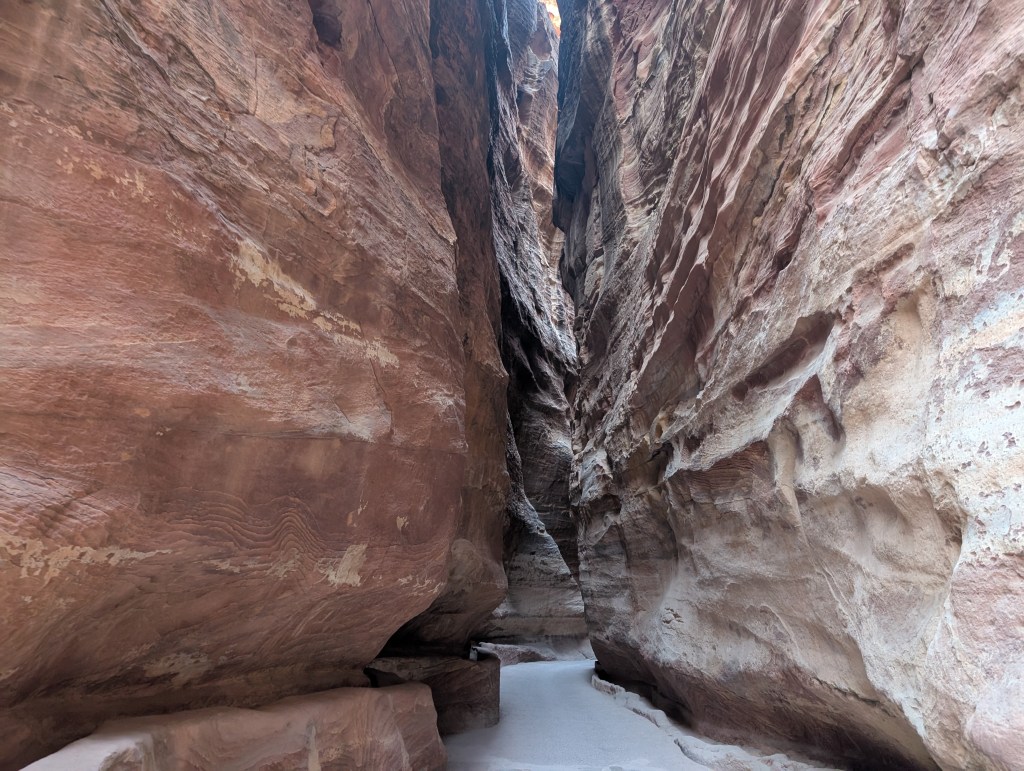
As I returned after an evening in Wadi Musa, the town which had expanded endlessly to accommodate Petra’s one-time swelling crowds, the paucity of visitors really began to hit home. Walking down the Siq before the buses full of day trippers had arrived from Amman became a mystical experience, with the folds of the cliffs acting as curtains, flattering to deceive and reveal their biggest secrets with each twist and turn.
Unlike the day before, the golf carts and Jordanian crowds weren’t in attendance – my girlfriend and I were virtually alone. The same was true of the Treasury.
We plunged deeper into the ruins than before, quickly realising that, though the Treasury was without doubt the best-known of the sights, it was by no means the most spectacular. Almost as soon as we exited the Siq and walked past the Treasury, we were greeted with any number of equally impressive structures, all carved into the red sandstone rock faces.
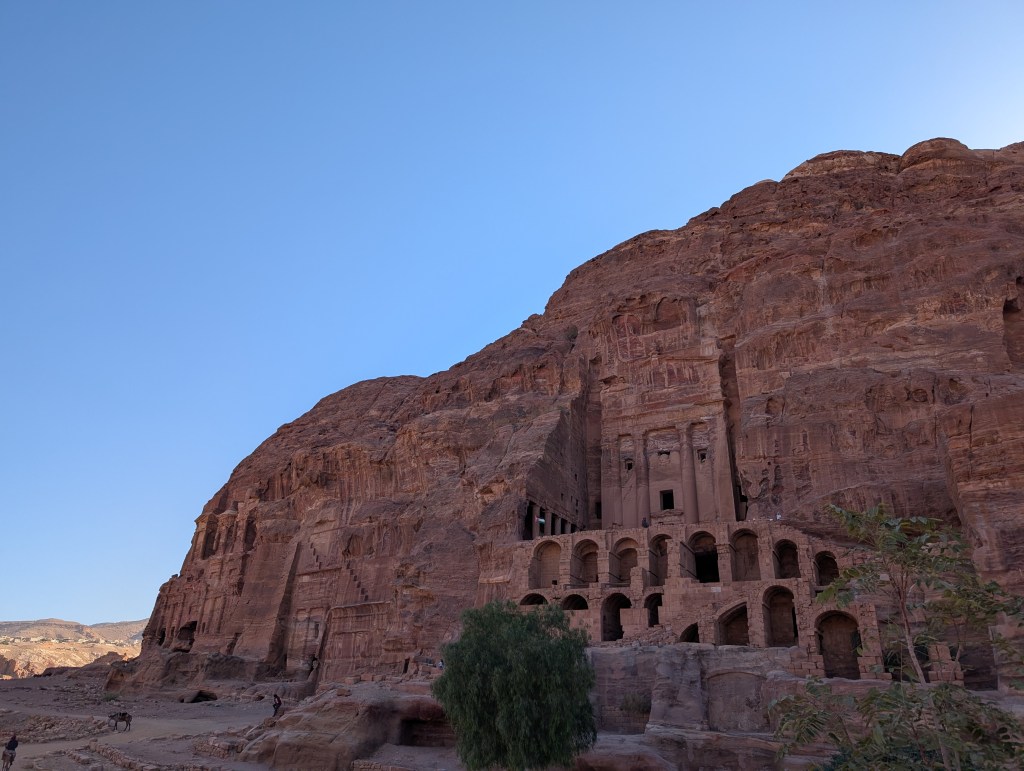
That said, it was the scale of what surrounded me which I found most impressive. This was a monument to man’s ability to shape the world around himself, quite literally by cutting directly into million-year-old mountains to create homes, tombs, water storage areas and places for rituals.
No small nook or cranny seemed to be untouched by the Nabatean people’s mastery and dominance of their surroundings. Climbing the many steps to the Monastery (Petra’s most spectacular structure in my opinion), the trail forked, encouraging me down a narrow channel to reveal a small temple-like building known as the Lion Triclinium.
The site as a whole seemed to encourage distraction, tempting you down narrow passageways and up winding staircases in an effort to discover, learn and explore. It was little wonder that the site was a filming location for Indiana Jones and the Last Crusade; as much as it sounds silly I was half expecting to turn a corner and discover a long-lost ancient relic or previously unknown tomb complex. It was intoxicating.
“Being alone with one of the best views over a Wonder of the World is a slightly paranoia-inducing experience”
Nowhere encapsulated my enthusiasm and sense of exploration in Petra as much as the High Place of Sacrifice Trail. Leaving the main tourism route just after the Siq opened out, I found myself winding up a set of steep steps as they climbed up a canyon towards the summit of the cliffs into which so much of the city was hewn.
Almost as soon as I started climbing, it felt as if I had left the few other tourists behind entirely. Left in almost complete silence aside from my heavy breathing from climbing the steps in the increasingly warm sun and my walking boots which had developed an irritating squeak each time I placed my foot down, I ascended and became increasingly, gloriously isolated.
Looking down upon the basin which formed the heart of the ancient city, I gained a totally different perspective on the site as I watched birds flitting between the cliffs below me. The few tourists trudging through the heat of the day up and down the main road had been transformed to tiny specks, like miscoloured pebbles amongst the sandy expanse.
It was little wonder that the High Place of Sacrifice was a sacred place to the Nabateans. The isolation from the main city while also being geographically close led to an overriding sense of peace. Gone were the donkey rider sellers, the cafés and police vans which populated the lower reaches.
The thing which made it most peaceful, though, was that I was alone. I’ll admit for a second that being alone with one of the best views over a Wonder of the World is a slightly paranoia-inducing experience, leading me to question whether I had strayed over some unknown boundary line and would soon be booted off the site by some angry police guard or park ranger – it really was that empty and, in turn, eerie.
The reality was, though, that I was exactly where I was supposed and allowed to be. I could scarcely believe my luck.
Settling down to lunch upon my isolated clifftop, it dawned upon me that, though this had been a magical experience I’d likely never forget, this abandonment of Petra by tourists had a much darker side. While I benefitted, Jordan suffered.
This was a tricky predicament; the money spent by tourists at the stalls, restaurants and cafés had dried up, leading to a sense of desperation which I had never experienced before from street sellers. In some cases, I questioned whether the stall holders were less looking for a lucrative sale and more just begging for my money out of sheer desperation.
It seemed as if little governmental support had been offered to them as their income disappeared overnight. To me, this was extremely concerning. Without the local people there, the conservation of a site like Petra would become impossible. Indeed, with recent international aid cuts, I knew that Jordan was already in a tricky position with cultural preservation without the kicker of the war in Gaza and tourists becoming too afraid to travel.

The aid will not be returning any time soon, it seemed. As such I was in a sense glad that I had decided to visit during such a tricky time. Sure, there were obvious benefits to me doing so; getting a Wonder of the World to yourself really just being the starting point in that list. Hopefully, though, if enough people do the same and discover that Jordan is entirely safe despite wider regional conflict, the tables may turn on such a spectacular and unforgettable monument to our ancient past.
Until that day, this is somewhere which I’d recommend above most others I’ve been fortunate enough to experience. Full or empty, Petra deserved its place among the Seven Wonders of the World. It now deserves the return of the tourism which should come with it.
 Into The Elsewhere