I knew the bus journey would be tough. Scheduled at 20 hours between Uzbekistan’s capital, Tashkent, and Kazakhstan’s biggest city, Almaty, it was going to be long, probably bumpy, include a border crossing and likely provide literally nothing but identikit steppe to see out the window (when it was light at least).
Around an hour in, standing alone on the Kazakh side of the border, I soon realised just how tough this experience was going to be. I regretted my decision not to wait a couple of days and take the train. As far as I knew, the bus had left without me and I was stranded with no easy way of getting any further than exactly where I was at that moment.

The bus, which I assumed must surely have crossed the border faster than I had managed on foot, was nowhere to be seen. In my mind, this was mostly because it was likely a hundred miles away down the road, with the conductor happy to be rid of his naïve (and probably irritating) Western tourist.
If anyone reading this has been unfortunate enough to stick around any one of these border towns which dot the globe for more than around 20 minutes, you would know that it was an extremely unpleasant place to be. Built up in a hurry around the fortified border gates, the buildings consisted solely of concrete floors with grey breeze blocks filling gaps between pillars. In most cases, unfinished floors were stacked above the ones that were inhabited. It felt like it had been built for temporary use and in an extreme rush to make the most of all the cross-border traffic and trade.
Litter was strewn across the dusty ground, the only residual sign of the many thousands of people who had passed through the town, no doubt intent on being well clear of the area as quickly as possible. The only people who seemed to inhabit this ramshackle and, as far as I knew, nameless settlement were the endless money changers, all claiming the best rate for changing Som into Tenge. Bleak didn’t begin to describe it.
“Bright blue majolica tiles had been replaced by grey concrete and … all aesthetic flourishes had seemingly been removed”
Long after I had been approached by, and rejected, all of the money changers, I saw a large boxy vehicle rumble out of the Kazakh border gates, silhouetted against the security lighting of the compound. After four hours of being stranded, I was relieved to be reunited with my bus. I was back onto the road to Almaty.
That said, it soon felt like I was out of the frying pan and into the fire. After a pit stop for food at around 2 o’clock in the morning (which, I must admit, I wasn’t hungry for) the bus rumbled out of the service station, me sitting at my faded blue seat with my knees a mixture of jammed into the row in front and stretching out and blocking the aisle.
There really was no upside to this situation. As the sun rose on a sleepless night, I was desperate to arrive in Almaty. Gazing at my phone, the vastness of Kazakhstan, the world’s ninth largest country, really hit home: we were only a fraction of the way, clearly with hours left until arrival. Even my usual pastime in such situations of staring out the window at the passing scenery had been confiscated from me.
This was because all I could see were some extremely distant hills on the horizon and, before reaching them, what seemed like hundreds of miles of flat, grassy steppe with the main road passing, arrow straight, through the middle of it all. Once the alien nature of such a place had worn off after an hour or two, I was again left to ponder how I had ended up in this situation and what Almaty, one of the region’s most cosmopolitan cities, may have to offer once I arrived.
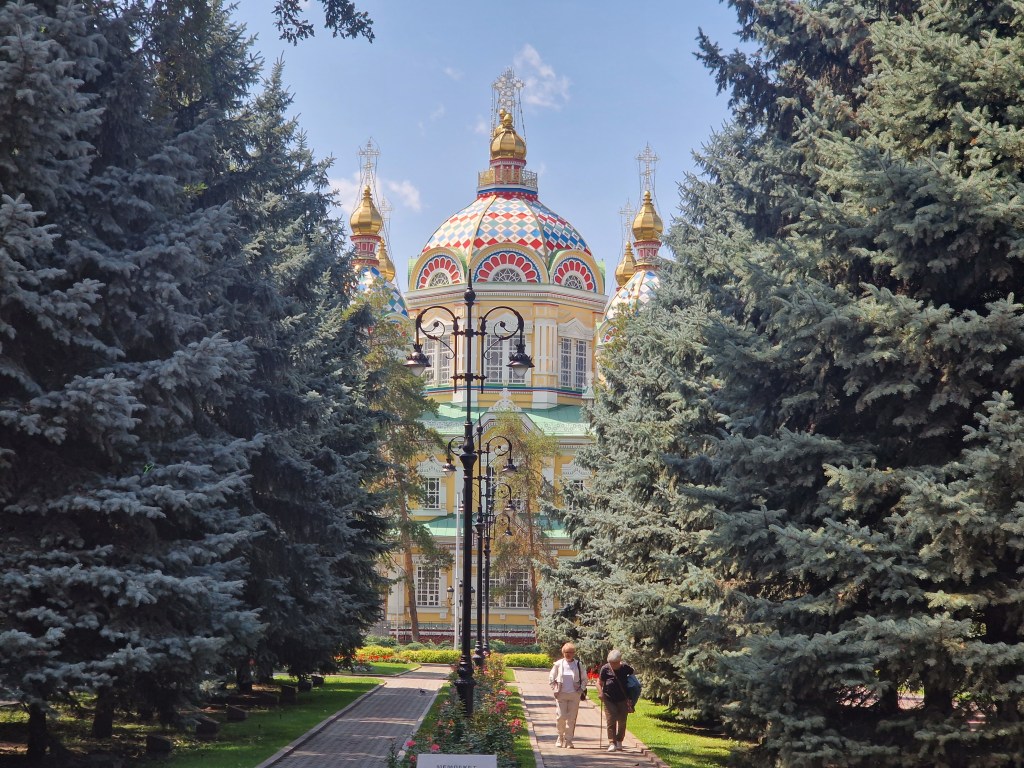
After what felt like an interminably long wait as the bus trundled along the Kazakh highway, only punctuated by the occasional bumpy deviation onto dirt tracks where the main road hadn’t been completed yet, I arrived in Almaty.
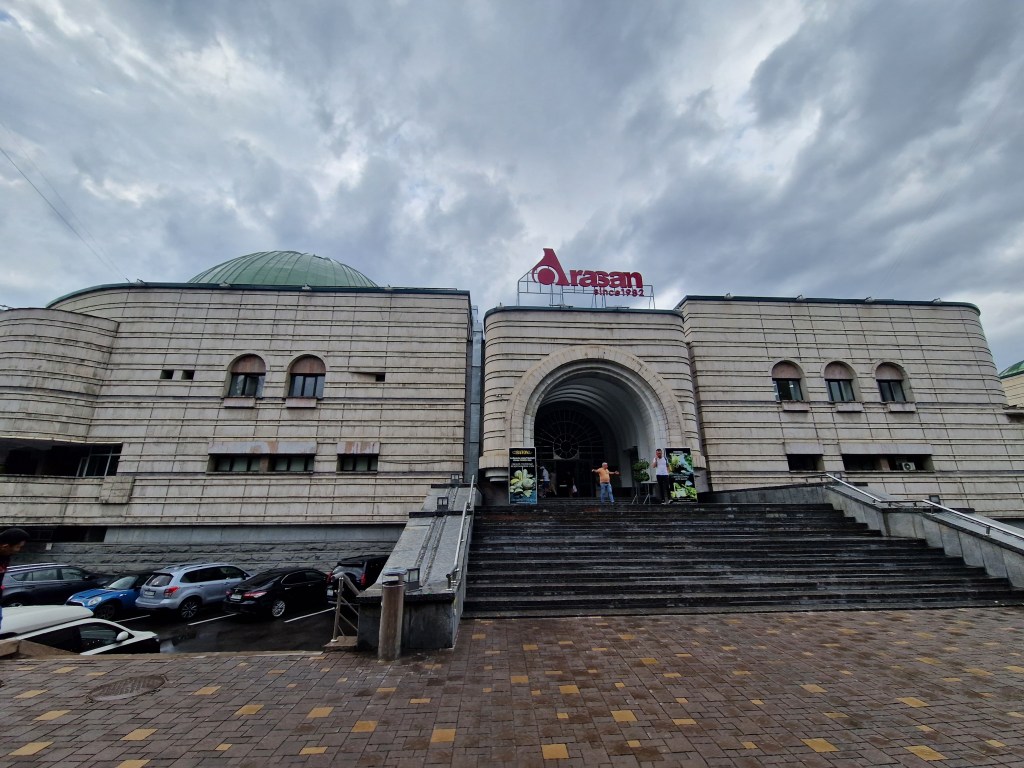
Immediately I was greeted by the imposingly large structure which was Sairan bus station. The differences from Uzbekistan, with its famous Silk Road cities and the ancient architecture within them, were stark. Bright blue majolica tiles had been replaced by grey concrete and, as could be expected of the brutalist architectural style, all aesthetic flourishes had seemingly been removed in the face of pure functionality and an effort to appear as vast and overwhelming as possible.
Peering briefly inside reinforced the feeling that I had just landed in an alien world, extremely far removed from my native Western Europe. Instead, the extensive Cyrillic script plastered over the walls, including those advertising any number of destinations within Russia, meant that the bus station felt like a living relic of the Soviet era, likely still operating in much the same way as it did under the control of leaders as far back as Khrushchev.
“I watched many of the older Kazakh men nonchalantly wandering round naked or with an extremely small towel”
Soon realising that there was little more to be seen in the bus station than sleeping travellers laid across the blue plastic bench seating, I decided to make my exit. Worn down and weary from the endless bus journey across the steppe, I had begun to formulate a plan to bring myself back to life, hopefully taking in some culture while I was at it.
That said, my first stop was a McDonalds (hardly cultural, I know). After such a gruelling journey, I needed some semblance of Western normality, as can sometimes be the way with bus and train rides like these. In Uzbekistan, visiting the golden arches wasn’t an option as it numbered among the few countries worldwide yet to have one open. I was glad for a small (if predictably bland) taste of home. The Kazakh food would come later as I explored Almaty’s cosmopolitan streets further.
The second part of my plan was somewhat more suitable for my surroundings as I made my way to Almaty’s famous Arasan Baths, seeking further relaxation and comfort after being cramped up in a tiny seat on a bus for more than 20 hours.
If first impressions were anything to go by, things weren’t promising. I was greeted by more of the same Soviet era brutalism as I neared the complex, though at least this time stripes had been added as just the tiniest nod to the notion of aesthetic appeal. I assumed that, inside the building, things would be ramshackle, having not been facelifted since it was constructed in 1982. Certainly, that was the feeling I got when stepping inside the bus station earlier that day.
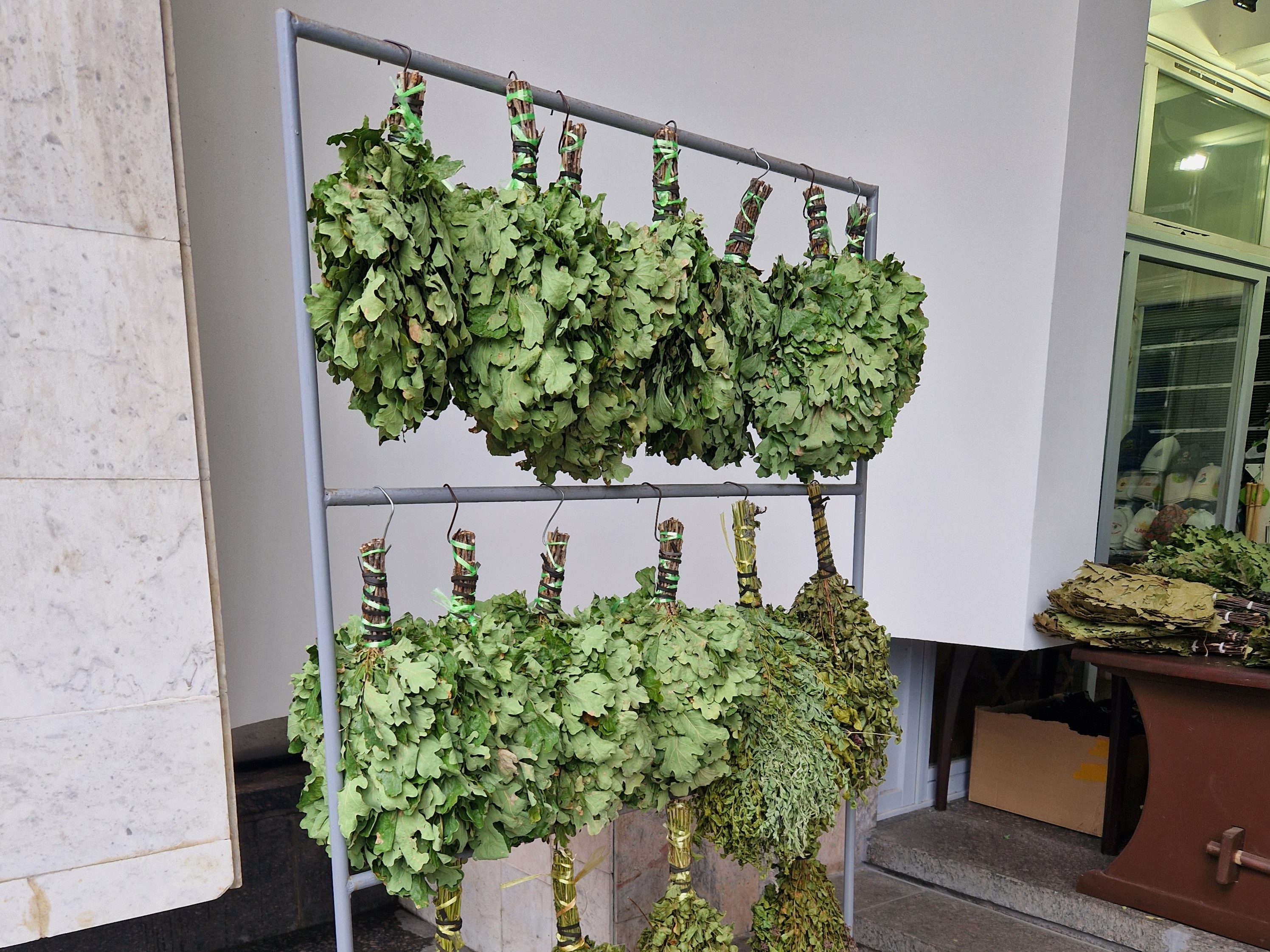
I pressed on, stepping over the threshold, past a stall selling bunches of leaves – something which, at the time, seemed horrendously out of place to me.
Walking into the gender-segregated changing rooms, any preconception of a run-down, creaking-at-the-seams building disappeared. The rooms were clean and had modern lockers, lockable with a key provided at reception. On various shelves and other prominent locations, menus showed the variety of massages and other treatments on offer.
Even so, it was still a deeply unfamiliar and nerve-wracking experience for me, as I watched many of the older Kazakh men nonchalantly wandering round naked or with an extremely small towel wrapped around their (usually quite extensive) waistlines. I had no idea of cultures and customs. It goes without saying that I was the only Westerner I could see. Probably even the only English speaker.
Nervously, and with a towel wrapped around my own waist, I crept around the various rooms, full of men sweating in unbearably hot saunas of various sorts, drenching themselves in ice-cold water or sitting around other pools on benches and chatting. Though it didn’t feel unfriendly, it was even more alien to me than the Soviet era architecture and the journey across the bleak steppe that brought me to Almaty in the first place.
The most popular room in the whole complex was by far the Russian sauna. It was only here that it became clear why the strange stall selling bunches of leaves sat outside, as I was confronted by numerous Kazakh men, topless, wearing pointed felt banya hats and sweating profusely in the heat, while flagellating themselves repeatedly with the bunches of leaves, many of which had come loose and covered the damp floor.
I had to throw myself in. Though I didn’t go as far as self-flagellation, I sat and sweated in the sauna, following it up with cold plunges, further saunas (Turkish and Finnish in case you were wondering) and generally sitting around and contemplating my surroundings.
Truth be told, it was extremely relaxing – once I had suppressed my sense of being an outsider and having no understanding of exactly what was going on, I enjoyed spending time in the saunas and pools as I felt my muscles loosen from the journey the night before.
Leaving the Arasan Baths, not only was I relaxed, with skin softer than you would have expected for someone who had just travelled such a vast distance and airways more open than it would be assumed an asthmatic could manage, but I felt like I had lifted the lid on a deeply intimate part of life in Almaty.
Don’t misunderstand this – I was not about to willingly share a bathtub with a Kazakh stranger (or anyone of any nationality for that matter) but seeing the bathing rituals of a different culture was unexpectedly eye-opening. It revealed to me a people who were still deeply rooted in their traditions and, with the prominence of the baths within the city, proud of it. Maybe it had been worth the journey after all.
 Into The Elsewhere