I have often been told that we know more about the surface of the Moon than the depths of Earth’s oceans. For me, this is a great, unexplored frontier completely separate from the world above the surface even when a few metres below it. Its endless blue mass, stretching beyond human imagination in all directions, tailing off into murky depths and concealing all manner of secrets has been a source of personal fascination and adventure for about as long as I can remember.
That said, the opportunity for exploration only rarely comes my way. I am no James Cameron, regularly exploring the ocean’s deepest and darkest corners with nearly unlimited funds. Instead, I have so far contented myself with scratching the surface and going scuba diving.

This brings me to Jordan – weirdly a country that, until not all that long ago, I ignorantly assumed was landlocked. Indeed, it certainly appears that way on a map to all apart from those with the keenest eyes able to make out its paltry 16-mile seafront.
Travelling on the bus from Amman, the country’s capital, to Aqaba, its southern, coastal city, I slowly became aware of the opportunity to again explore below the ocean’s surface. Little did I know that this would be unlike any other diving trip I had done and for more than one reason.
First, though, (and I apologise) a very quick geography lesson. Basically, Jordan owns a 16 mile stretch of water with Saudi Arabia to the south. So far, so good. Unfortunately, things get a little less good in terms of regional stability when you consider that just across the small Red Sea inlet from Jordan and Saudi is a tiny stretch of Israel, closely followed by Egypt.
“What it wasn’t … was a logical place to go scuba diving”
I’ve said it before and I’ll say it again here: I’m not here to comment on Israel or the war in Gaza. That said, the region around that small inlet of the Red Sea can be best described in one word. It’s tense.
It wasn’t always the case. Though the relationship between Jordan and its neighbours has always been fairly good, it has affected tourism. Nowhere was this more obvious than as I travelled from Aqaba to the dive school in Tala Bay, a cluster of resorts purpose-built to serve a tourism market which has since disappeared.
Where Aqaba was a bustling city, full of busy restaurants, cafés and souks that doubtless will warrant a piece of its own in good time, Tala Bay was a strange sort of attempt at replicating some of the worst elements of Dubai. Empty sand-coloured blocks stood side by side, each varying from its neighbour minutely in an architectural effort to disguise the planned, unnatural nature of the development.
And then when I say empty, I really mean empty. Besides the extremely occasional tourist (who, inside the compound, was able to wander around without worrying about standards of dress unlike anywhere else in the rest of the country), there was nobody around. Lawns were being watered and manicured for the benefit of those who had left for Amman or, more likely, other countries; security points manned to protect absent inhabitants and bars and restaurants standing open and serving nobody.
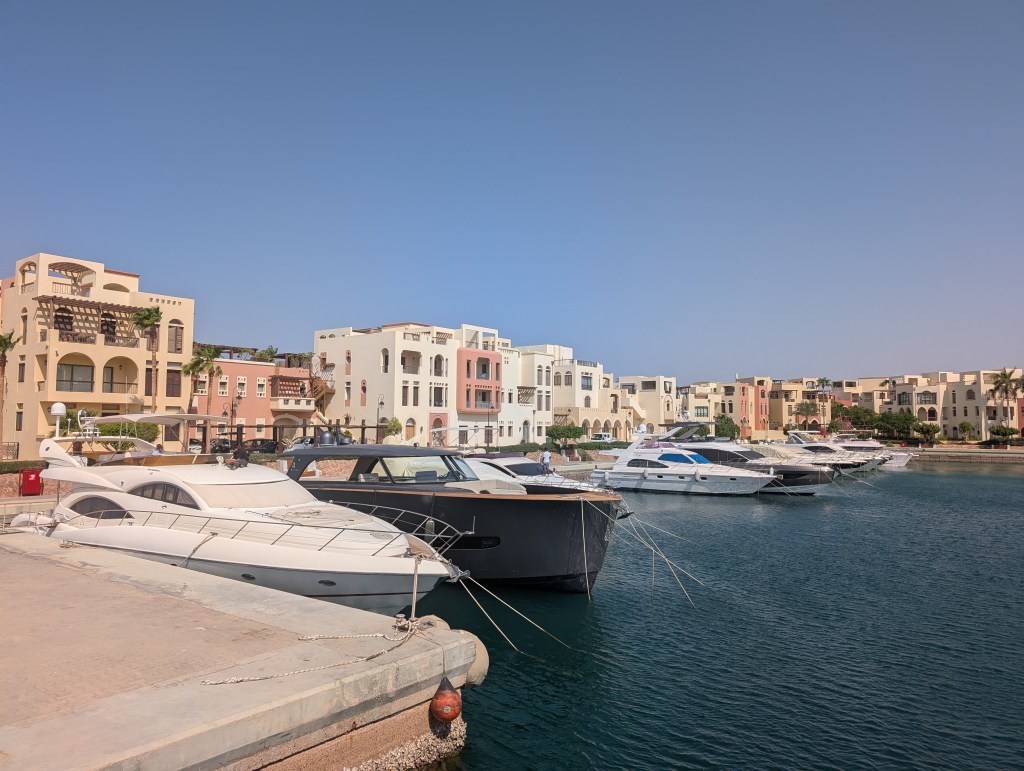
This illusory atmosphere of a place pretending to be something without the people to actually sustain its existence extended to the dive school, as a group of five of us were whisked to a boat fit for 55. Though it was extremely pleasant having such a palatial space to relax in between dives, I couldn’t help but think that this was a region in what struck me as an unstoppable decline.
The reasons for this soon became crystal clear. As we exited the harbour at Tala Bay and headed out into the Red Sea, I almost immediately heard the thumping sound signalling the arrival of a helicopter above us. It quickly transpired that this belonged to one of the four military forces stationed in the area.
The boat crew and dive guides sat there, totally unperturbed by this sudden arrival; it was a regular occurrence in their lives. We were quickly informed that this was, admittedly to my relief, the Jordanian military. The khaki coloured helicopter travelling up and down the inlet was conducting military exercises with a number of small speedboats at the furthest extent of Jordanian waters.
Of course, the idea of a country conducting military exercises was nothing new. All major armies do it, often in contested (or at least contentious) waters, like the US in the South China Sea. There was something about the context here, though, which was entirely different.
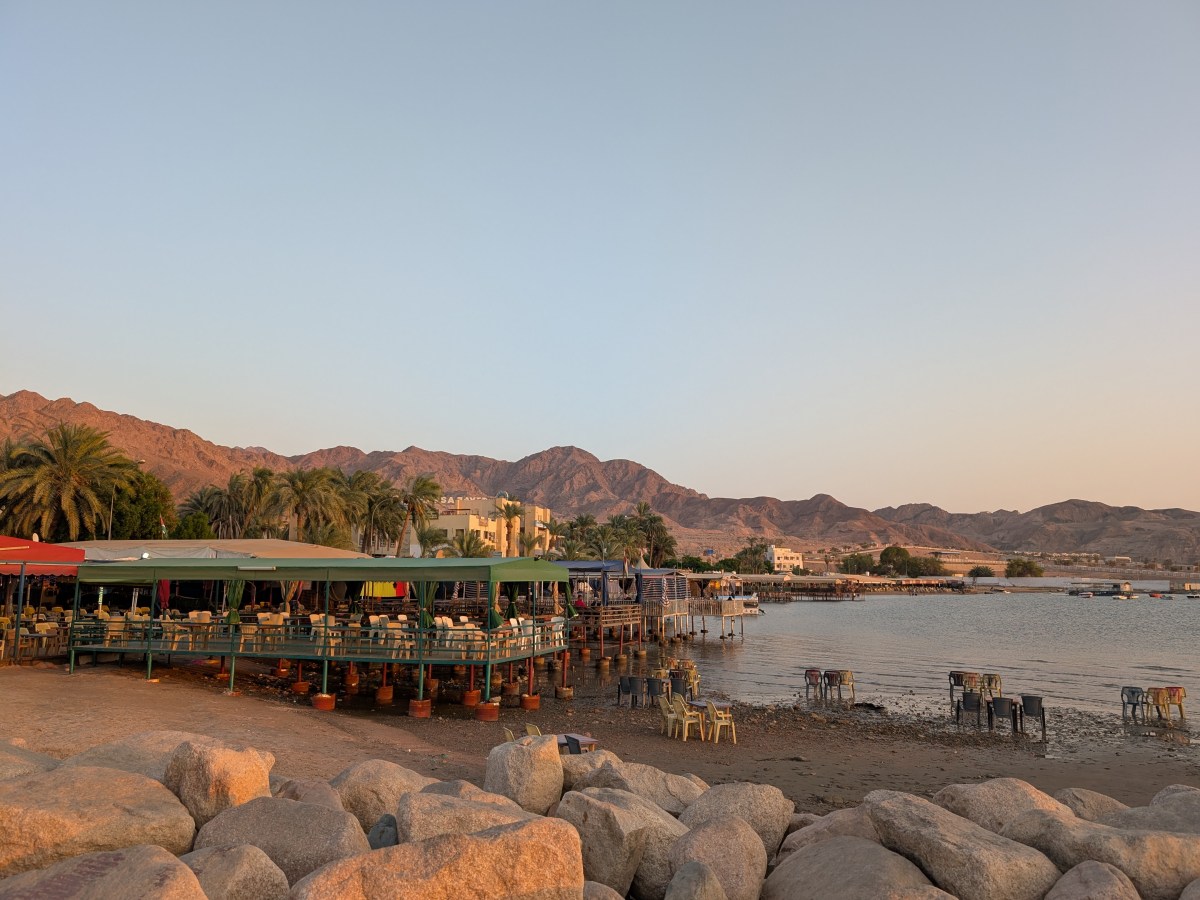
Whereas somewhere like the South China Sea is contested, the exercises can happen far away from the actual landmasses of the countries which each stake claims to the water. In the Red Sea? Not a chance. The inlet that Aqaba sat upon was about 5 miles wide, with both Egypt and Israel clearly visible from the beachfront promenade in the city centre.
This was a deliberate show of Arab power, rubbed in the face of a neighbour who had set a precedent on launching attacks against other states within the region. It was a warning in plain sight of all the people living on the shores of the sea.
What it wasn’t, while I was above the surface at least, was a logical place to go scuba diving.
That said, I soon found myself suiting up, strapping buoyancy devices and air tanks to my back, and then taking one long step off the side of the boat and into the pleasantly warm and clear waters below. Letting the air out of my suit, I slowly sank down to the sea floor, a few metres below the surface.
“Suddenly my guide darted off to the side, the relaxed pace at which we had been swimming becoming more urgent”
Within one metre of being below the surface, the world underwent a dramatic, almost instantaneous transformation. Where the world above the water had been defined by tension and overt shows of strength and power, the world underwater ticked along to a distinctly slower beat.
While I expected that most of the life below the surface would have been scared off by the endless helicopters and speed boats ploughing up and down the narrow channel, incredibly they hadn’t been. Instead, in lieu of large natural reefs, the Jordanian government had sunk a number of old, unused things for coral to grow onto and smaller fish to use as shelter. Among these, somewhat ironically given the situation above me, were a military transport plane and an old tank.
The main thing which hit me though was the sheer abundance of life under the surface. Swimming between old electricity cables that once linked Egypt and Jordan, we came across comically round and flat pufferfish, stripey clownfish and eels. It was a riot of colour, peace and natural beauty.
The serenity of the surroundings made it a pleasure to glide through. Where I was tense and acutely aware of exactly where I was above the surface, I felt my muscles relax below it. I was just a temporary observer of this little-explored world, aware that I would eventually have to surface as the air in the tank strapped to my back was expelled steadily through my mouthpiece as I breathed. Somehow though even this seemed unimportant at the time; I was totally enchanted by the numerous schools of brightly coloured fish of all shapes and sizes passing by me as I swam.
Suddenly my guide darted off to the side, the relaxed pace at which we had been swimming becoming more urgent. I followed, questioning what had caused such a rapid change of pace. Where a movement like this above the surface would have elicited nerves and thoughts of harm coming my way, here I found myself excited at the thought of seeing something truly special under the surface. The difference in my response was down to all of around 15 metres.
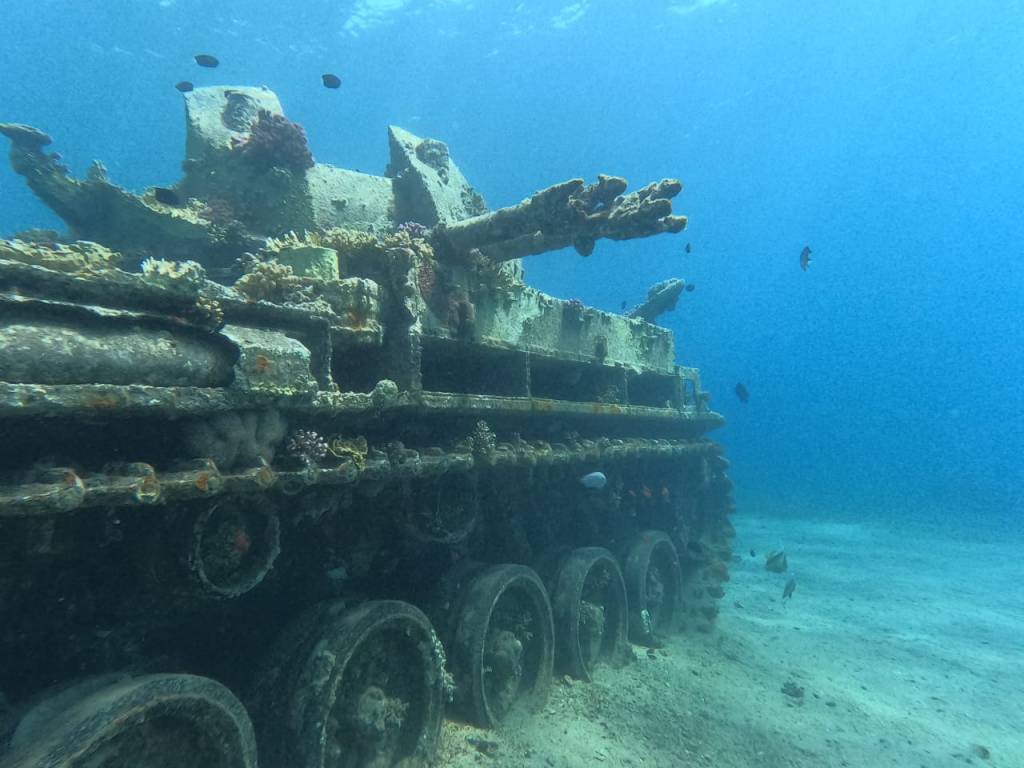
Eventually, I saw what had sparked such a sudden detour from our planned route. In front of me, munching on grass (and seemingly anything else it could get its jaws around) was a large green turtle. Though I wasn’t able to speak underwater, I was gobsmacked.
The creature didn’t seem to care about our presence either, more intent on feeding instead with its head largely stuck down various nooks and crannies. We must have stayed there, floating perfectly in the water and watching it go about its life as usual for a minute or two (it felt like ten, but a minute is a long time when diving).
Coming back up to the surface and the largely empty boat, I couldn’t help but reflect on the extraordinary difference just a few metres made in the world I observed. Where the “human” world, above the surface, was one wracked with tension and all manner of hazards and danger, all of that melted away as soon as I descended below the gently lapping waves.
It went to show how, despite our often misguided beliefs, we only form a very small part of the world in which we live. Though the species I saw did have to live with some distinctly human effects (such as rising sea temperatures), they also lived in a world which we are often unable to touch. As far as I saw it, that was a good thing; we could probably learn a few things from how the multitude of life coexists in relative peace and harmony just below the waves while we conduct military exercises just metres away.
 Into The Elsewhere