The stars were the reason why I travelled to the Wadi Rum Desert in Jordan. The pristine skies, devoid of light pollution, aside from the occasional plane flying across the Middle Eastern sky, lent themselves perfectly to an opportunity to stare endlessly up at the heavens, in wonder at the sheer, infinite vastness of the universe.
My mission to stare deep into the bowels of the universe, often back millions of years at stars which actually, in contemporary time, may have long been extinguished (such were the distances that light took that length of time to travel to Earth), was easily fulfilled. Settled into an extremely comfortable Bedouin-style camp, I ventured a short distance out into the desert to admire my endless surroundings.
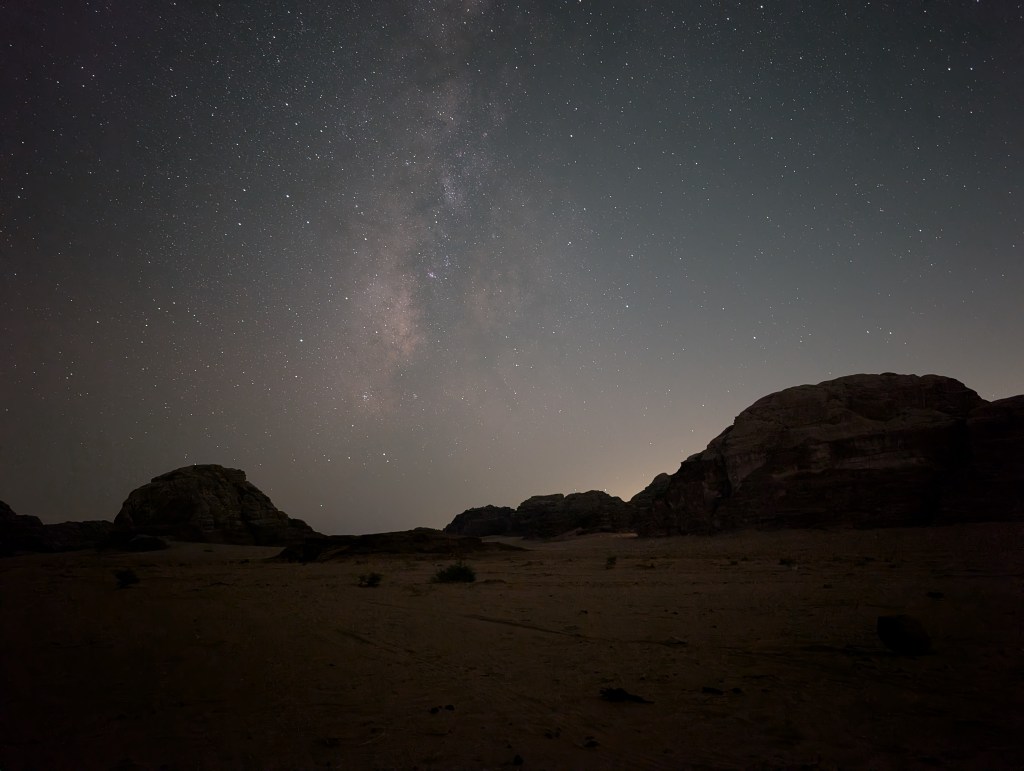
It was, in every sense, vast. The blurry smear of the Milky Way, rising from behind the monolithic stone cliffs, was clearly visible, alongside myriad shooting stars, planets and an incredible stillness and quiet which I will remember forever. Though I undeniably wasn’t alone, with the camp just behind and several others dotted around me, I felt like I was. I felt like I was staring into a portal into the very centre of the universe about which we understand so little. It was a humbling and unforgettable experience in equal measure.
However, to tempt visitors to this national park with its stunning night skies (and to simultaneously extract the maximum amount of cash from passing, and likely relatively well-off tourists) the local Bedouin people, who have called the desert home for thousands of years, have created tour companies selling overnight excursions into the desert, exploring it by day and staring at the sky by night.
“It was truly other-worldly – a landscape which was cartoonish in how obviously it was a desert”
The issue was that I was only truly interested in the latter of the two halves of the trip, ever so slightly viewing the former as, firstly, an exercise in staring at rocks and, secondly, a means to get to the night sky at the end.
This article (from here on at least) isn’t about the night sky upon which I was already sold. Instead, I was more interested in how the locals could justify inflated prices for tours around the desert. This, as much as it may not sound immediately interesting, is an account of an afternoon I spent staring at rocks in a Jordanian desert on a mission to answer a simple question: is it worth it?
Let’s get one of the major Wadi Rum selling points out of the way early on here: if you’re a fan of films set in deserts, it’s likely worth a visit. This was the location in which the recent Dune films have been set, alongside The Martian and Lawrence of Arabia. For film buffs, it’s something of a Mecca.
My journey into the desert started most similarly to the last of those three films: on the back of a camel. As our camels walked out into the monumental wadi (meaning valley in Arabic), I completely understood why this was the place chosen by so many directors for films set on other planets.
It was truly other-worldly – a landscape which was cartoonish in how obviously it was a desert, like something a 5-year-old would produce if asked to draw their take on a desert scene. Aside from Mexican-style cacti, it hit every single cliché.
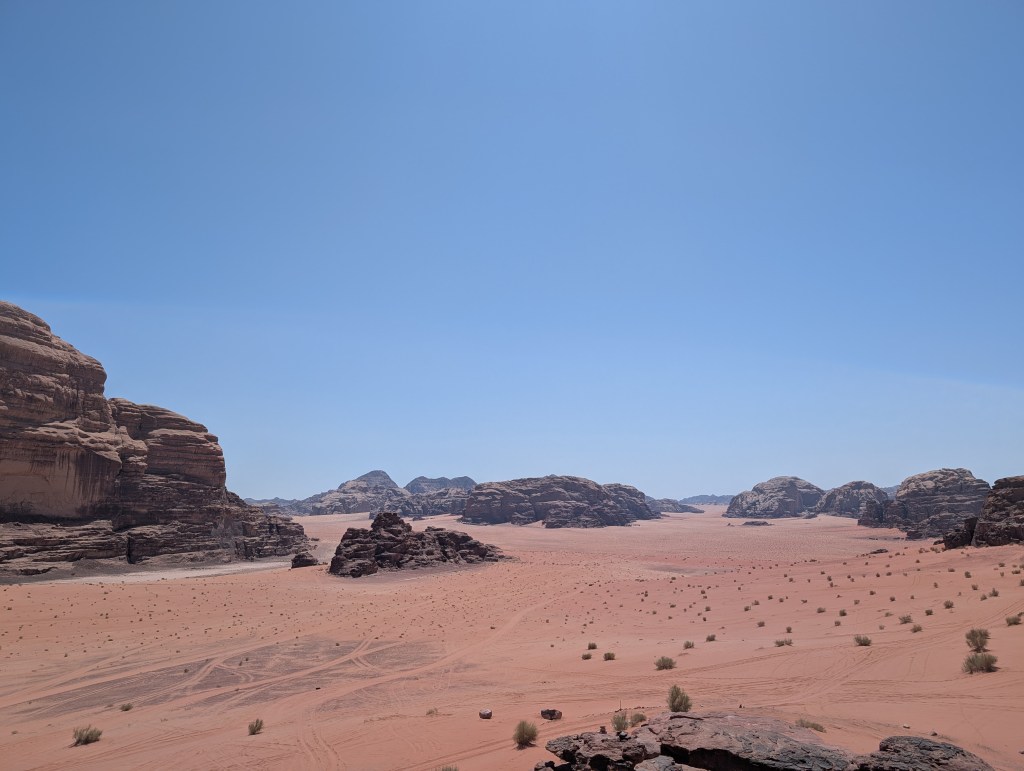
All around rose enormous, red rock mountains, rounded in shape from millions of years of weathering and abrasion caused by the wind whistling between them. The desert floor was covered in a layer of yellow-ish sand, occasionally swept up into small dunes piled against the rock formations above. All that punctuated the totally Martian expanse was the odd camp and scraggy bushes and other plants no higher than knee-level. It felt Martian; certainly a world away from Jordan’s towns and cities.
As the camels slowly plodded along under the harsh mid-morning sunlight, only the occasional passing 4×4 punctured the silence which enveloped anyone setting foot outside of the village. What was more surprising was that there weren’t more vehicles.
This was because, as much as it felt other-worldly, the Wadi Rum was firmly on the Jordanian tourist trail. Considered a highlight in the same league as the Red Sea coast or Petra, it was flooded with over 5,000 tourists a day before the pandemic hit. Since then (and not helped by the war in Gaza), numbers plummeted and haven’t recovered.
“The cliffs, eroded and curtain-like, would relent and reveal stunning vistas out into the desert”
Stepping off the camel and into the pickup which would take us on the rest of our desert tour, this became abundantly obvious. Though we were less than a kilometre from the village which served as the gateway to the desert, most signs of civilisation had evaporated. We were told we were at Lawrence’s Spring (something which the guidebook later pointed out as potentially false), where a larger Bedouin tent had been set up to serve as a tourist stall and café.
Even here, so close to the village and the outside world, the tent stood largely empty, with dusty scarves and other trinkets left untouched by curious tourists for years. The many benches in the café section of the tent stood similarly empty; a monument to more lucrative days gone by which had failed then to adapt to the new reality which Jordan faced as I visited.
There was an obvious and selfish advantage to this: the rock formations which I was so dubious about visiting were at least empty as we were driven between them. Even though, somewhat frustratingly, all the tour companies seemed to follow the same route as one another, snaking across the desert floor in a train of white Toyotas and Mitsubishis, the illusion of isolation in the vast desert expanse could just about be maintained.
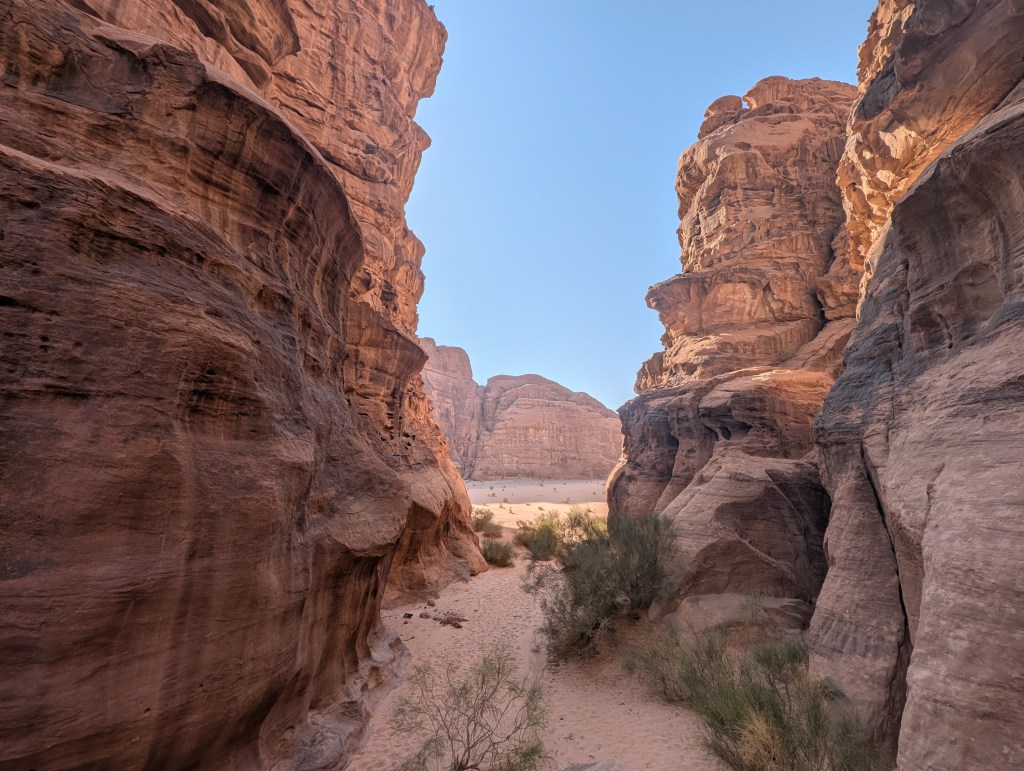
Nowhere was I more thankful for this than when we were offered the chance to walk up various smaller wadis by our Bedouin guide and driver (who, as it happens, must have been around 15 years old). This was where the desert was at its most dramatic, as the high cliffs narrowed claustrophobically to the point where I thought the passage would result in a dead end. Then, just as I was ready to turn back, the cliffs, eroded and curtain-like, would relent and reveal stunning vistas out into the desert.
Having this experience without many other people milling around and fighting for the best photo spots certainly helped a lot. Unfortunately, though, it wasn’t the case at all of the places we were taken to as part of the trip.
Chief among these were the two rock arches which were among the best-known places in the desert. Here, people were allowed to climb up onto them, with the many guides down below clutching their clients’ phones and waiting for the moment the queue of waiting tourists finally spat out the one they were working for, so that they could take the photo which would inevitably appear front and centre on their Instagram page.
That is not to say that the rock arches weren’t hugely impressive. Cathedral-like in their scale, they also had a delicate appearance; an impossibility in their continued existence when it certainly looked like they should have crumbled long ago. If they were as secluded as some of the wadis we had been taken to earlier that day, I had no doubt that it would have been a highlight.
Instead, the highlight was surprisingly close in nature to the stars that brought me to the desert in the first place. Straight after visiting the largest of the arches, we were driven with more urgency than usual back out into a desert landscape as large as any we had seen up until that point. Perched upon a smaller outcrop looking over the expanse, the sun slowly set towards the horizon in front of us.
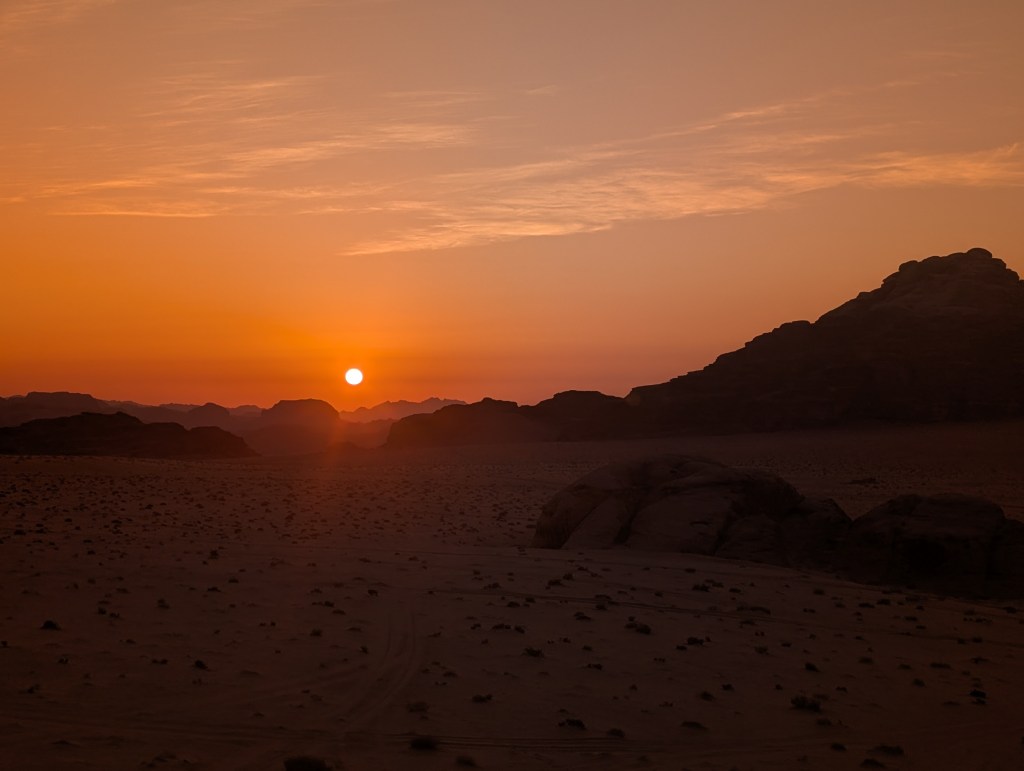
As I sipped tea which had been hurriedly prepared for us, the desert turned a deep red, with the rocky mountains silhouetted against the darkening horizon. As much as the night sky was unforgettable, there was a greater majesty in the stillness around us as the day came to the most dramatic end imaginable.
Though I had undeniably enjoyed the day travelling around the Wadi Rum Desert, I only truly understood the virtue of the day tour right at the eleventh hour of the day trip, watching the sun set. It wasn’t really the rocks themselves which had drawn me in, but how they interacted with the wider environment of the Wadi Rum, whether it was through magically revealing stunning landscapes at the end of narrow passages or reflecting and enhancing a sunset which was among the best I had ever seen.
Yes, the stars were still the highlight of the trip. Nothing (for me at least) will ever match the ability of a night sky to leave me in total awe, straining my neck and wondering at how small and insignificant we truly are as a planet. That said, in the desert, rocks had never been so interesting.
 Into The Elsewhere