I have always hated waking up early. However, up in the Tian Shan Mountains, after a restless night in a claustrophobically small yurt shared with two other hikers, it was a necessary and unfortunate evil. Though the first day of my hike had been reasonably successful, I was still nervous on day two as I was set to push on higher than ever before.
This is the second part of a two-part article. To read part one, please click here.
When the 6am alarm went off, I slowly rose with bleary eyes and made my way across the litter-strewn camp which – were it not full of yurts and up at 3,500 metres – could easily have been in a British festival site with the amount of plastic and other rubbish scattered around. The ground was wet with morning dew, which glistened gently under the morning sun.
“Every two steps I was taking forward and upwards, the mountain would reclaim one”
For most hikers on this route, this would have just been the first of two nights up in the mountains on the trail. Short of time, I knew that wasn’t a possibility for me and, as such, I had decided the best plan was to hike as soon as possible to the peak of the Ala Kul Pass at 4,000 metres and then make my way back down the valley I had walked up the previous day. Again, this was going to be a journey of personal growth and discovery.
The initial signs were ominous. Looking up from the camp, I could see only endless, scree-covered slopes, steep enough to require walking poles and a level of skill I was unsure I possessed. All I was armed with was a sense of determination to push on, reaching the ultimate goal of the pass’ highest point.
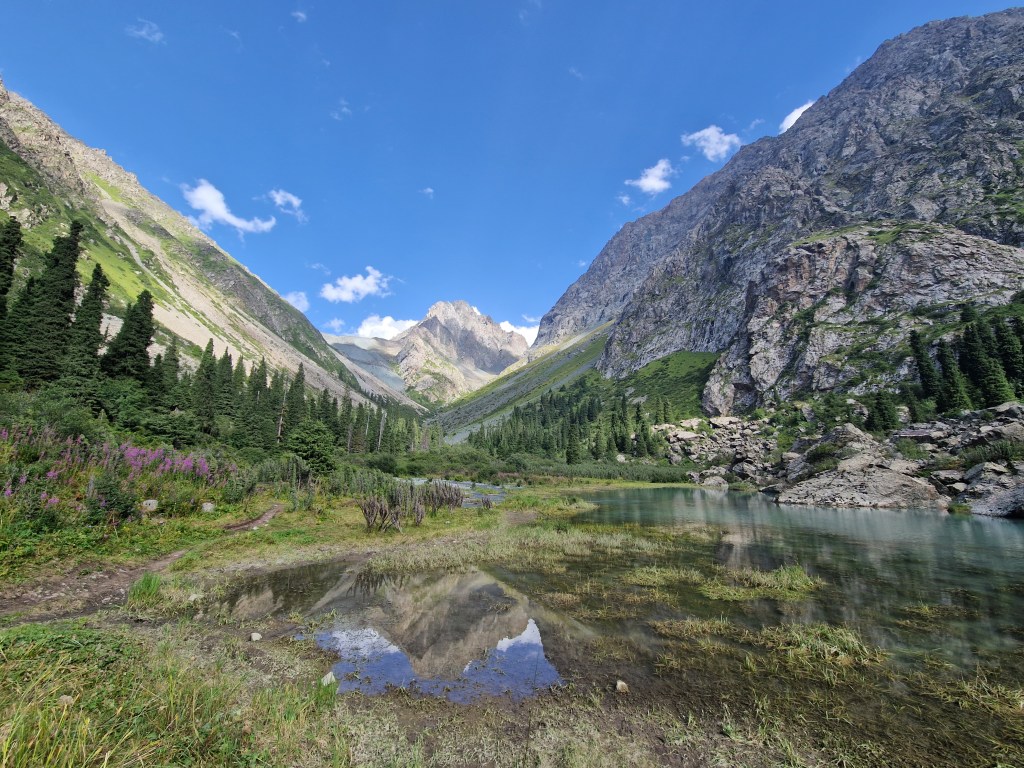
After a basic and less-than-filling breakfast, I set off past a lake which perfectly reflected the mountain peaks around it. This was another reminder of the sheer, rugged beauty of Kyrgyzstan and helped to dispel some of my nerves about climbing to such high and unfamiliar altitudes with little to no support available.
The slope felt even steeper than it looked. As it rose up out of the woods the dark grey shale crunched loosely under the weight of my walking boots. With the gradient, it felt that every two steps I was taking forward and upwards, the mountain would reclaim one and push me back towards the camp I had just left. At the altitude, it was exhausting work.
It was also getting colder as I ascended. Wearing just a pair of shorts on the exposed slope, I began to feel the wind whip between my legs and around my shins. Acutely aware of how inadequate my kit and preparation was at such an altitude, I tried my best to keep my head down and make quick work of the scree, which crumbled and sank beneath my feet as I went.
Passing a large, black boulder, I felt the ground slowly even out and the going got easier. The path was more defined and easy to follow – a sure sign that the scree slopes were coming to an end for now and I was finally approaching Ala Kul Lake.

This electric blue body of water, surrounded on all sides by more steep scree slopes which rose into mountain peaks, was as beautiful as it was bleak. There was no vegetation; the only green objects in view were a couple of fluorescently coloured tents, with their inhabitants getting ready for another day’s trekking nearby, heating some water and brushing their teeth.
I felt relieved and grateful in equal measure to be able to survey such an alien landscape. This was a frontier which few humans would have ever had the chance, let alone the willpower, to experience. All the same, I had made it. Sitting on another large boulder overlooking the lake, I admired the stillness of it all.
By this point, the mountains had had an enchanting effect on me – I was drunk on the sense of achievement and a feeling of being closer to the sky, quite literally above most other people and in a space most of them would consider extreme and uninhabitable (or at least certainly by Western standards).
Even so, I wasn’t even halfway there, with a climb up onto the pass above the lake to come, followed by the descent all the way back down to the trailhead, where I was hoping to be able to find transport back to Karakol. What was worse was that the weather was beginning to close in around me.
“There was a sense of serenity which was different to the windswept upper reaches which I had just about grazed”
While I had been focussing on ascending the scree slope to the lake as quickly as possible, the sky had turned from mottled blue and white to a distinctly darker shade of grey. All too aware of the reputation of areas such as these for instantly changeable weather (and with the storm that hit the day before my hike still clear in my memory), joy quickly turned to concern.
In essence, I didn’t have the right kit if it did rain. I had picked up a packable waterproof jacket in Bishkek but was short of waterproof trousers or a hat and gloves if things really got serious. With my brain in overdrive, many of the pre-hike thoughts of dying of hypothermia on the side of an exposed Kyrgyz mountain sprang back into my consciousness. As much as I wanted desperately to push higher for what promised to be an even better view, I can’t say that I fancied the potential consequences of doing so.
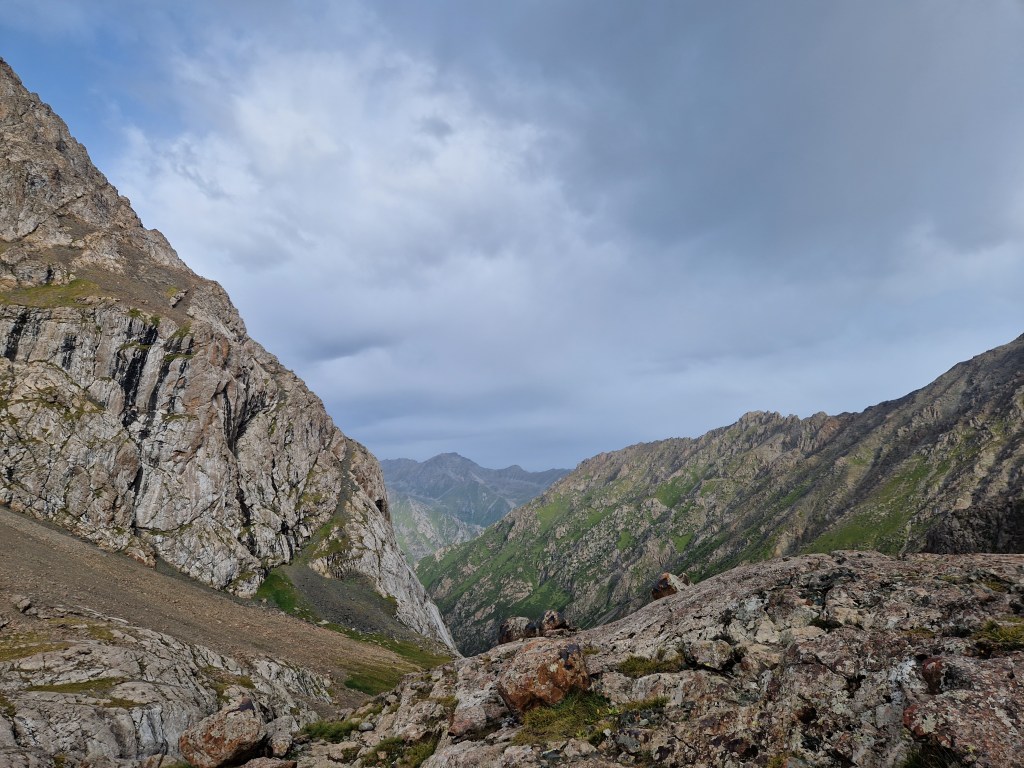
Ala Kul Lake was as far as I was going to go. Even this was possibly too high with the weather closing in and a dangerously steep scree slope to descend without any form of hiking poles or other support or stabilisation. With the complete lack of vegetation around me, the possibility of picking up a stick was also nil.
Instead, much of the descent was completed awkwardly, often on all fours as I bent over backwards to reach the occasional small rocks at the side of the path which looked stable enough to prevent me from rolling down the side of the mountain in a cloud of scree and dented pride. It was slow work, made harder by the still gathering clouds that demanded urgency that simply wasn’t possible in the circumstances.
Almost as soon as I descended off the exposed slopes leading up towards the lake, the sky began to brighten and the chances of rain or any form of storm evaporated. This left me with mixed feelings as I traipsed past the camp where I had spent the previous evening. While on the one hand, I looked set to remain dry, healthy and (most importantly) alive, I felt like I had blown the chance for something greater than what I had experienced. Though I knew that I had probably made the right decision, I was gutted to have not rolled the dice.
As much as I had been sold on the idea of hiking, I knew that I wouldn’t return any time soon to see the best of the Kyrgyz mountains. The opportunity had slipped through my fingers.
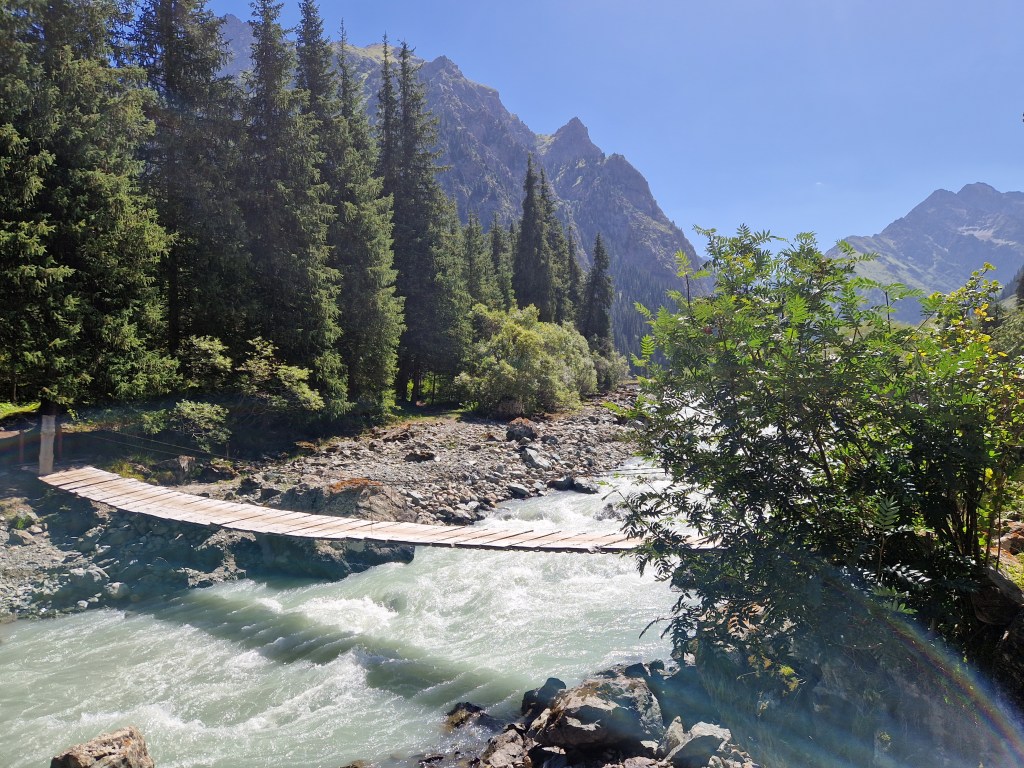
I soon descended back down to the valley which I had spent most of my time walking up the day before. At the river crossing which signalled the start of an easy walk back to the trailhead, I took some time to stop and buy a beer from a stall by the bridge.
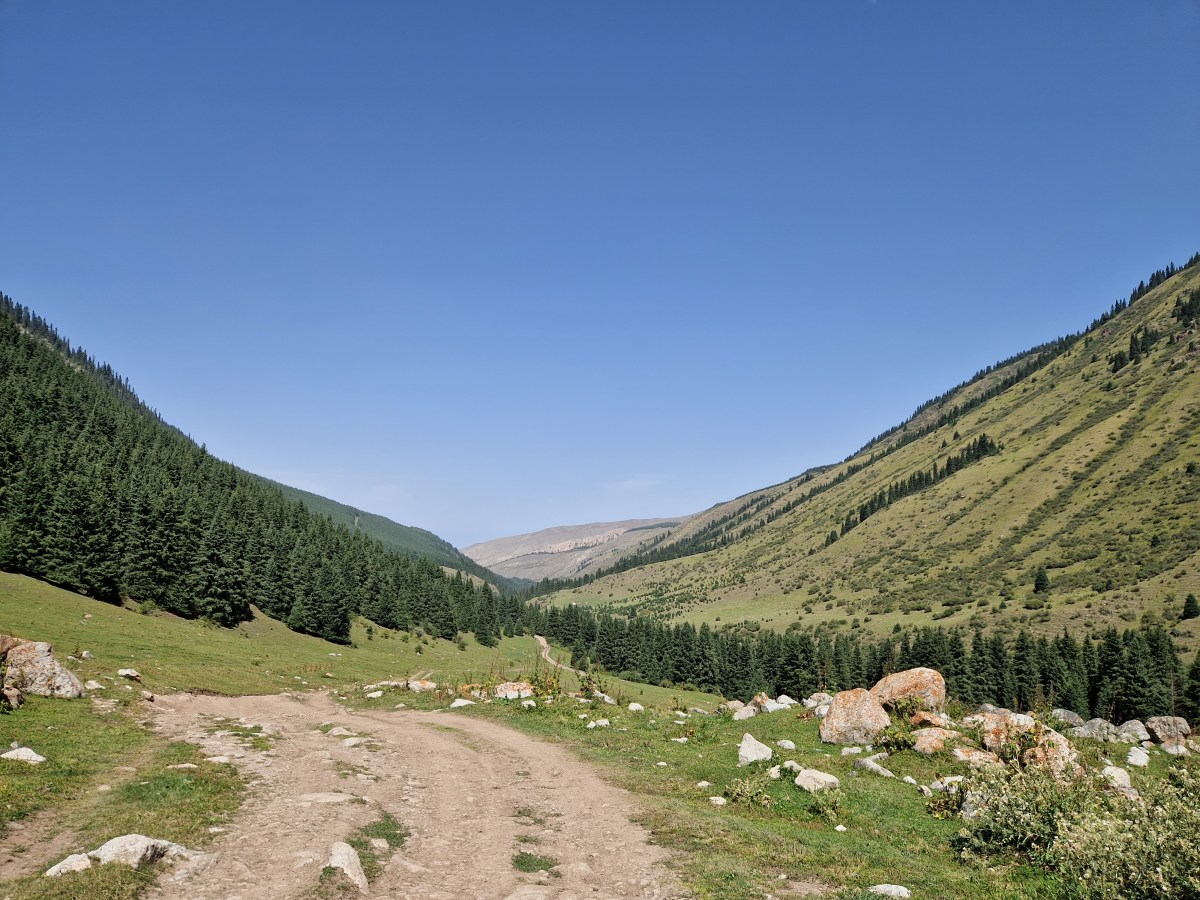
At this lower altitude, the mountains seemed to rise up much higher around me. Shrouded in pine trees, there was a sense of serenity which was different to the windswept upper reaches which I had just about grazed. In many ways, I preferred the valley floors to the mountain passes – they had a greater variety and sense of life to them, with wild horses grazing in meadows, birds singing in trees and abundant greenery all around.
This didn’t stop it being a long walk back to the trailhead, where I was hoping there may be a jeep which was waiting to pick up hikers and take them back to Karakol. I could slowly feel my daysack get lighter as I consumed its contents, quickly making my way through large amounts of water in the warmer weather at lower altitude.
As I reached the trailhead, I was alarmed to see that it was completely devoid of life and, more importantly, any sort of vehicle to take me back to the safety of my hostel. Low on supplies, this was bad news. All I knew was that I had to keep on trying to make progress back to the town. With just the last few dribbles of water left in the bottles I had brought, I set off along the road, resolving to try and hitchhike where I could for the ten or so kilometres back to Karakol.
After around half an hour of wandering down the dusty road, wheeling around on occasion to stick a thumb out in the direction of my destination, I finally got lucky as a brand new BMW 4×4 stopped about 20 metres down the road. Shocked that by far the nicest car that I had seen on the road was the one that had decided to pick me up, I was more than grateful for the lift.
For me, this final experience was illustrative of the whole trip. In all, I had undoubtedly fallen in love with the mountains, gaining a deep appreciation for their ruggedness and undeniable beauty. Even so, I knew that, the next time I was going to face them, I had to be better prepared. In short, I felt lucky that I had been shown some sort of mercy at the hands of such overwhelming natural forces. I was badly (probably criminally) underprepared to embark on a hike like this, especially without a guide or even hiking companion and, in return, I felt like I had been issued a warning shot. I also knew I would be back – this was just the beginning of an addiction which has stuck with me ever since.
 Into The Elsewhere