Tourism changes places. Whether you’re talking about the recent backlash against the endless hordes which descend on the Spanish coastline each year or the steady evolution of Vietnam from war-torn to backpacker hotspot, it is clear that there are both positives and negatives to the change, development and, occasionally, disruption that foreign visitors can bring.
When tourism grows in a place, it has the ability to divide. There will be inevitable winners and quite a few losers from such a boom – those involved in tour guiding, running restaurants or stalls close to big attractions will almost certainly benefit while others, living just a little too far away or too slow to grab a piece of the pie, likely won’t.
“The manner in which Jerash reveals its Roman ruins to a visitor is hardly subtle”
Nowhere was this as starkly demonstrated to me as in the city of Jerash, just a little bit north of the Jordanian capital city, Amman.
The reason why Jerash ended up stuck in my memory in such a way was the sheer physicality of the divide. The touristy part of the city was separated from a distinctly more Arabian-feeling half by a large canyon. The thing was, though, that I wasn’t entirely convinced that the side which I was supposed to spend most time on (as a tourist in Jordan) was necessarily the most interesting.

To explain why, though, it’s necessary to tell the story of why I ended up in Jerash in the first place as, frankly, it’s no ordinary Jordanian city. Instead, it’s built around some of the most extensive and best preserved Roman ruins in the whole of the Middle East. I would be lying (and perhaps a bit delusional) if I tried to claim that I went to the city for any other reason besides the opportunity to marvel at what remained nearly 2,000 years later.
The manner in which Jerash reveals its Roman ruins to a visitor is hardly subtle. Almost immediately as I entered the city, the enormous Hadrian’s Gate stood around three storeys high on a mound. At one point, this marked the formal southern entrance to the Roman city and it was appropriately imposing for the job.
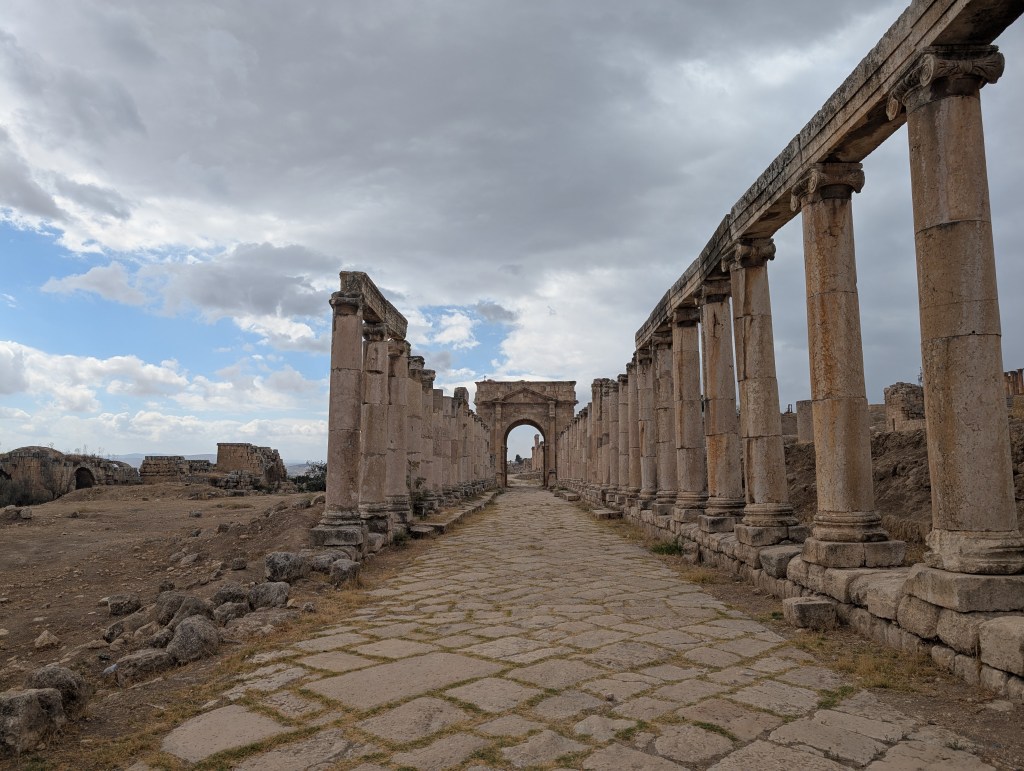
Walking through the gate, the city opened up before me as the landscape was dotted with ancient, colonnaded streets, a hippodrome and marketplaces. I can’t profess to be particularly knowledgeable about Roman history but the scale of the building was spectacular enough to immediately encourage me to go and explore more. Crossing a circular public space, I quickly found myself amongst some of the largest ruins, first of the Temple of Jupiter and then a semicircular theatre.
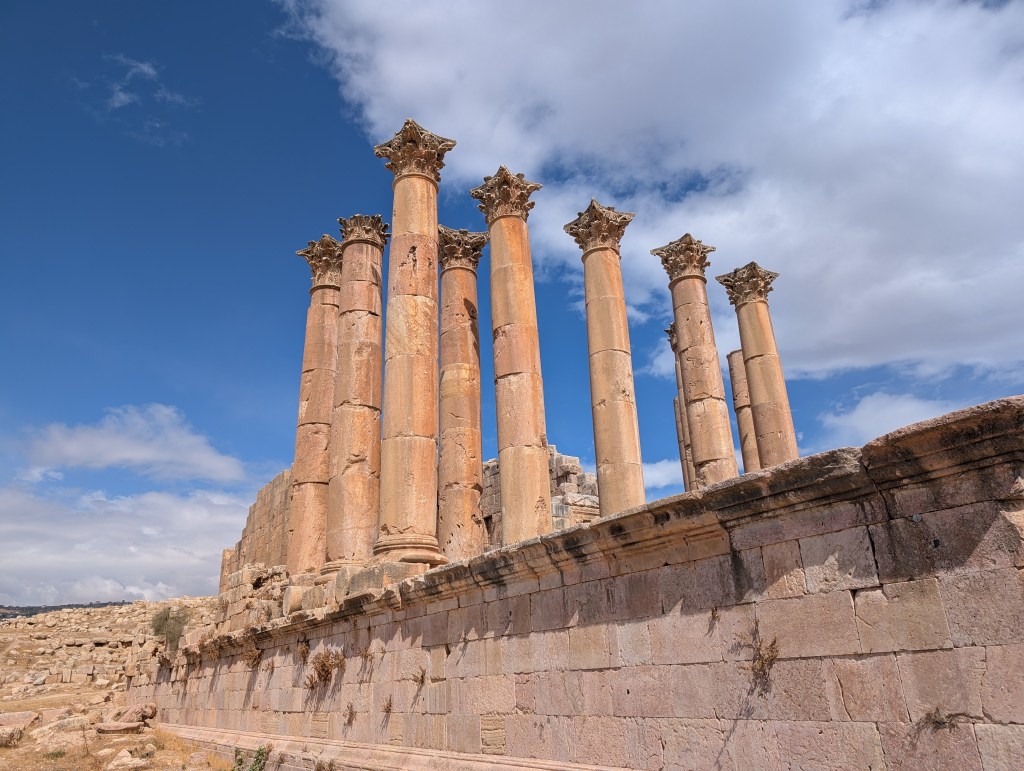
These were structures which, even by today’s standards, were impressive. Much like I would have done if I was visiting a medieval church or modern skyscraper, I found myself craning my neck upwards to marvel at the scale and solidity of the columns and walls that seemed to soar impossibly into the air. That they had stood for over a millennium in an area which wasn’t immune to seismic activity was even more remarkable.
At another temple (The Temple of Apollo), it was explained how these columns had withstood so many years of abuse, both human and natural. As it turned out, the sections of the columns weren’t actually fixed to each other with any form of mortar; instead they were held together by pins and holes along their centrelines. In the case of strong winds or earthquakes, this allowed them to sway, staying standing through all that was thrown at them.
It was small elements like this which brought a touch of life to the otherwise fairly desolate site, even if it was spectacular in its scale and preservation. In many ways, I wished there had been more moments along these lines to begin to explain more of the living history (and perhaps that was slightly down to me being stubborn enough to refuse to hire one of the many guides offering their services at the entrance gate).
As it happened it left me in awe of the Roman engineering capability without encouraging me to stay longer than was necessary to explore the site. Sure, the sewer system as well as how drinking water was supplied to the inhabitants was impressive, as I read the written explanations on boards around the site. However, it wasn’t the sort of place which I was yearning to sit down and have a coffee in, watching the world go by as I did.
Though it physically existed as I visited, it was almost completely devoid of human presence and dynamism. As the Romans had died as a civilisation, ancient Jerash had gone with them.
This was the difference between Jerash and somewhere like Rome. In Rome, the modern city was built upon and around the Roman ruins and provides a second lease of life to so many of the sites. In Jerash, the Roman ruins felt entirely separate from the modern city due to the large canyon dividing the two (with only a bridge first constructed by the Romans to connect them).
Glad to have visited the Roman half of the city yet also wanting to see a little more, I walked across the bridge into the newer, Arabian half.
As soon as I crossed the bridge, the atmosphere around me changed completely. Where the Roman side was (in human terms at least) dead, the modern half of the city was alive and bustling with human activity.
“Finding a place to eat was as much a stab in the dark as buying a lottery ticket”
The streets enveloped me as I walked through them, with buildings closely packed in and shops spilling out onto the pavements. This left little room for pedestrians, who wove between stacks of fruit and vegetables and cars which were often brought to a standstill by the narrow roads and the sheer number of people going about their business on foot.
While exploring the Roman ruins had been sedate, slow even, this was almost overwhelming in how raw it was on my senses. Above the general hum of people, car horns occasionally blared. Skipping past various street-side obstacles, my sight was drawn to butchers cutting up lamb carcasses as they hung gorily in large shop windows. The smell of animal flesh slowly decomposing in the Arabian sunshine mixed with petrol fumes and clouds of sickly smelling steam from shisha bars.
Among all of this, I quickly realised that I was entirely out of my depth. It was approaching lunchtime and, on a mission to find food, I found I had no hope of reading any of the Arabic only signs. This wasn’t like in other areas where it was supplemented by English for the benefit of people like me. This was a place where few foreigners ventured.
Finding a place to eat was as much a stab in the dark as buying a lottery ticket. The only evidence for anywhere being a restaurant to a non-Arabic speaker was the presence of the odd counter in a shop which was open to the street front. Seating in all places was upstairs and, I could only imagine, segregated as was often the case in more traditional and conservative Jordanian restaurants. There was little to say “restaurant” from street level to the uninitiated.
Having ordered a chicken wrap at a restaurant which I didn’t know the name of and sat down in a position overlooking a particularly chaotic intersection, I had no idea what to expect. The presence of a smattering of other locals in the same room was hopeful that the food may at least be edible. Whether an episode of food poisoning would ensue afterwards was a very real concern.
In reality, I need not have been concerned. The wrap was undoubtedly one of the best which I had in the whole of Jordan – the perfect balance of crunch from the toasted bread and salad, with sourness from pickles, a touch of sweetness from the houmous and the rich chicken bringing it all together.
Though I had come to Jerash explicitly to see the Roman ruins, it was this experience on the newer, Arabic side of the town which stuck much more vividly in my head. Undoubtedly, the structures built by the Romans were more spectacular than the two- or three-storey blocks put up by the city’s more recent inhabitants. However, Jerash showed the importance of people in bringing a place to life. Without people, the ruins had seemed sterile and, despite the spectacular architecture, even bland at times.
The huge variety of the new town, with different people busily going about their lives in plain view of the rest of the world, was so much more compelling to me as a tourist. In a sense, it’s a shame that my girlfriend and I were seemingly the only people there from outside Jordan. The other tourists visiting Jerash stuck firmly to the Roman side of the canyon which divided the two halves, concentrating the benefits of mass tourism into an extremely small area and remaining totally oblivious to the gloriously chaotic streets just metres away across the divide.
 Into The Elsewhere