After an hour of walking, I plucked up the courage and said it. I asked the tour guide, “What’s your opinion on Slobodan Milošević?” I braced for verbal impact. My Serbian guide paused and smirked a little, before delivering an opinion that he had doubtless been asked for before by other overstepping and nosy Western tourists.
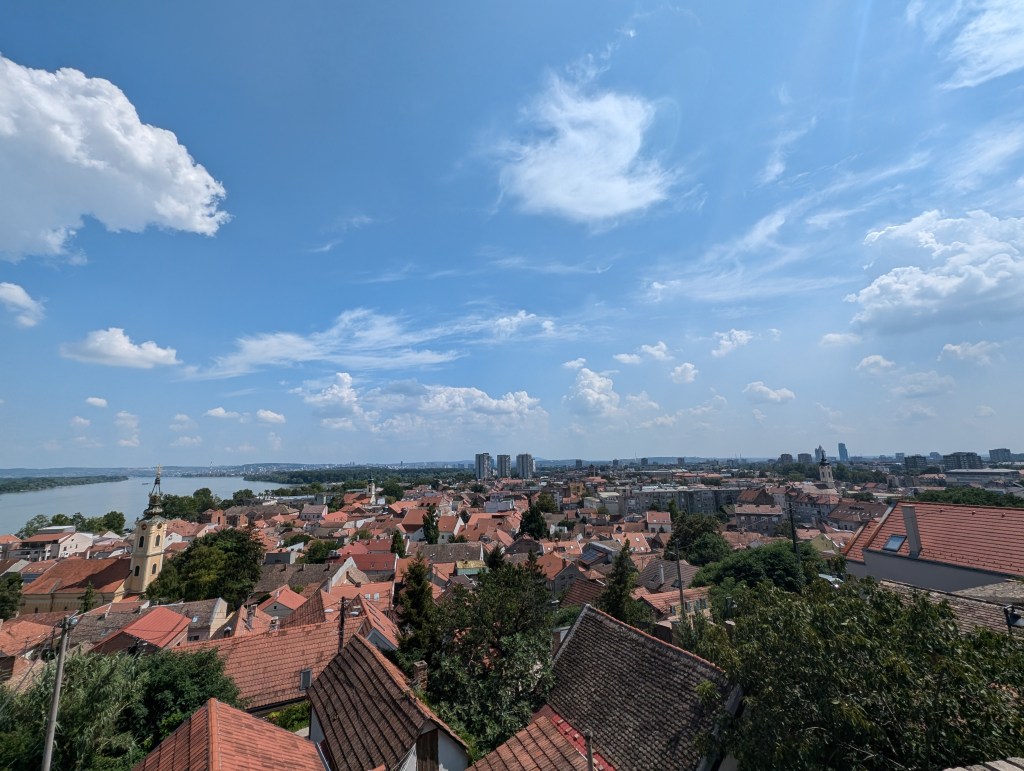
I was in the midst of a walking tour around the streets of Belgrade, the Serbian capital. To date, this is one of the very few places on European soil to have felt the destruction caused by a full NATO bombing campaign, during the Kosovo War in the 90s. This was no rash decision either; the Serbs, fresh from their heavy involvement in the Bosnian genocide, had marched into neighbouring Kosovo and were threatening a repeat performance. The Serb (or, at the time, Yugoslav) leader? Slobodan Milošević.
“My question wasn’t entirely dissimilar to asking a German what they thought of Hitler”
My question wasn’t entirely dissimilar to asking a German what they thought of Hitler. Of course, in Germany it would more than likely have caused upset, embarrassment and general awkwardness, something which I’m always keen to avoid in a foreign country. In fact, considering the size and doubtless strength of my burly and slightly gruff Serbian guide, this really was best avoided here.
Still, I asked. Milošević was an objectively reprehensible human being, having been tried for crimes against humanity among other things (during which he died before a verdict was reached). As much as there is never a correct answer to a question like mine, the answer was obvious.
“I thought he did a lot of good for the country”, my guide calmly and matter-of-factly replied. I beat a hasty retreat back into the massed group. Conversation over before it started.
It seems that the obvious answers aren’t always the ones you get.
As much as the answer to my question was shocking, it was unfortunately representative of a general atmosphere that I picked up during my few days in Belgrade. That is not for a moment to suggest that this was a country which celebrated war criminals, just maybe one which had decided that the best route to the future was to paper over the cracks rather than pursue full reconciliation with the past.
As much as there were clear negatives to this approach, as I had just found out during my non-conversation, it had also become abundantly clear what the benefits were. This was a city which was firmly focused on the future, looking to establish itself as one of Europe’s premier capital cities, to rival the likes of Budapest or Prague.
The best example of this future-focussed attitude was an evening spent on the banks of the Danube, in the shadow of monolithic grain silos that had been built during the days of Yugoslavia as part of a wider industrial complex.
In many cities, somewhere like this would be a wasteland. If the silos themselves hadn’t been demolished, they would have stood on the riverbank and slowly rotted as a decaying monument to a better and more prosperous time. This was not the case in Belgrade. Here, the 28-metre-high concrete cylinders were covered in bright street art, totally at odds with the grey surrounds.
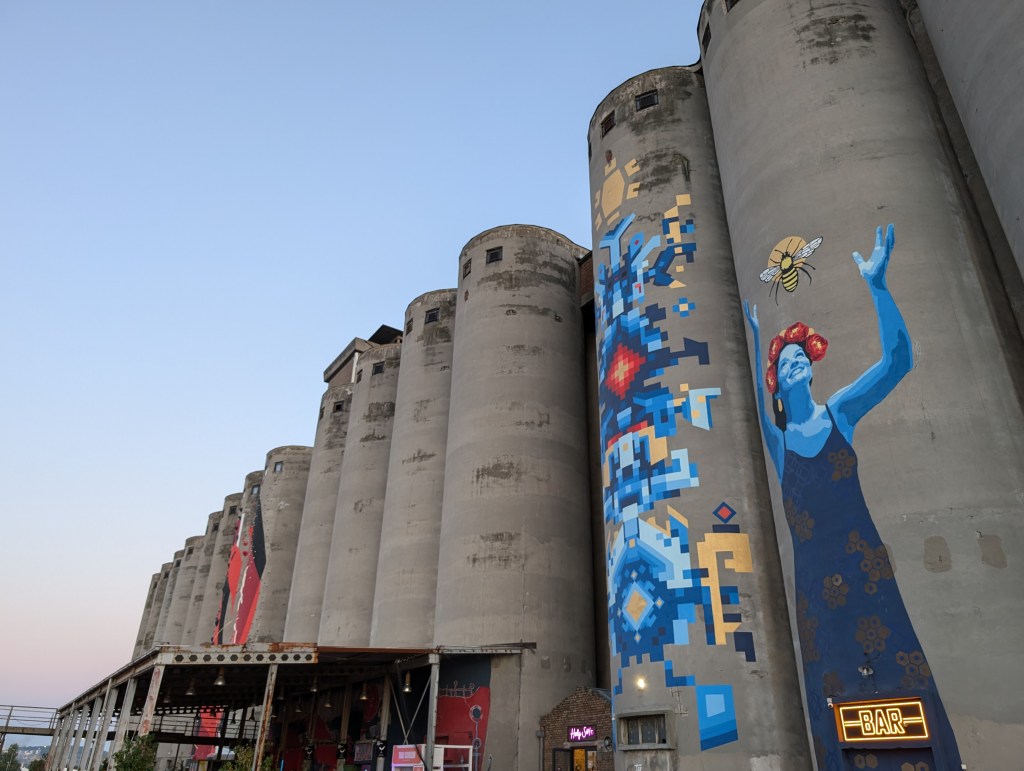
Below this, shelters had been made from rusted steel and corrugated iron. Tables stretched from the silos themselves to the steps down to the riverbank, while bars served local craft beer and music played over a sound system. As much as the surroundings were anything but modern, it felt bang up-to-date and was swarmed with everyone under the age of 30 who called the city home.
Though I wasn’t about to walk around tables asking the same question as I had of my walking tour guide, the feeling I got here was that opinions would have been markedly different. I may as well have been in a different country for what it was worth.
As the sun set over the banks of the river, turning the grey concrete a bright orange, I was a touch confused about the overall attitude of Serbians around their recent history and current state. In many ways, Belgrade wasn’t exactly a friendly city; few people ever smiled and, just occasionally, it felt like walking down a darker street was a genuinely bad decision.
“This was a city which … was seemingly insecure in its standing amongst its European peers”
However, Silosi (the name of the venue I was sitting at) and so many other places begged to differ almost entirely. I don’t think it would be exaggerating to say that this was the easiest city in Europe to just run into warm and friendly courtyard bars, albeit off dodgy and unfriendly streets.
Sipping local beers or, if the night was going in a certain direction, rakija (a Balkan spirit made from seemingly any fruit going, though typically plums) was an absolute pleasure among the general hum of other young Serbs on nearby tables, laughing and chatting with their friends. These were places which welcomed me and my girlfriend with open arms and where I was happy to spend a good deal of time.
Generally speaking, the city was also very clean and tidy and, during the day, was a pleasant place to be with a slightly crumbling charm. It was not uncommon to feel water dripping onto your head while walking down a street, only to discover that the pool of water on the pavement had been created by yet another decrepit air conditioning unit perched precariously on the wall of a Soviet-style apartment block.
All of this made Belgrade an extremely pleasant place to visit, yet also entirely contradictory. Even the crumbling buildings were juxtaposed by enormous vanity projects such as the new Belgrade Railway Station, complete with jagged, modern roof and replacing the quaint, older and more classical building.
Yes, this was undoubtedly another example of how Belgrade had chosen to look forward rather than backwards. The only difference here was that the past had been entirely disposed of rather than recycled into something modern and creative, as was the case on the banks of the Danube. The need for modernisation in terms of buildings like train stations is undeniable, though it was still a shame to see the pretty (yet significantly smaller) old station disused at the edge of the city centre.
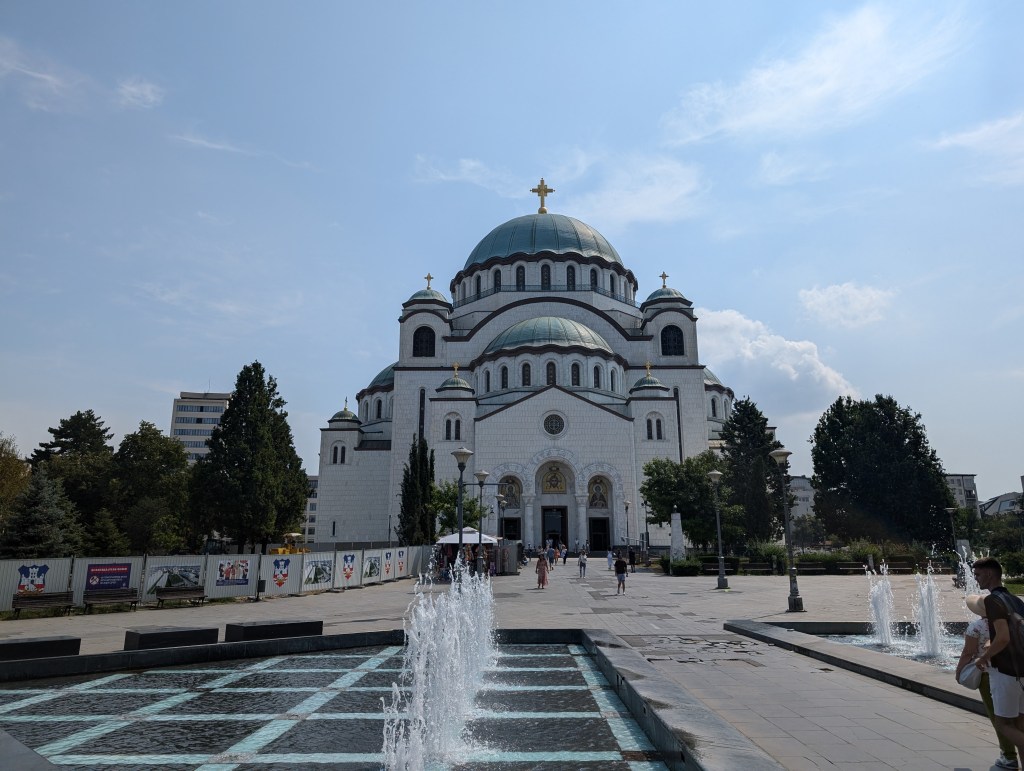
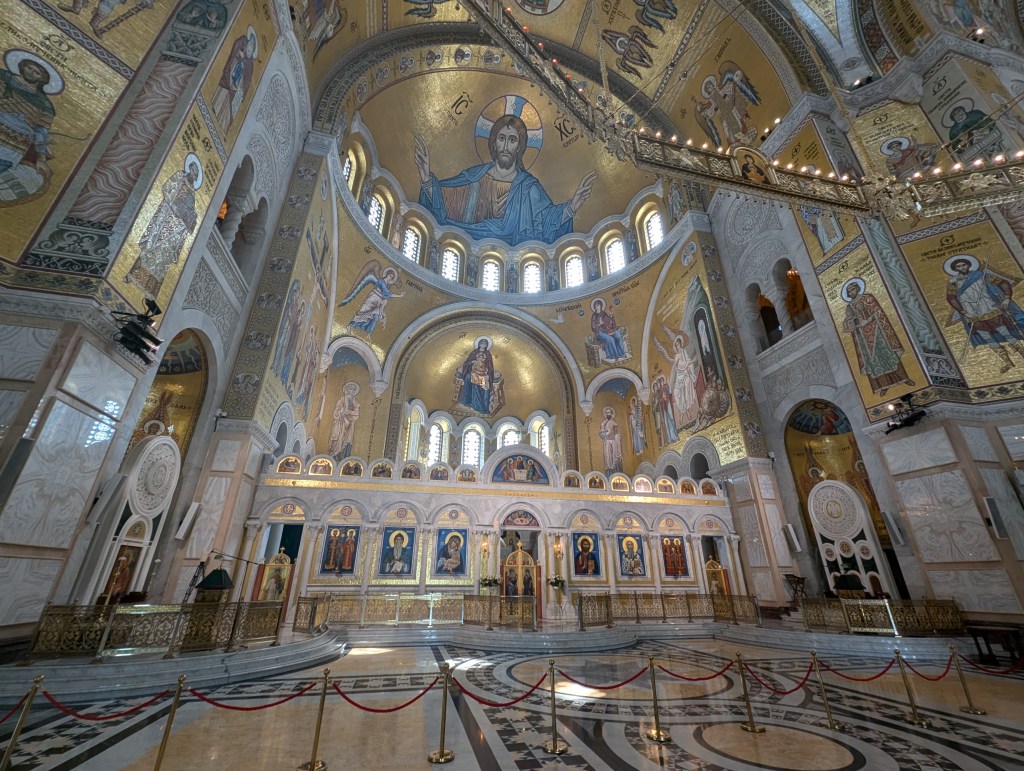
The tendency of this modern reimagining of Belgrade towards the monolithic was off-putting. Between the train station and city centre was the Church of Saint Sava, completed in 2004 after a long period of construction. To provide a sense of scale, this was one of the largest Orthodox Christian churches on the planet. Stepping inside was the polar opposite of Belgrade’s cosy courtyard bars – it was cavernous, with whispers from tourists craning their necks to admire the mosaic-clad interior echoing around the vast interior.
In many senses, it was spectacular. The interior was covered in iconography, with an absurdly liberal use of gold across all surfaces. The building itself sat isolated amongst wide open expanses of parkland and squares, emphasising its obvious size and scale. Though I was impressed, I didn’t feel an urge to stay and drink in the surroundings. It was sterile rather than beautiful.
Again, this pressed to the core of the contradiction of Belgrade. This was a city which, despite having so many merits, was seemingly insecure in its standing amongst its European peers. Monuments such as the Church of Saint Sava felt like an unnecessary attempt to patch up flaws that quite possibly didn’t exist in the first place. Even if the city had never built the church and so didn’t have a monument to show off to the world, its charm would have still remained, actually being enhanced without the distraction of such enormous white elephants.
Just as there were some perceived cracks which didn’t require papering over, the city (and maybe even country) had somehow ignored many larger issues when it came to the wars of the 1990s.
As I walked into the main square in the city centre, where my eye may have been drawn to beautiful buildings in other cities, I instead noticed graffiti stretching a storey tall. One floor up and on a prominent corner in all capitals, it read “the only genocide in the Balkans was against the Serbs”.
This didn’t seem to bother people, who nonchalantly walked below it without batting an eyelid. Personally, though, it left me conflicted: this was a nation clearly struggling to understand the devastation it wrought upon its neighbours and unwilling to recognise that its leadership may have, at one point, committed acts which would have been beyond the imagination of most.
It was a shame. As much as I loved large portions of what Belgrade offered to a foreign tourist, my main memories of the trip centred around a bygone war which it could (arguably should) have made much more of an effort to come to terms with.
 Into The Elsewhere