Khiva didn’t quite have the grandeur of other Silk Road cities. Mind you, this was hardly a surprise considering its remote location out in the wild west of Uzbekistan, deep within the Kyzylkum Desert. While it may not be home to as many impressively large and ornate monuments as the likes of Samarkand, I was sure that it would have still provided a very welcome break to any Silk Road trader passing on their way towards Europe.
Though I wasn’t bound for Europe as I visited, I certainly counted myself among the ranks that were more than happy to see the imposing city walls come into view over the endless desert horizon.
“The drama of the shadows … was vaguely mesmerising, causing the day to melt away into ancient history”
A journey from nearby Nukus which had been made significantly more complicated than it should have been due to a marshrutka not running as planned had taken its toll, as much as it was entirely predictable in this part of the world. Both that and the fact that the half-completed roads, with one carriageway paved and the other distinctly unpaved, had been the cause of a vehicular game of chicken, as trucks bore down on my wheezing minibus.
Just as a head-on collision was imminent, steering wheels were violently jerked and catastrophe narrowly avoided. My heart rate never dropped below a terrified 160 beats per minute. Perhaps I was less happy to see Khiva and more just happy to remain alive.
Still, I arrived and quickly checked into my guesthouse, just the other side of the west gate that led to the Ichan Kala, the historic and fortified centre of the diminutive city. As the sun set on the city, it lit up the sand-coloured walls, so that they were a burning orange. I could feel my body slowly relax after the tension of the journey earlier that day. The drama of the shadows and orange highlights on the fortifications was vaguely mesmerising, causing the day to melt away into ancient history.
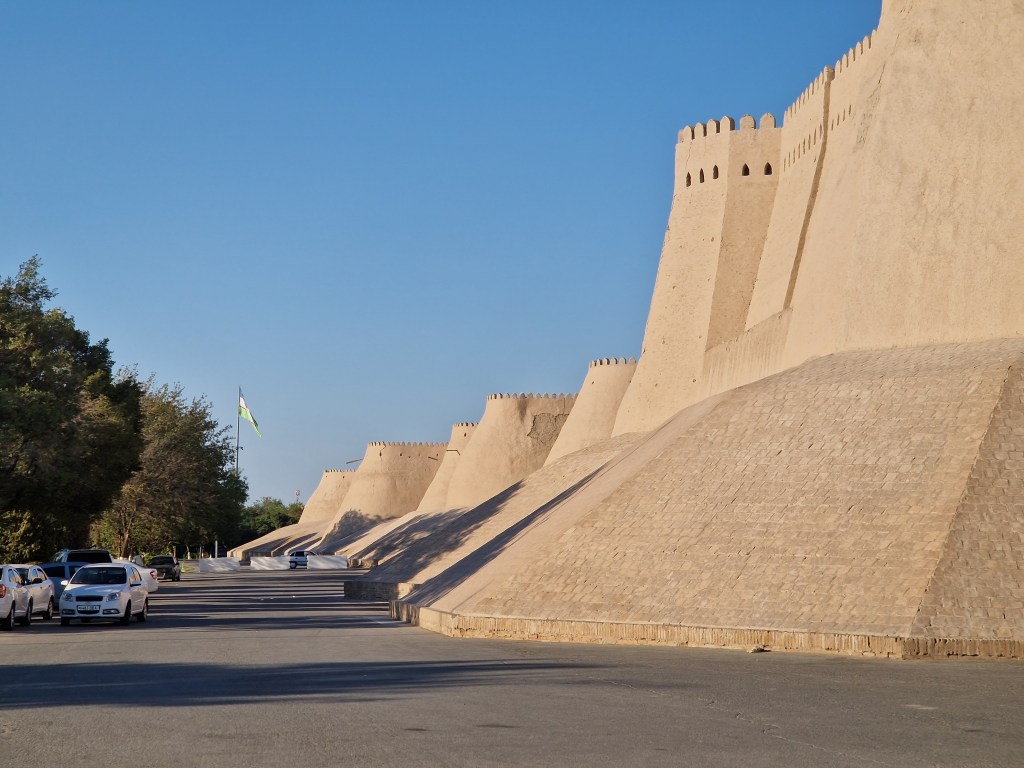
That evening, I first ventured into the fortress. Lifeless from the outside, the sturdy walls obscured anything inside. This seemed to extend as far as the boxing competition happening in the main square, perhaps 200 metres from my guesthouse but separated by the enormous ramparts. As much as I was bemused at quite how I had stumbled across an Uzbek boxing competition, it gave the whole place a feeling that it was lived in – something which I was happy to see.
In some senses, it also cemented my impression of Khiva as a city of drama. Seeing the fighters, fists clad with boxing gloves and fitted with headguards, both trying to deliver a knockout blow to their opponent while not receiving one themselves, was a raw and exciting spectacle. I couldn’t claim to be particularly well versed in the sport of boxing but understood the drama of the match, with every cheer, gasp and round of applause coming from the gathered crowd drawing me in further.
I wasn’t the only one who had been drawn in by Khiva’s charm and sense of the dramatic throughout history. Just across the square from the boxing tournament was a squat, ornately tiled cylindrical building. Glancing at my guidebook, I quickly saw that this was in fact an unfinished minaret, designed to be the world’s tallest at the time of its construction in 1852. Allegedly, the intention was to be able to see all the way to Bukhara, around 400 kilometres away.
As much as the beauty of what was actually built was clear to see, I couldn’t help but imagine what the finished product may have been, providing spectacular views across the desert and acting as a lighthouse in the desert to weary travellers.
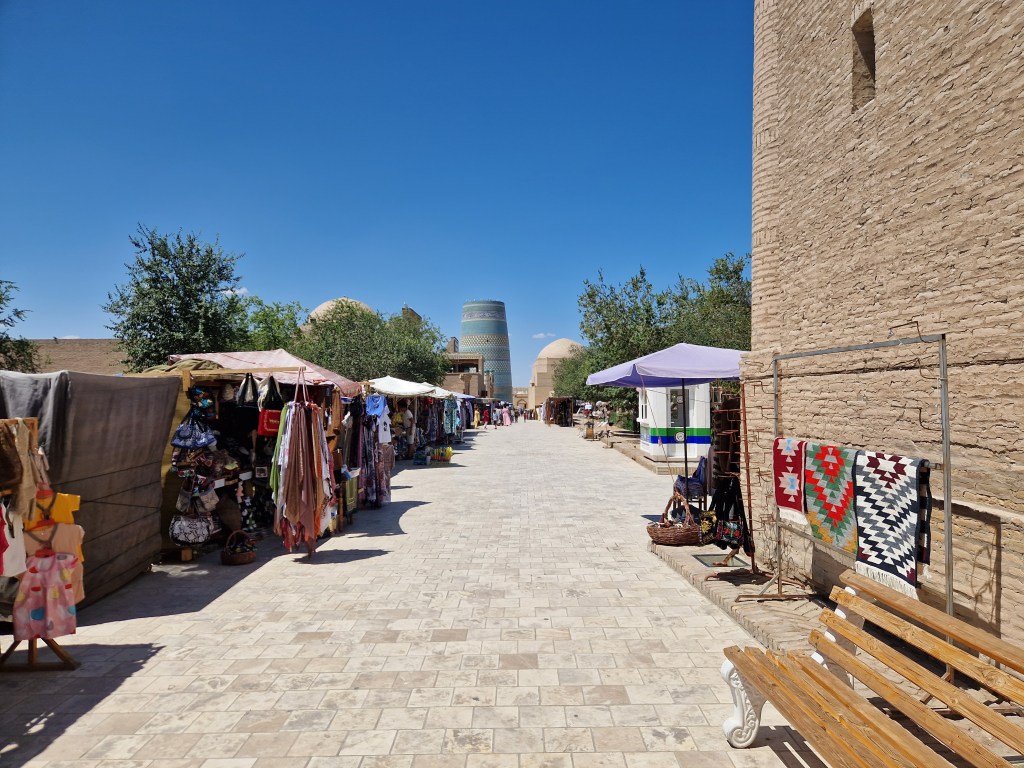
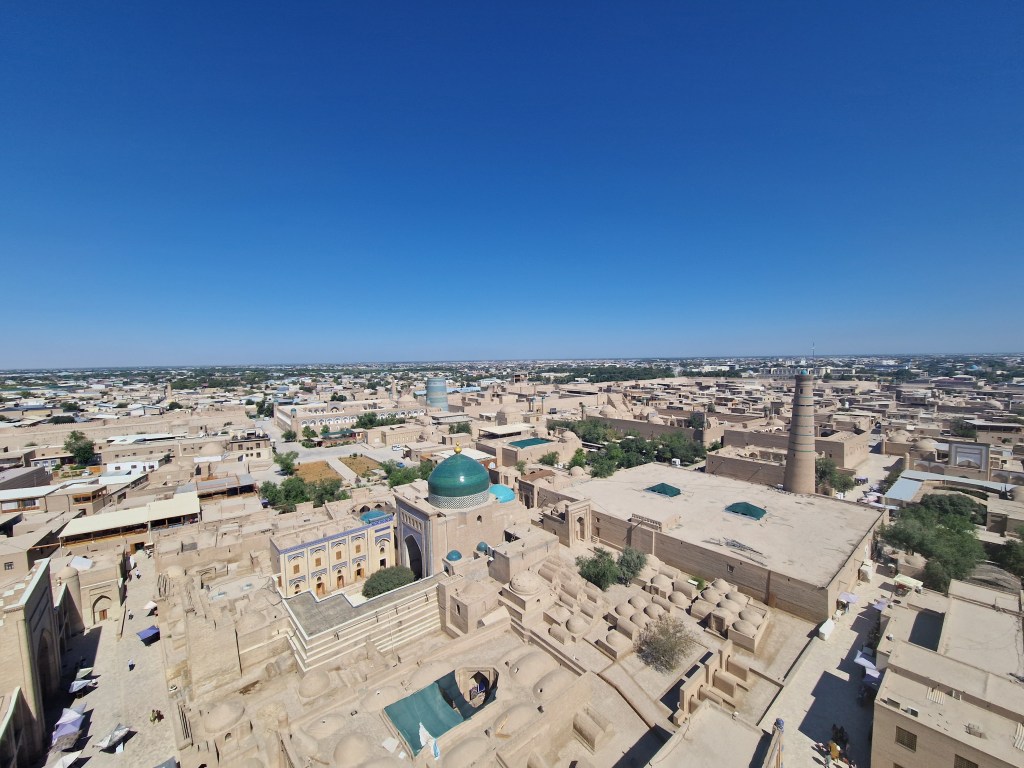
As it happens, I was able to get just a taste of what the Kalta Minor Minaret may have offered to the city. Walking around the dusty and twisting streets inside the Ichan Kala, I decided to try to see the city from above and paid to climb a different minaret, belonging to a neighbouring madrasa.
The climb up the impossibly steep steps was an adventure in its own right. Each of the ledges was perilously narrow and worn down by years of feet running up and down it calling the local communities to pray. Equally, the steepness, combined with how low the ceilings were as they wound up the needle-thin tower, led to a slightly claustrophobic experience. It was less like climbing stairs and more like trying to mountaineer up an ancient monument.
After around five minutes of simply praying that I wouldn’t meet a fellow climber on their way back down the tower (something which would have inevitably required one of us to reverse), I made it to the top, with absolutely no idea if descent would be safe or even possible.
Some of the best views are the ones you have to work hardest for. Climbing the steps, as they wound round on themselves, only served to contribute to my appreciation as daylight suddenly broke into the spiral, signalling the end of the climb. Looking around at my new surroundings, I certainly wasn’t disappointed.
“Instead of a cameraphone, I should be clutching a whip and wearing a Stetson”
The extent of the city stretched out in front of me, with the sandy and blue domes and towers of the Ichan Kala clearly visible in the foreground. The few people foolhardy enough to wander the streets in the middle of the desert sunshine could be seen making their way between the various street stalls selling silk suzani and intricately carved woodwork panels.
Beyond this, a few grassy fields quickly led to the brown desert expanses which lined the horizon. Largely flat, it was easy to see how a 19th century leader thought he could build a minaret to be able to see Bukhara. Indeed, the view, alongside the flat desert plains, brought the remoteness of the city into sharp focus.
Having (very carefully) descended the steps down from the minaret, I carried on exploring the many streets, palaces and other sites of Khiva. One of the most remarkable things about this was how empty the whole city was of foreign tourists. Sure, there were some locals on the streets and the many stalls gave the all the colour and vibrancy that the city required. Somehow though, in the process, it had managed to dodge the large crowds and tour groups which would have caused any sense of drama or beauty to evaporate in an instant.
Wandering one of the palaces, I quickly realised that I was totally alone. Finding a shady spot amongst the majolica-clad walls, carved wooden columns and colourful painted ceilings, I sat and took a moment to simply appreciate this Uzbek gem of a city.
I was truly lucky. The drama of the city would, I was sure, soon prove irresistible to foreign visitors and, when combined with its relatively small size, destroy it to an extent. I was lucky enough to experience it before it made the inevitable leap into the mainstream.
Towards the end of my time in Khiva, it was clear that the city wasn’t quite done with me as I counted down the hours to my train to Bukhara. Spotting one last listing in my guidebook, I decided to visit the Juma Mosque, nestled amongst all the other monuments and minarets which I had been wandering around for the past couple of days.
I had been to mosques before, both in the UK and in places like Morocco. Expecting a traditional domed structure with minarets and high ceilings, I was a bit taken aback when I came across a low, squat building. Crossing the threshold, there was no open courtyard or anything else which I would have associated with a traditional mosque.
It felt like I had stepped into a film set. Dozens of columns, supported through perilously thin, tapered bases, held up a wooden ceiling. The large room was almost completely dark except for a central light well which caused the columns to cast dramatic shadows across the basic brick floor.
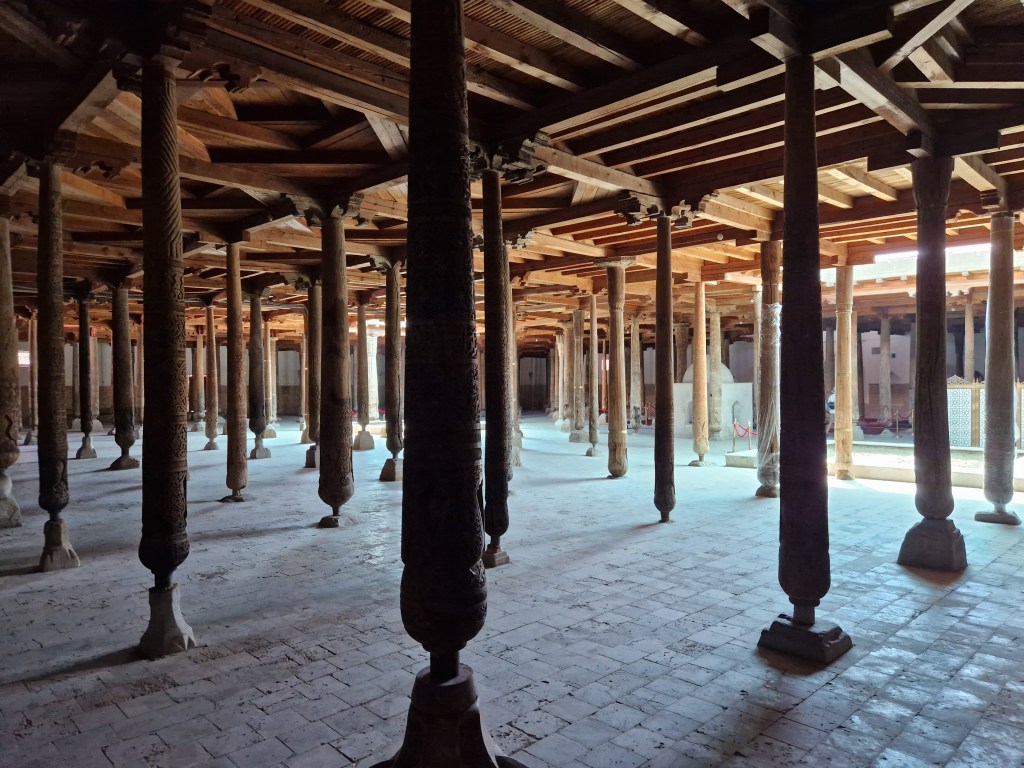
There was no majolica tiling (something which I would have expected in Uzbekistan) and, apart from a couple of alcoves, nothing to really suggest this was a mosque at all. As much as it was totally out of character with pretty much the rest of the region, I loved wandering between the wooden carvings in each of the pillars.
The place ignited something within me, my imagination running ever so slightly wild with fantasies about how, if I leant on a certain spot or stepped on a specific tile, the secrets of the city would be revealed through some sort of secret passageway, like in Tomb Raider or Indiana Jones. There was nobody else in the room as I walked around, feeling that, instead of a cameraphone, I should be clutching a whip and wearing a Stetson.
The magic of Khiva was in places like the Juma Mosque. I got the sense that, with its remote desert location, the ancestral inhabitants of the city felt they had licence to just go a little bit beyond convention and push the boundaries, creating drama and intrigue for passing merchants to marvel at on their long journeys between the East and West. Today, the merchants may have disappeared and been replaced with a smattering of tourists but Khiva’s drama and magic certainly hadn’t.
 Into The Elsewhere