I knew things weren’t going brilliantly when I was within a few quick swigs of finishing my last bottle of water. Well, there were at least some pros and cons to the whole situation of walking solo back down a stunningly beautiful Kyrgyz valley on a lovely sunny day.
Starting with the advantages of my situation, I was in one of the most serene environments I had ever experienced. To my right-hand side was a river, gushing and gurgling with electric blue meltwater from the nearby Karakol Glacier; chestnut wild horses grazed gently in meadows and drank from the pools and eddies washing along the gravel beaches of the stream. At the sides of the rutted track I was wandering along were towering pine trees, which gave the whole arrangement (horses aside) a distinctly Alpine feel.
“One foot in front of the other. Ignore your drying throat”
Even better than all that, I was alone and able to peacefully absorb my surroundings without any of the bustle and noise of the Central Asian cities that I had visited just days before. Even so, while this was definitely a good thing and had made for an unforgettable experience up in the higher mountain passes just earlier that day, it was quickly turning into a bit of an issue.
While Kyrgyzstan’s valleys were so special to me due to their lack of a human presence, in that moment I could have done with a human or two fairly sharpish. Namely, a shopkeeper who could have sold me a new bottle of water for the fifteen-odd kilometre walk back to Karakol and the safety of my hostel.
Still, at least my surroundings were pretty. I kept looking up at the many greens and blues, shoving any (possibly premature and overly-dramatic) thoughts of death by dehydration at the foot of an enormous Tian Shan peak. One foot in front of the other. Ignore your drying throat.
After about an hour spent in outright denial, watching the scenery get smaller and less spectacular as I travelled further down the valley, a realisation dawned upon me that the whole “ignorance is bliss” thing probably wasn’t going to be sustainable. My map was showing a good three- or four-hour walk back; it was approaching the early afternoon, with the sun only getting warmer and I was getting increasingly tired and demoralised.
There was one hope left: though it was a long way back to Karakol (and my hostel), the trailhead where I had been dropped off the previous day was significantly closer. All that was required was to get there and just hope that a jeep was around to take me the rest of the way back.
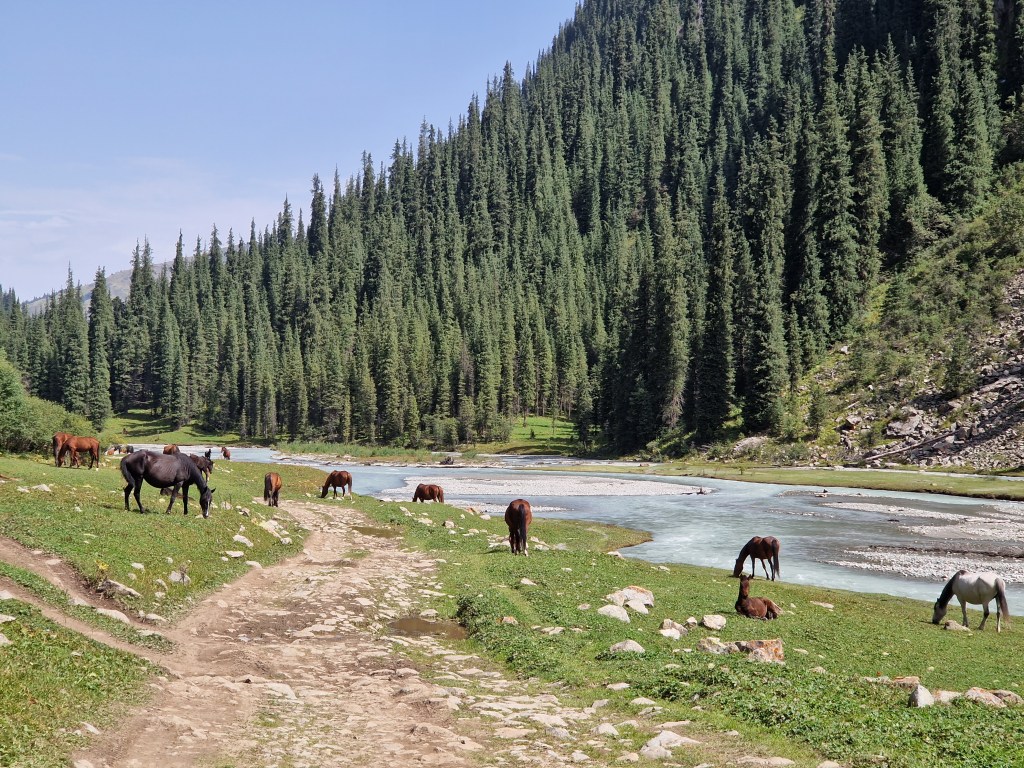
The trailhead was little more than a turning point – a marker of the end of the road for all but the hardiest vehicles and most experienced drivers. It divided the mountains from civilisation beyond, with telegraph poles, basic huts and some houses all dotting the valley’s lower reaches but absent beyond this point. As I approached through more tall and obscuring pines, I had no idea what fate I would have to face.
My heart sank as I finally made it to the previous day’s starting point. At the trailhead, there was no more life than there was anywhere higher up the slopes. No cars, no drivers, not even anyone with a phone that could have been used to call somebody up the mountain and rescue this particular dehydrated and underprepared Westerner.
Sitting and waiting for a car which would never appear, I realised that there was basically no other option than to keep pushing on. I ate some of the now stale bread which I had carried around with me and contemplated walking the rest of the distance. That said, my knees and feet ached at the very thought of it and I still had no idea what to do about the whole water situation. I needed to find a car and, as much as I hated the thought, there was only one realistic option. A last resort.
I had never hitchhiked before, making me all the more nervous about trying it solo in Kyrgyzstan. I knew that some people swore by it, particularly in Central Asia, but the tired and pessimistic side of my brain was still scared to start walking along the road, whipping round at the slightest sound of an engine and sticking my dusty and grubby thumb out in the hope of a lift from a complete stranger. Something about it just seemed wrong.
Trudging down the road, it wasn’t long before I heard that nerve-inducing rumble. Looking over my shoulder, a beaten up Mercedes appeared up the hill. Turning round and walking backwards, I thrust my hand out and pointed downhill with my thumb to absolutely no avail. Half disappointed and yet also pleased that I wasn’t now stepping inside a stranger’s car, I carried on.
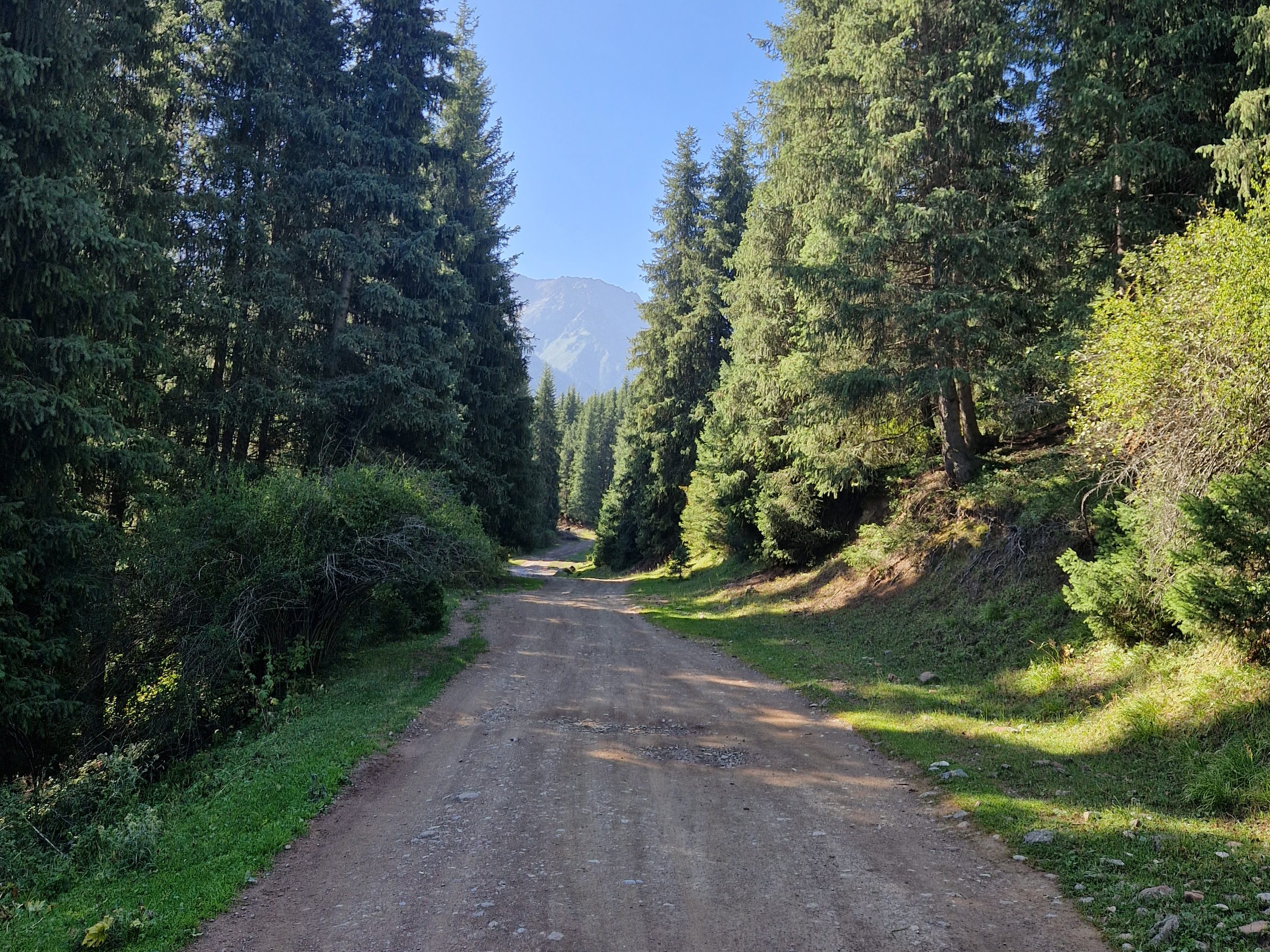
It took about half an hour and half a dozen cars or so to pass. All were battered by a combination of tough mountain life, old age and questionable Kyrgyz driving standards. All subsequently left me choking or trying to hold my breath as they passed as quickly as possible in a cloud of dust. By now, the valley was beginning to flatten out and the houses were becoming more abundant. I was quite a bit closer to Karakol but my water was down to a dribble and I was parched. Then, to my absolute amazement, a car stopped just down the road.
What was even more remarkable was the type of car. This wasn’t a decrepit Lada, but a brand new BMW 4×4. As I hopped in the passenger seat to be welcomed by a Kyrgyz man driving and his wife in the back, I could barely believe my luck. I was equally bemused when the car started beeping to tell me to wear a seatbelt, having become so used to the local buses which never even had them.
“Fortunately, they at least understood when I thanked them for stopping and told them my final destination”
Now, my Russian was severely lacking to say the least and my Kyrgyz was even worse. As much as I wanted to find out all about these two guardian angels in their (extremely nice) car which I was now almost certainly soiling with a couple of days’ worth of sweat and a good amount of roadside dust, it was always going to be an uphill struggle. Fortunately, they at least understood when I thanked them for stopping and told them my final destination.
We set off and, to my relief, a phone was soon thrust in my direction from the back of the car, with a translation app open to begin to ask questions about why exactly a Western tourist who spoke next to nothing that a local could understand had been found dehydrated at the side of the road.
“Where are you from?” was the first question which appeared on the phone screen. Nervous of taking the phone myself to reply and get it translated back into the language of their choice, I decided to plough on with what little Russian I had.
I replied with one of the few words I had actually picked up, such was the frequency with which I was asked the question, “Angliya” (or England to you or me). From here, the questions kept on coming and something of a digitally-enabled conversation began to form.
I quickly learnt that my companions were from Kyrgyzstan, visiting this corner of the country. They determined the same about me in that I had been travelling in the wider region for all of around three weeks. Still slightly surprised by their generosity in deciding to pick me up – something which would have been almost entirely taboo in my native UK in this day and age – I was keen to repay the favour and be good company on the short drive into Karakol.
This made one of the later messages that came via the phone from the driver’s wife all the more heartbreaking and confusing. It simply read, “Is there something which has offended you?”. I panicked.
“No, no. I mean… nyet, nyet.” I almost spat the words out, worried that I had done something which had actually offended them. Sure, the language barrier was nearly insurmountable in the circumstances and definitely left a lot of room for confusion and misunderstanding. However, I was also acutely aware of how traditional this part of the world could be; was it that I had accidentally flouted some unsaid rule or custom or perhaps behaved in a way which made them think that they had broken one of mine?
Unfortunately, it was a question I was never able to get an answer to. Instead, I tried to pull the largest grin possible to show how happy and grateful I was about them pulling my dehydrated and knackered body back into Karakol.
Despite the obvious difficulties, there was something deeply human and personal about this whole interaction. Not only were these two endearingly generous people, willing to help another complete stranger in need, but the language barrier had reduced us (or at least me specifically) to almost exclusively using body language as a means of communication. It felt primitive but at the same time drew us together as human beings, of no meaningful race, nationality or culture.
During that car ride, I felt as great a connection with the world around me as I had in the mountains – the difference being that this world was human rather than physical, unlike the mountains.
Arriving in Karakol, the car pulled up at the side of the road and the man driving reached for his phone to take a selfie with the three of us. I offered him money for fuel (as I had read was customary) which he immediately refused. At this point, I just regretted never at least getting the names of the two of them, such was their kindness towards me. Instead, I just waved apologetically, thanked them and shut the door behind me. The BMW disappeared down the road in a cloud of dust and, with it, an unforgettable and unexpectedly human experience of the Kyrgyz mountains.
 Into The Elsewhere