I knew that I was reliant on technology as soon as it was taken away from me. A serial Google Maps user, I was used to immediately knowing where I was and, perhaps after a touch of orientation and maybe one wrong turn every now and then, where I was going.
This was all well and good and something I admittedly have taken entirely for granted in 99 percent of all the situations I have ever found myself in, whether in the somewhat familiar surrounds of London or somewhere entirely unfamiliar, such as Jordan.
“The reality … couldn’t have been any more different to the narrative usually associated with the Middle East”
What I did know for sure was that I wasn’t at Amman International Airport. Even so, there was the little blue dot, blinking away on my screen sitting in the palm of my hand, proudly and confidently showing that, despite the four-hour journey south, I was sitting safely in the departures area. In reality? My trip to Jordan had only just started and I certainly wasn’t at the airport – I was instead on the tiny stretch of Red Sea coast claimed by the country, in the baking city of Aqaba.
I was as bemused as I was disoriented by the situation. Of course, it was by no means dire and I was confident that I would eventually reach my hostel regardless. It would just mean a longer time spent under the blazing sun, slowly dehydrating under the weight of my backpack.
There must have been worse places for this to happen though. What unfolded in front of me was a wide coastal boulevard with palm trees running along its grassy centre. The odd car slowly rumbled along the wide expanse, past archaeological digs, forts and a multitude of restaurants in the midst of the afternoon lull in business.
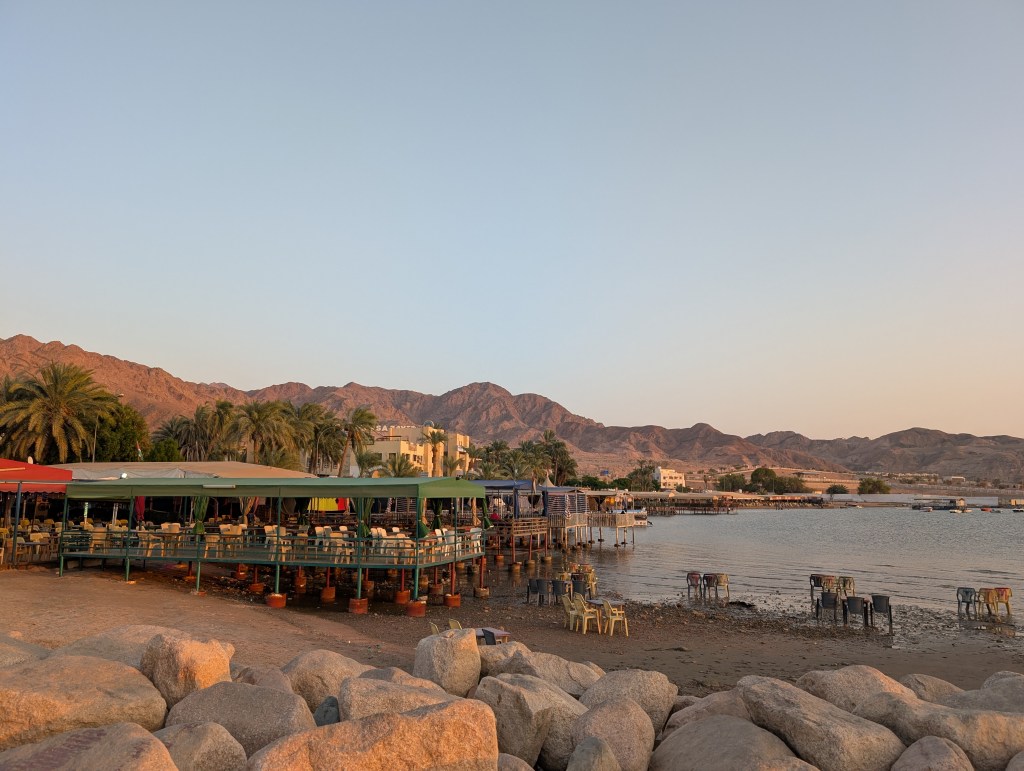
Across the small inlet of the Red Sea upon which Aqaba sat, I had the rare opportunity to see not one but two other countries: Israel and Egypt.
In fact, as I tumbled into the thankfully air-conditioned hostel room, it transpired that one of these countries in particular was the reason for my initial disorientation and bemusement as I stepped off the bus and into the scorching heat of the city.
The city’s proximity to Israel was something that interested me. Apart from the GPS blocking that the military continued to pursue over much of Jordan (I can only imagine to confuse incoming missiles), this was a country that had, for one reason or another, been at the centre of much of the regional instability in the Middle East in recent years.
At the same time, everything across the bay seemed almost entirely normal. Certainly Aqaba was peaceful – sleepy even – in the afternoon heat. Across the water also lay the city of Eilat, Israel’s port on the Red Sea that was equally normal in how it appeared just a couple of miles away. None of the sirens, missiles flying overhead or military presence that you might expect when you have such a noisy neighbour.
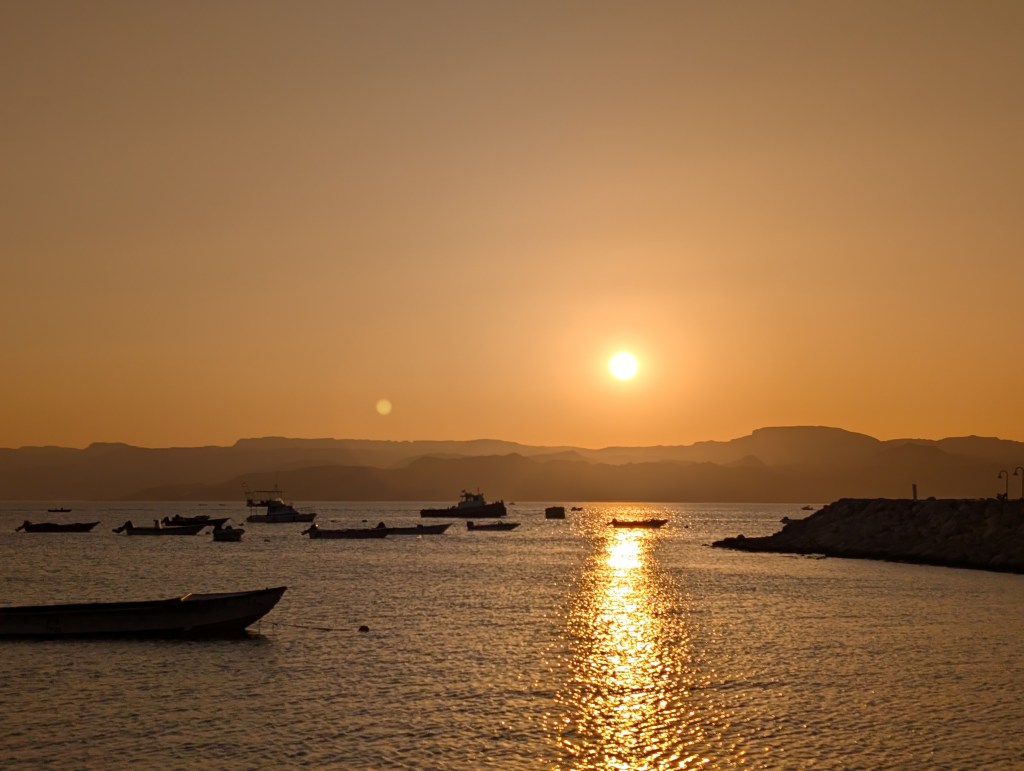
As the sun slowly set over the Egyptian coastline, though, Aqaba slowly arose from its slumber. The beachfront bars, each complete with rickety decks mounted on stilts above the sea, steadily fired up their loudspeakers one by one, until the beachfront was a cacophony of music, ranging from what was no doubt the latest Jordanian chart-topper to more recognisable Western songs.
At the same time, jet skis and colourfully-painted glass-bottomed boats cruised around the harbour, searching for any business available from the few visiting tourists.
This reflected the new reality in Aqaba – Jordan’s second largest city, one which drew large crowds to its beach clubs, marine life and laid-back attitude, was now largely devoid of foreign tourists. If the bars weren’t entirely empty, only one or two of the many tables would be occupied by Jordanian families or groups of friends, drinking exotic smoothies and smoking sickly shisha.
“If the country became cowed in the face of this deadly tension, it would risk losing its very identity”
As the fabric draped around the edges of the bar platform were pulled back for sunset, I didn’t quite understand why this was the case. Much like with my phone as I arrived in the city, the reality of the situation couldn’t have been any more different to the narrative usually associated with the Middle East in the West.
Instead of missiles flying overhead, I was dazzled by the sun setting over the gently lapping Red Sea while enjoying a mint lemonade, which was a speciality in Jordan and seemingly their substitute for beer as a mostly dry country. With my girlfriend sitting beside me, the opportunity to unhurriedly play cards, chat and enjoy the scene as the whole landscape turned orange before nightfall was a true pleasure. In that moment, even the throb of the music coming from the neighbouring bars seemed to melt into the background as the world became a more serene and peaceful place.
Walking into the city after a waterfront sunset drink, the city seemed to have been transformed again. Where shops and restaurants had been quiet as we stepped off the bus in the afternoon, they were now pulsating with life. Despite the lack of foreign visitors, it seemed as if the Jordanian people had taken it upon themselves to make up the shortfall, enjoying the best of the city’s shawarma stalls, coffee shops and shisha bars. Everywhere was alive with people.
Sitting down on a balcony on the first floor of a restaurant, I was treated to fresh sayadiyeh, a fish dish with rice and almonds often likened to Spanish paella. As the fish flaked apart and the sauce covering it melted into the rice, again the context in which life in Aqaba existed was muted for a second.
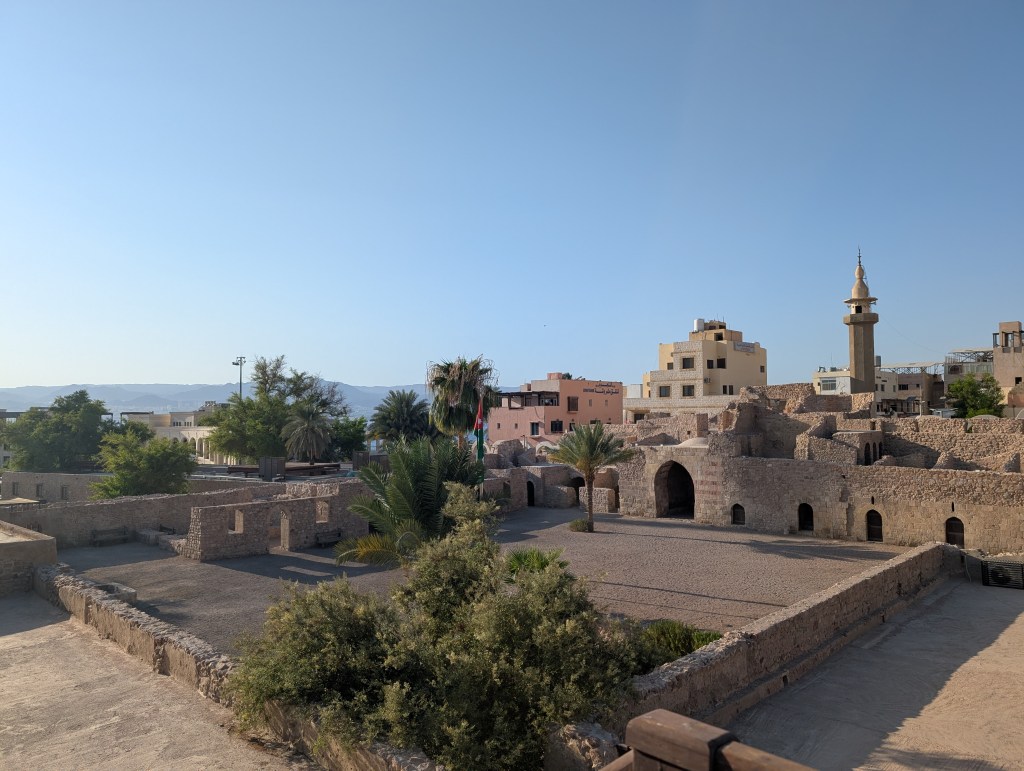
Over the few days that I stayed in Aqaba and was lucky enough to wander its streets and souks, I began to appreciate the privilege which I held in being able to do so. As much as this was a city which was very much alive and kicking, it did live under a cloud at the same time, which was made abundantly clear to me almost as soon as I had moved further north on my journey through Jordan.
Checking the news on my phone, my eyes were immediately drawn to a headline talking about how Eilat, the Israeli city just a couple of miles from Aqaba’s city limits, had been hit by Houthi missiles, injuring many inhabitants. As much as this didn’t affect Aqaba directly, it was still a sobering thought that such deadly force was being used regularly only a stone’s throw away, with Jordan very much facing the possibility of being caught in the crossfire.
If anything, it made my impression of the city all the more remarkable as I read the news story. The fact that families were still out on the beaches, spending their weekends enjoying the highlights of Jordan’s short coastline was heartening in the face of something which, doubtless, would force some indoors in terror.
What I experienced in the city has encouraged me given the recent headlines and war in Iran and the wider region. Though this is a war in which Jordan has been much more directly affected, what I saw in Aqaba showed me that this is a country which was extremely likely to carry on in its own, unique and atmospheric way.
It is important that it does too. It’s indisputable that Jordan has had a rough time of it since the pandemic, when you consider the subsequent regional tensions both around Israel and Iran. That said, if the country became cowed in the face of this deadly tension, it would risk losing its very identity – the sort of thumping atmosphere which provided the background to stunning sunsets over the Red Sea.
Of course, I haven’t been able to visit Jordan since the United States’ attack on Iran (and I can’t imagine that many tourists are making the journey more generally either), so I can’t say for sure whether this is truly the case or not.
All I do know is that if it does change, it will lose the very thing which makes it an interesting place for visitors like me and, as a result, the easy times of mass tourism and the money it brings into the country will never return.
I personally hope that this is not the case. In fact, I look forward to the next time I sit down with a mint lemonade at a bar perched precariously over the sea on Aqaba’s beachfront, all to watch the sun go down once again. Who knows, maybe Google Maps will even work when I return.
 Into The Elsewhere