Its not often that you see birds flying from above. As a species usually firmly pinned to terra firma, the thought of joining animals blessed with the gift of flight has undoubtedly been something which has obsessed the human race for centuries. However, sitting among Petra’s clifftops and staring down at the birds flying below me and the specks of humans far beneath them, the sensation of flight was too obvious to ignore.
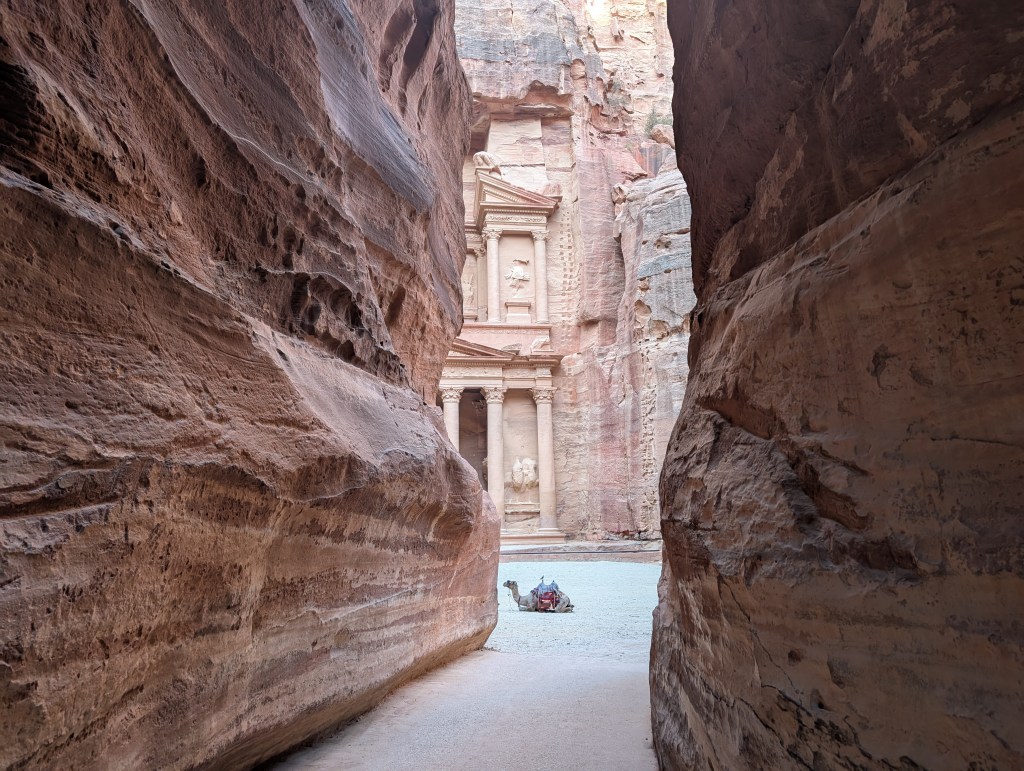
Petra, as Jordan’s largest and best-known tourist site, was much more than just the Treasury which was made famous by Indiana Jones. It’s an enormous site, criss-crossed by paths running up and down wadis, over clifftops and across the baked earth of the central basin, weaving between Roman and Nabatean ruins.
Over the course of a day or so, this was something which I had quickly grown to appreciate. My feet were sore from trudging along the dusty paths, populated only by tourists and Jordanians looking to sell things. Even so, I was hungry for more, having climbed up to the Monastery and wandered some of the larger tombs just beyond the Treasury.
“A decision slowly began to crystallise. I would climb.”
My only companion was my Lonely Planet guidebook. Sitting in one of the leafy cafés within the basin to get some respite from the sun and enjoy an overpriced coffee, I got reading about some of the more interesting and varied trails which I could embark upon.
The variety was overwhelming: anything from opportunities to see Crusader fortresses to experiencing the Treasury from a new vantage point was seemingly possible. As I sat upon the rickety bench covered in traditional Bedouin textiles and tried to avoid the many cats which slunk and wove between the table legs and visitors’ belongings in search of their next meal, I struggled to make my decision.
Through much deliberation, a decision slowly began to crystallise. I would climb.
According to my guidebook, this was no arbitrary or insignificant route either. Instead, I would be heading to perhaps the most holy and important site in the whole city: the High Place of Sacrifice. Reading on, I was reliably informed that this was a place of mysterious ritual, with the purpose and ceremonies which occurred at the site largely forgotten over time.
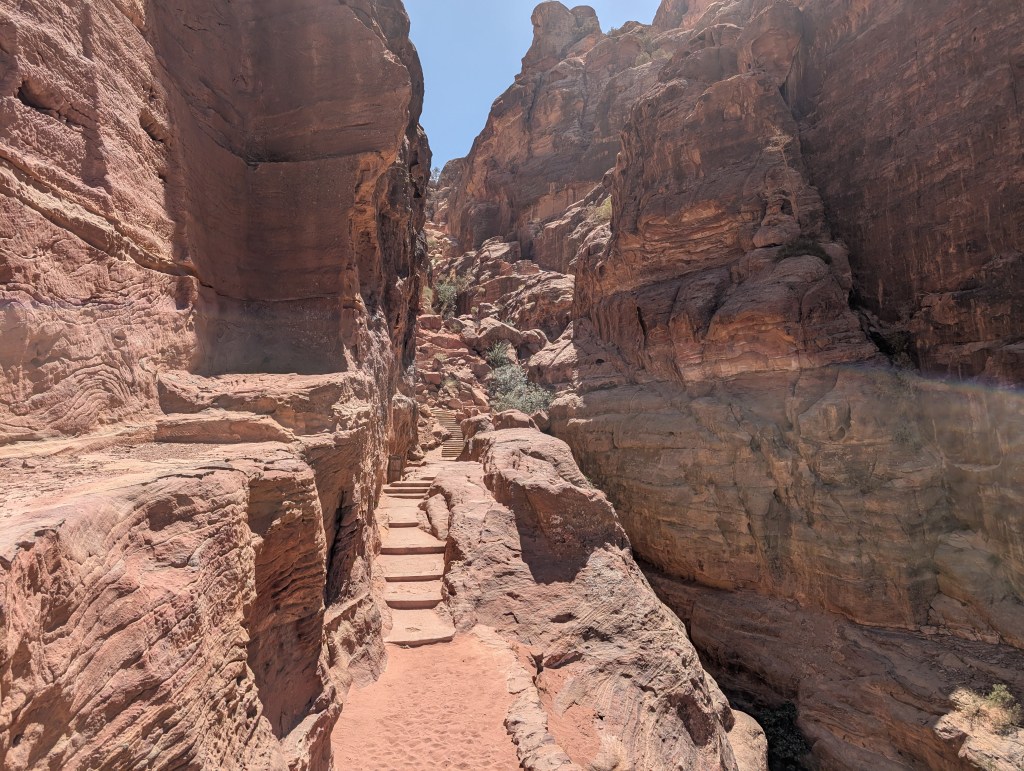
Though the exact Nabatean traditions which had been observed on the clifftops had been lost to history, it was still clear to me that this would be an important place for the civilisation which once called this city home. I was set to venture to one of the highest points around, overlooking all of the tombs and other buildings which would have stood below. This was no place to build an unremarkable house or everyday shop. Even to me, two thousand years later, it seemed important.
Paying my bill and leaving the dusty tracks of the basin, with their golf carts and large tour groups, behind, I set off up what appeared to be a small crevice between two large cliff faces. As it turned out, this was a wadi, similar to, yet much steeper than, the one which served as the entrance to Petra from the town of Wadi Musa.
On either side, the rock faces rose steeply and provided some respite from the sun baking everything in sight into a dusty, arid and bleak landscape. This fleeting shade occasionally gave way to a scrubby bush—the only sign of life around me as I ascended out of sight of the crowds below.
Though the path had undoubtedly been modernised for the crowds which had descended upon Petra prior to the pandemic, the sense of history was at the forefront of my mind. This was still the same route as the one which would have been taken by people thousands of years ago, with the many scratch marks in the hewn rocks a sure sign of a civilisation creating the path long before the advent of power tools or explosives which would inevitably have been used in more recent times.
“This was the face of someone who had spent their life coping with the endless heat, dust and sun that the desert had thrown at them”
The climb itself was short yet intense in its gradient. With altitude came a greater sense of isolation. Gone were the cafés and stalls present below. Only at one point did I pass another small group descending from the clifftops, smiling as they passed and letting me know that I was nearing my destination.
Eventually, the path levelled out into a sandy bowl surrounded by much smaller cliffs. This made the path impossible to follow as it seemingly forked into a multitude of directions. Not knowing which was the correct one and without a map which was informative enough to guide me through such a maze, I was forced to pick one and stick with it.
Clambering over a series of boulders, I heard a shout from the distance. Below me, a small Jordanian woman who had been dozing in the afternoon sun was shouting up at me and pointing in almost the opposite direction. It was clear I had gone wrong.
Retracing my steps, I thanked her for her course correction. Her wrinkled yet kind face smiled back at me as she pointed towards the High Place of Sacrifice. I could see in the way that she moved and looked how tough life must be for the locals who relied on Petra to earn a living.
This was the face of someone who had spent their life coping with the endless heat, dust and sun that the desert had thrown at them. While she looked older than her years might have suggested, there was a resolute sense to her as well—one of a person who had overcome more than their fair share of hardship yet knew that there was plenty more to come.
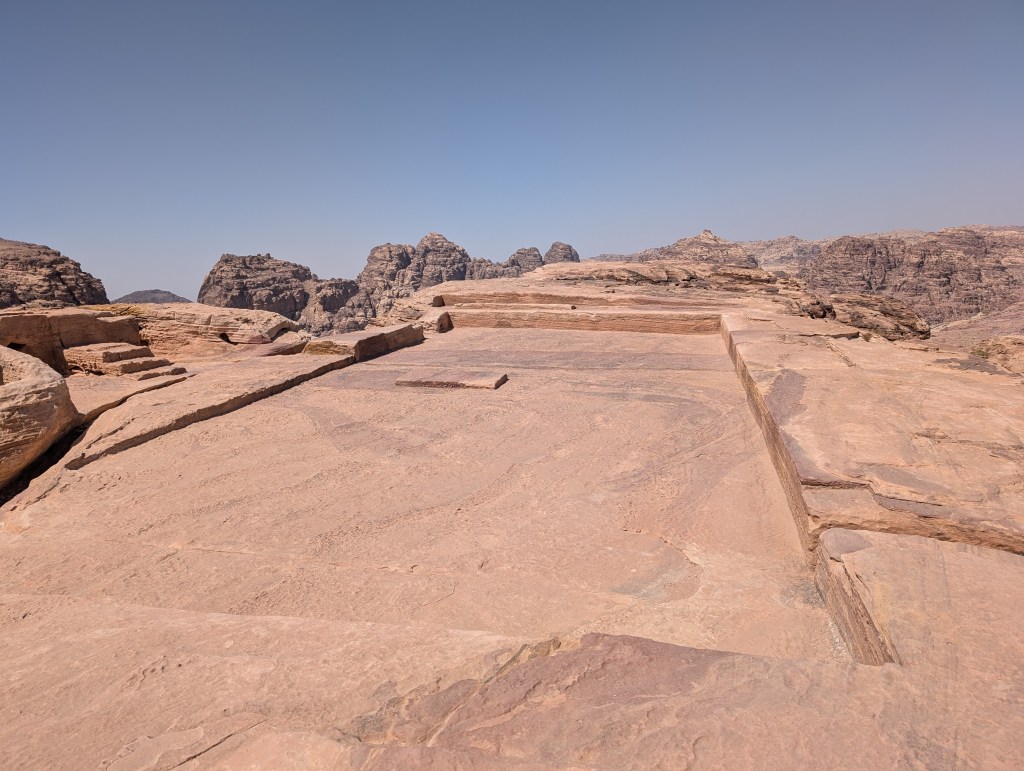
Moving in the direction in which she pointed, I soon found myself surrounded by the first sure signs of Nabatean ritual. Out of the artificially flattened clifftop rose two large obelisks. Eroded by sandstorms in the years since they were carved directly out of the cliff, their exact function had, like many of the structures around me, been lost over time.
This was just the beginning as I hopped between the boulders and wandered the paths weaving across the clifftop. As I headed towards the cliff edge looking over the rest of the basin, I found that the ground had again been flattened into a series of large, shallow basins and channels running between them.
It was thought that this was the place where the sacrifice rituals actually took place. A small lump of rock, again carved directly from the cliff rather than being placed there from elsewhere, sat at one edge—presumably an altar of sorts.
The whole place had a mystical feeling. Certainly, it was almost impossible to decipher its true purpose in the modern day, which allowed my imagination to run wild with images of processions of priests climbing up to the clifftops to make offerings to their gods in some long-forgotten ritual.
As I visited, the sense of theatre and ceremony which I assumed once may have been obvious had evaporated under years of hot desert sunshine. Instead, possibly due to the reduced visitor numbers due to conflict in the wider region, there was an overwhelming sense of peace and serenity.
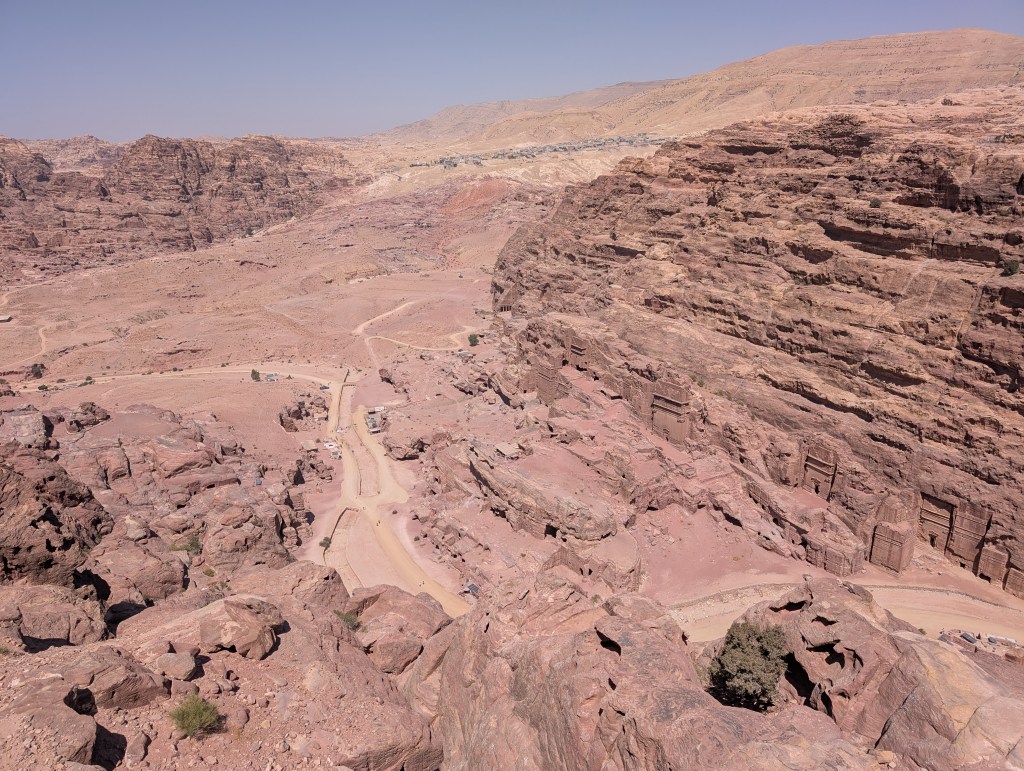
Only the gentle whistling of the breeze punctured the otherwise almost complete silence as I wandered alone. As the cliff edge approached, I took a seat at the edge to look down upon the ant-like figures hundreds of metres below: tourist groups being hurried to the next site by their guide, the owners of the café which I had sat at just before I had started climbing, charging more tourists for extortionately priced coffee and tea, or the occasional golf carts ferrying those struggling in the heat between the most accessible of sites.
It was at this point, as I unwrapped my packed lunch of basic sandwiches and some juice, that I saw that I was even above birds which were flying through the basin below me, quite possibly to their nesting spots in the cliff faces.
I appreciated the calmness of the High Place of Sacrifice. It provided a welcome break from the hassle of increasingly desperate donkey owners looking for business or stallholders coaxing people into their shops. Though I was so close to that very world, I felt that I had risen above it, much like the birds flying below, and was totally immune to their advances.
It was obvious to see why this was a sacred place for the Nabatean people. The altitude above the rest of the city was enchanting, encouraging anyone who set foot there to stay and reflect on the unfolding chaos and thronging crowds below them.
Though that wasn’t quite the case as I sat there, the place still had an enchanting quality—one which urged me to try and work out the intricacies and purpose of the rituals which had been commonplace thousands of years ago.
 Into The Elsewhere