The path was steep and loose. The sandy gravel, smoothed by countless pairs of walking boots trampling over the same path made the descent treacherous. Despite the not insignificant difficulty in getting there without the help of a guide or tour group, I had made it to the Colca Canyon, one of the world’s deepest.
This is the second part of a two-part article. To read part one, please click here.
This was a hike which defied logic. The conventional wisdom of “what goes up must come down” had been obliterated and turned inside out. Starting by descending felt counterintuitive and counterproductive.
Indeed, in descending now, I was acutely aware that every metre descended would have to be recovered the following day as I scrambled up and out of the nearly kilometre deep fissure.
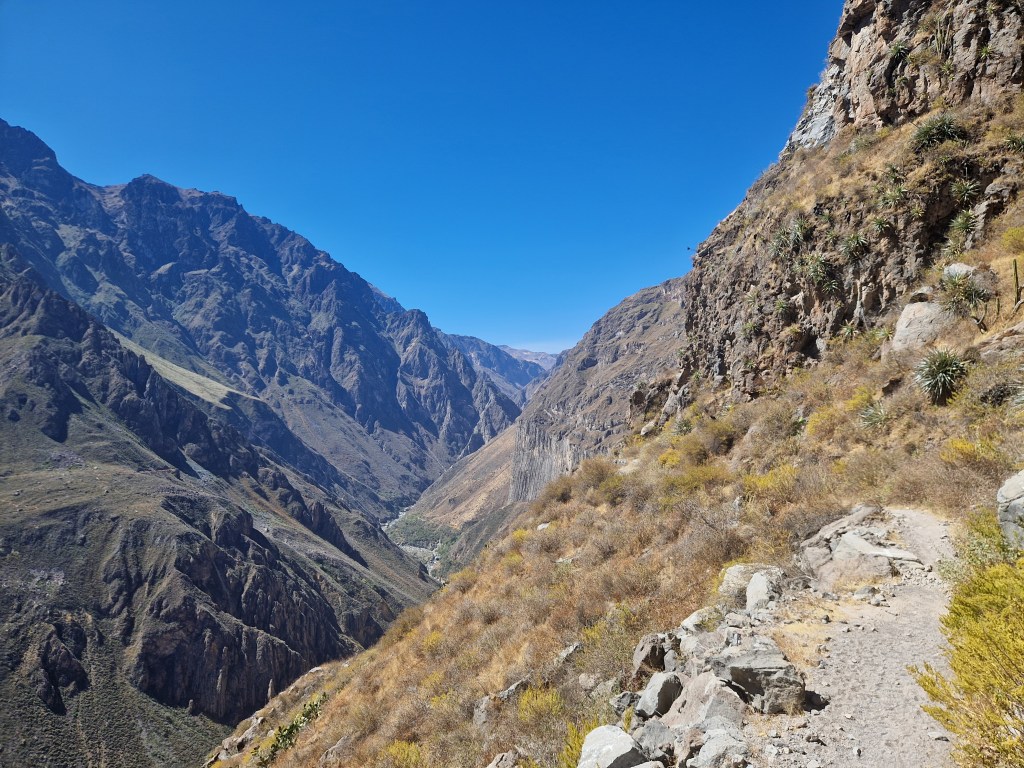
All around me was scrubland, clinging perilously to the sheer slopes. Due to the clear lack of rain in the area, everything felt desiccated, as if it could be set ablaze in a second by one careless tourist dropping a still half-lit cigarette butt.
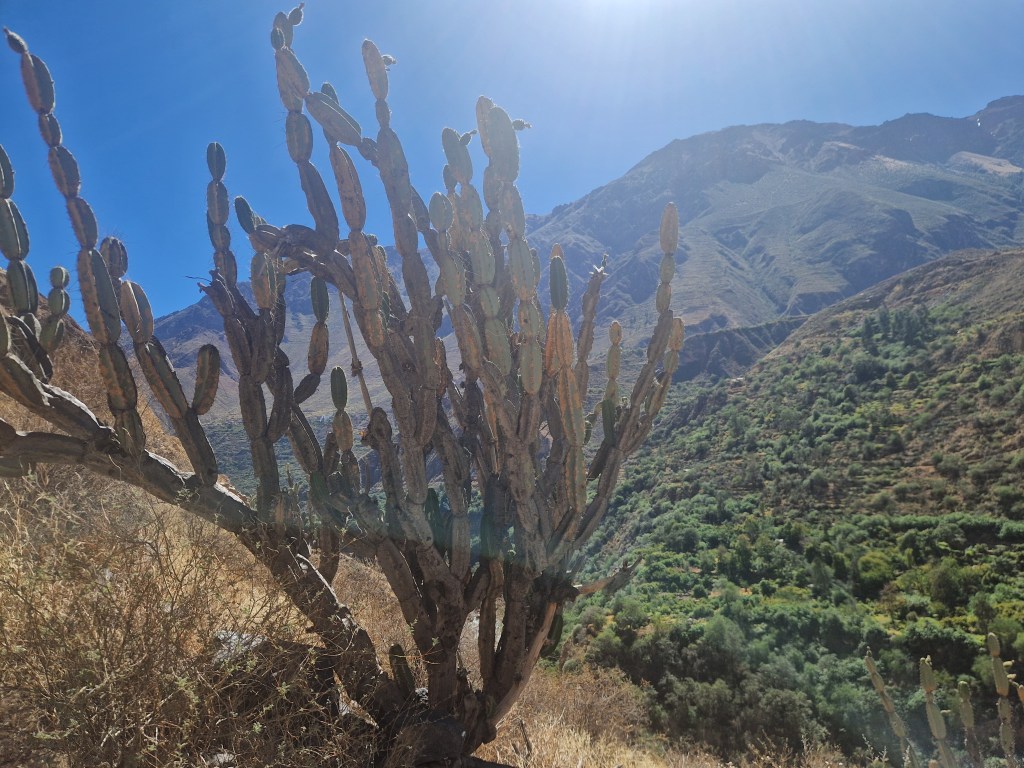
Rounding a corner and seeing cacti which wouldn’t have been even remotely out of place in The Good, The Bad and The Ugly gave the whole experience a wild west feeling. Slipping and sliding down the narrow path, as I struggled not to fall victim to the precipice below me, I could easily imagine myself as some sort of weather-beaten outlaw, focussing on trying to restore justice by, in this case, refusing to be on an organised tour.
“My destination was San Juan de Chuccho, … furthest away from the world above”
It was either that or the unrelenting sun, coupled with a complete absence of shade and a later start due to delays getting to the trailhead had allowed a level of delirium to set in. I had not packed enough water to cope with the additional walk along the road which I had opted to embark upon and so was, at this point, rationing supplies.
At any rate, tumbleweed blowing across the path, quickly followed by gun-toting horsemen and some sort of clapboard saloon wouldn’t have taken me by surprise in the slightest had they appeared in the distance. To support my case, the communities which lived at the bottom of the canyon were indeed isolated, though, with the advent of mass tourism, not as cut off as they may have once been.
Even so, it was a miracle that humans had managed to settle at the base of this vast canyon at all. Certainly, before cars and other mod cons became available, life must have been incredibly tough as, to get pretty much anywhere, a climb of approximately 1000 metres would be required, maybe using a donkey to carry goods or people but most likely just on foot.
Plunging further into the depths, the silence which had only been broken by fellow hikers was interrupted more forcefully by the sound of intensely rushing and turbulent water. Though I didn’t dare look too far over the edge of the path for fear that it may slip out from underneath my feet, I knew this was the Colca River, signalling my approach towards the canyon’s base.
My destination was San Juan de Chuccho, a place that could only really be described as a hamlet and situated at one of the deepest points, furthest away from the world above.
Even so, the tour groups from Arequipa had gone some way to transform this settlement. Though the houses were still of extremely simple construction, complete with thinly thatched roofs and often mud and straw walls, foreigners either stopping for food and drink or even a night’s stay after a taxing descent had resulted in a number of guesthouses or extremely rudimentary restaurants popping up.
At this point, I was absolutely ready to stop for lunch. Even so, sitting down at one of the few places around, I wasn’t ready for a three course lunch which, to say the least, sat heavy in my stomach for the rest of the walk.
The woman running the restaurant was clearly slightly surprised to see someone turn up alone, such was the grip that the tour groups had on the route. Despite this, she found me a table and, with a smile that seemed half sympathetic to me travelling alone and half happy to have another paying cover walk through the garden gate, laid the table and got me some food (this wasn’t the sort of place for menus).
Serving up the typical Peruvian nondescript soup with quinoa and vegetables which had started to lose their colour from being stewed in the broth for too long to start followed by tough and dry chicken with rice and potatoes, it was hardly delicious. Mercifully, fruit was produced at the end of the meal. I picked at it knowing that I had paid for it yet had no real desire to eat anything else.
My main interest at this restaurant was hydration. Having ploughed my way through a significantly greater portion of my water than I had anticipated, I was thrilled to see a fridge (which wasn’t plugged in) stocked with large bottles of water and Coca-Cola. I ended up with one of each, giving me what I really needed to push on further down the canyon.
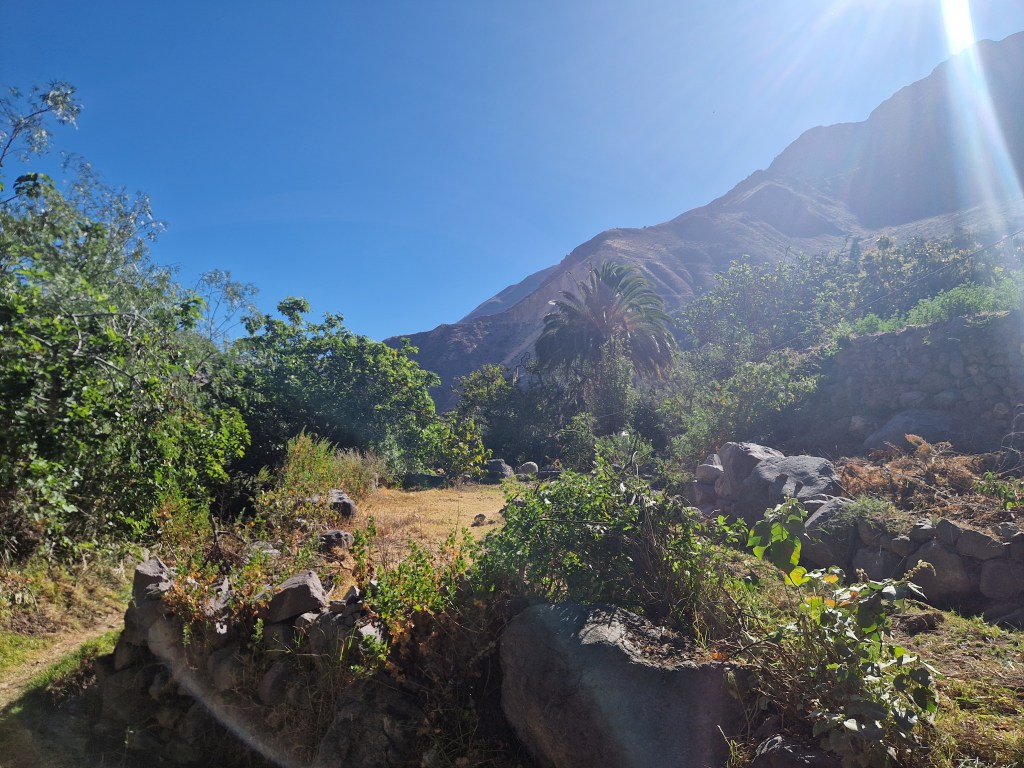
Walking out of San Juan de Chuccho, I was surprised, given how arid my surroundings had been higher up the slopes, at how lush and verdant it was at the bottom. Years of practice in how to divert waters from the gushing river had paid dividends to the communities who called these sparse villages home as they were able to cultivate their own crops including for building materials such as reeds for thatched roofs. There were even trees to provide some welcome shade.
All of this made hiking both easier and harder. On the one hand, I was delighted to finally have the sun off my back. However, the many small fields and tracks and paths crossing between them made navigation without the use of a guide nearly impossible.
As I would overtake a tour group moving at a glacial pace as they digested their lunch, I would then quickly find myself at the end of one of these labyrinthine paths and at a complete dead end. Trudging back, I would then find myself stuck behind the same group that I had just overtaken as they had, of course, taken the correct route and passed me as I was lost. It was slow progress.
Despite the odd wrong turn, walking alongside the Colca River eventually brought me to Sangali, where I was planning to stay the night. Having walked around 13 miles in heat that I was in no way acclimatised for, I was just relieved to be checking into my guesthouse.
The guesthouse in question was predictably basic. Sangali lay directly below the much larger town of Cabanaconde, where the main road to Arequipa passed through. Even though the two were separated by just a five kilometre path, they couldn’t have been further apart in reality.
“The endless switchbacks of the path began to take their toll on my legs as much as my morale”
Where in most scenarios a road would have connected the two, it was impossible between Sangali and Cabanaconde as, within that five kilometre journey, a climb of 975 metres would be required. The only way Sangali could be accessed even as I visited was by donkey down that path.
Predictably, there was only so much that a donkey could carry down the canyon and so I was unsurprised that my bedroom was more of a cubicle than a sealed room, with light shining through from my neighbour as the wall met the roof. All of the fixtures felt loose, as if the whole building was crumbling and shifting on the loose gravel surface, shaking them free as it went.
As I enjoyed a beer with the few other guests staying that night, talk inevitably turned towards the grim climb facing us all the next morning. The owner of the guesthouse had offered us each a donkey to ride up to Cabanaconde though, as we had no choice but to ascend the path somehow, the prices were sky high. Despite this, a couple of them took up the offer – I did not.
Waking at 6 o’clock in the morning to avoid the worst of the heat, I threw my few belongings into my bag and set off to attack the gradient, insistent that I could master it in less than two hours. With only my headtorch guiding the way as the sun was yet to rise, let alone illuminate the canyon’s furthest depths, I felt sweat trickling down my back within a few paces.
As my breath slowly escaped my lungs and my heart rate rose, the endless switchbacks of the path began to take their toll on my legs as much as my morale. This wasn’t helped when I was inevitably overtaken by the guests who had chosen to use donkeys the night before when I was around halfway up.
It was an experience which didn’t contribute much to my time in the Colca Canyon. I viewed it simply as finishing the job; it was neither enjoyable, interesting nor helpful in understanding and experiencing the area I had found myself in. The only thought which crossed my mind beyond how tired my legs and lungs were was how tough it must be for the population which calls the base of the Colca Canyon home – this was no small undertaking and having to do it regularly would have been truly lung-busting.
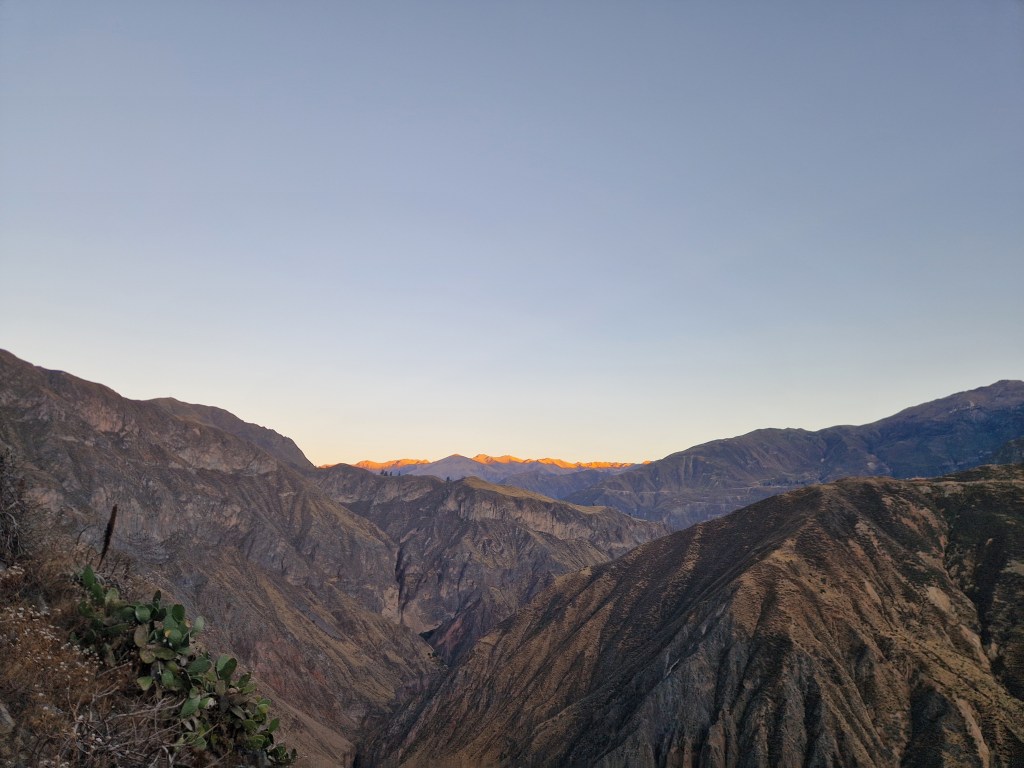
Breathless and basking in the slowly rising sun as it revealed the canyon stretching out below me, I eventually reached the point which would usually have been the culmination of a hike rather than the termination of it: the “summit” at Cabanaconde. I had made it out of the Colca Canyon, unguided and thankful that I had been determined (or silly depending on how you look at it) to go it alone.
This was a place where traditional ideas of landscape were reversed. This inversion caused unexpected microclimates, formed a home for one of the world’s most majestic birds and created a group of extremely hardy people who called it home. Though I’d seen only a small portion of all of this, the Colca Canyon has shown me just enough of its secrets that was enchanted by its ragged beauty.
 Into The Elsewhere