So you want to go to Europe? To the Adriatic coast? And you want to avoid the crowds? Leaving Tirana, these were the questions I was busy asking myself, unsure if there even was an answer to all of them, given the ever-increasing fame and levels of tourism across the whole of Albania.
Certainly, this wasn’t something which was so difficult a few years before my visit. For so long (and much like the country as a whole), the Albanian coastline was an untouched paradise of pristine white beaches, azure blue sea and almost every other beach-related cliché in the book. It was untouched and unexplored.
That was the case a few years ago. Now, things were different.
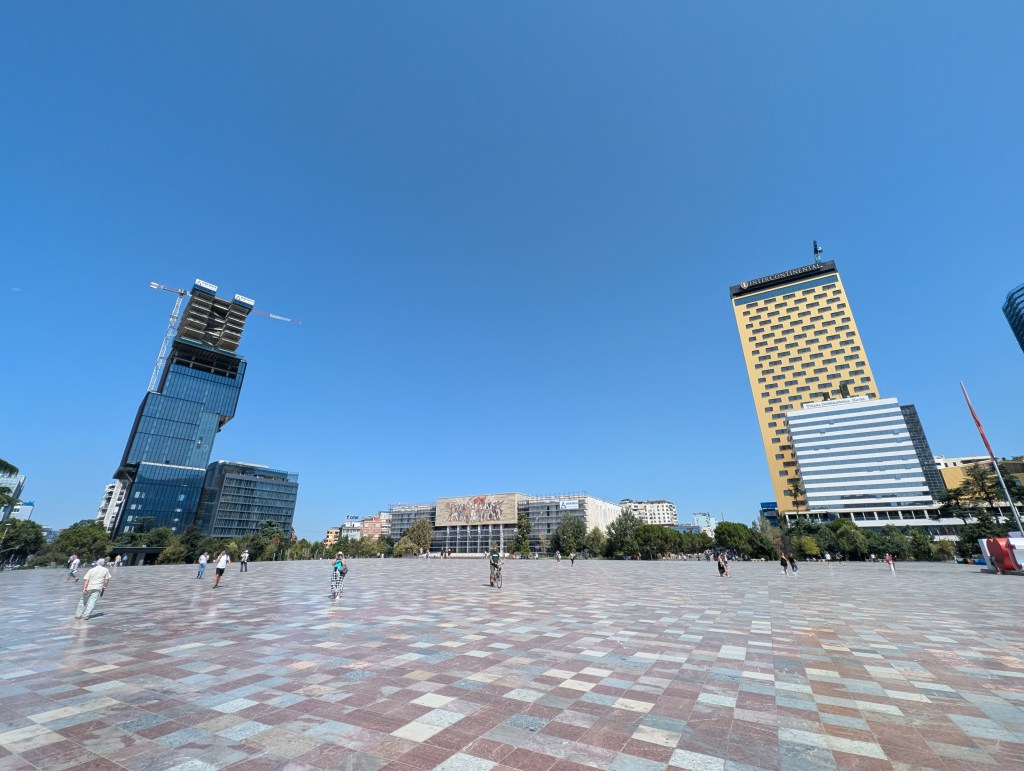
Budget airlines began to cotton on to this emerging market, selling cut-price flights into Tirana from across Europe and from there the coast was an easy hop in a local bus or, for the adventurous, using a rented car on Albania’s slightly madcap roads. The whole country changed rapidly with the promise of all of the Adriatic beauty found in Croatia but with prices so low you would have thought they had missed a zero off your restaurant bill.
The best, most unspoilt beaches went first; the towns of Sarandë and Ksamil were flooded with visitors, their roads becoming car parks of battered rental cars and rumbling tourist coaches. Their beaches? Every inch was consumed by plastic deck chairs and straw umbrellas, with competing DJs playing over each other in a bid for attention and business at their respective beach clubs.
“All of the noise and hustle of the city had … melted away in the intense summer heat”
Though the natural beauty doubtless remained underneath all the change, it was obvious that the transformation these places had undergone was here to stay. The genie had been let out of the bottle and there was no going back.
As much as I would love to claim that I visited these places with my girlfriend before anyone else thought of it, I can’t. This left us with the challenge of trying to find the last remnants of the old Albanian coast in a country where beach clubs and booming music were increasingly the norm.
Too chicken to drive in the country, this was going to be difficult and, sitting in a Tirana hostel, hours of Google searches ensued.
Slowly a single candidate began to emerge: a town called Himarë, halfway down the country’s dramatic, beautiful coastline. It was apparent that getting there wouldn’t be entirely simple (which likely explained why it was supposed to be relatively quiet still) but the reward for doing so seemed worth it.
The next morning, I found myself at one of Tirana’s main bus stations. However, when I say bus station what I probably mean is a dusty, open patch of bare earth filled to bursting point with any number of ancient minibuses, none of which would go to my intended destination.
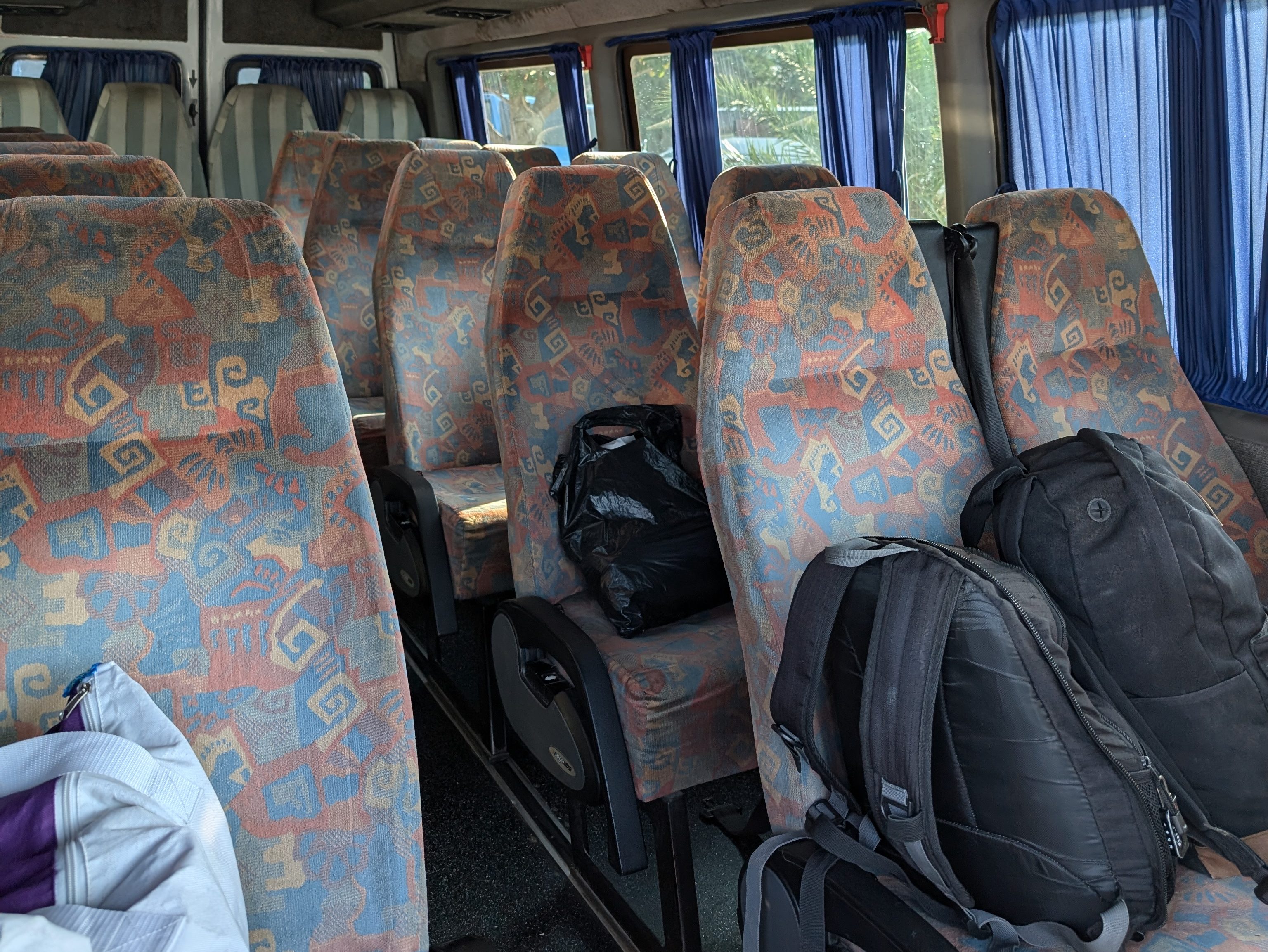
Walking around and looking past the crowds at each of the placards placed in the vehicles’ windscreens, I knew that we had to find a service to Durrës, the old capital and coastal city not far from Tirana. Once this unscheduled bus reached the coast, I had heard that we would have to get off at an unknown point and catch a second, unscheduled bus to our ultimate destination. It was not entirely obvious whether any of this would actually work.
Fortunately it seemed that all the minibus owners knew each other and, having found out that the ticket conductor on the bus which we had ended up on spoke a tiny bit of English, he was able to arrange an almost seamless change. We were finally on our way to Himarë.
As the bus wound its way along the coast road perched along the clifftops, it was easy to see why this coastline had gained such notoriety in an exceptionally short amount of time. Sun-baked countryside landscapes lined the road as rolling hills rose into the distance inland. Every so often, this gave way to a small town or village, largely unbothered by increasing visitor numbers and still firmly rooted in a more rural and laid-back way of life.
“Like in the towns we passed through on our way to Himarë, it felt as if time was standing still”
This was a place where time seemed to run slower. All of the noise and hustle of the city had, it seemed, melted away in the intense summer heat.
Determining the slowed rhythm of the Albanian countryside was the sea itself, its ripples gently reflecting the sunlight and creating a canvas of brilliant white against a backdrop of crystal clear blue. Whenever the road descended off the clifftops, sedate waves washed up against beaches and coves largely ignored by the locals and mostly inaccessible to tourists.
It was an altogether calming environment to travel through, punctured only by the wheezing and straining of the ageing, un-air-conditioned minibus as it struggled with the occasionally steep gradients of the coast road. Still, before too long, we rumbled our way into Himarë itself.
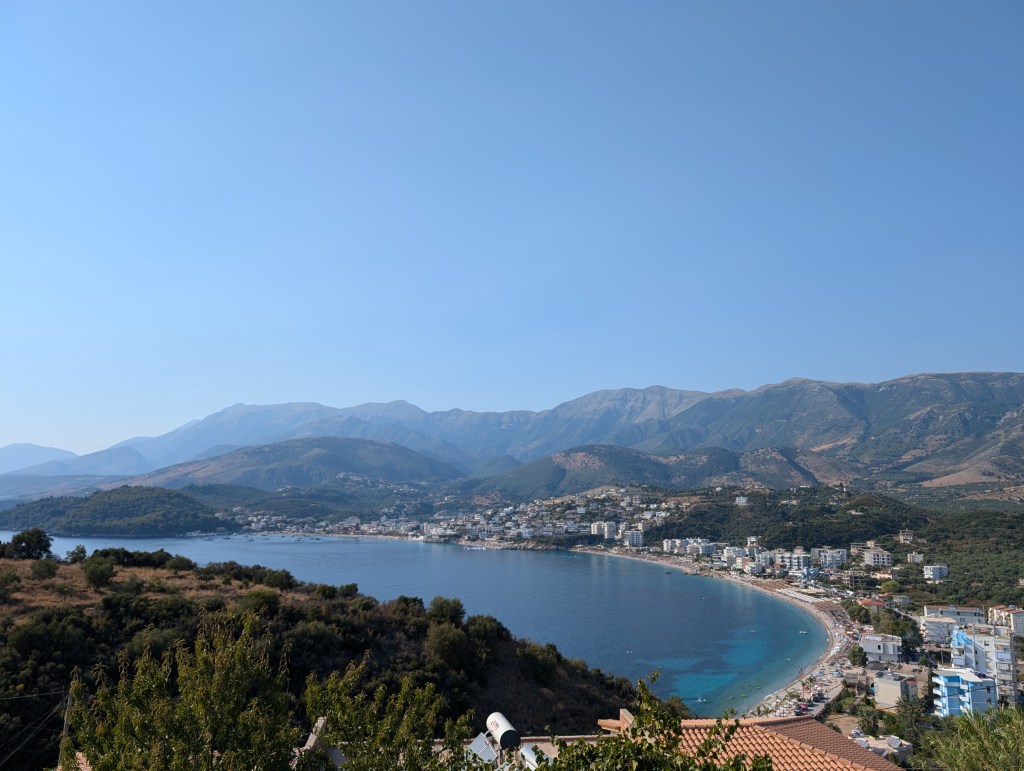
My first impression was of a laid-back town. Sitting on the coast within a depression in the clifftops, it was by no means backwards and had some tasteful but modern developments but, at the same time, it by no means had the manic energy which you may expect of a bigger hub like Sarandë.
Knackered from the journey, we stopped for a coffee at one of the beach-front cafés. Staring out across the wide beach, it was obvious that we had managed to achieve the mission to an extent. Certainly, there were no beach clubs or evidence of over-development. Instead the expanse was largely occupied by Albanian families, the parents sunbathing while the children splashed around at the water’s edge. There was no need to pay for sunbeds, with people simply spreading beach towels directly onto the white pebbles instead.
However, with the town so close by and the expansive nature of the beach with no small number of people on it, I still felt that there was better to come. It was nice, though no Albanian beach paradise that all of the photos promised.
Having left the café behind, we sweatily trudged with our backpacks along the main road through the town towards our guesthouse on a hill to the south. The view at the top was well worth the climb, as we were greeted with a panorama across the whole town and the large bay within which it sat.
Beyond the guesthouse and over in the next bay, I noticed that there was a pin on Google Maps labelled Filikuri Beach. Though it was impossible to see over that side of the headland from the balcony, it had all the hallmarks of what we had travelled so far to find: there was no town butting onto it, it didn’t appear in many travel guides and it was surrounded by cliffs.
The last of these upsides proved, as we made our way over to the beach the following day, to be a double-edged sword.
At the beginning, the path was simple. First along roads and tracks which then gave way to narrow paths, nothing was difficult especially as we had shed our heavy backpacks. Even so, there was no indication of how we would actually descend to sea level as all three remained stubbornly flat.
The answer quickly revealed itself as the path dropped away into nothingness. About 50 metres below, I could see the brilliant white stones of the unpopulated beach, inviting us to make the precarious descent.
It was evident that this was something many people had tried to do before us as we quickly found a rope to give us something to hang on to as we lowered ourselves down the cliff face. This roughly followed a line of least resistance, avoiding the worst of the drops and making things as gradual as possible. That said, one misstep and anything about a path of least resistance could quickly be forgotten as you tumbled down to the beach below.
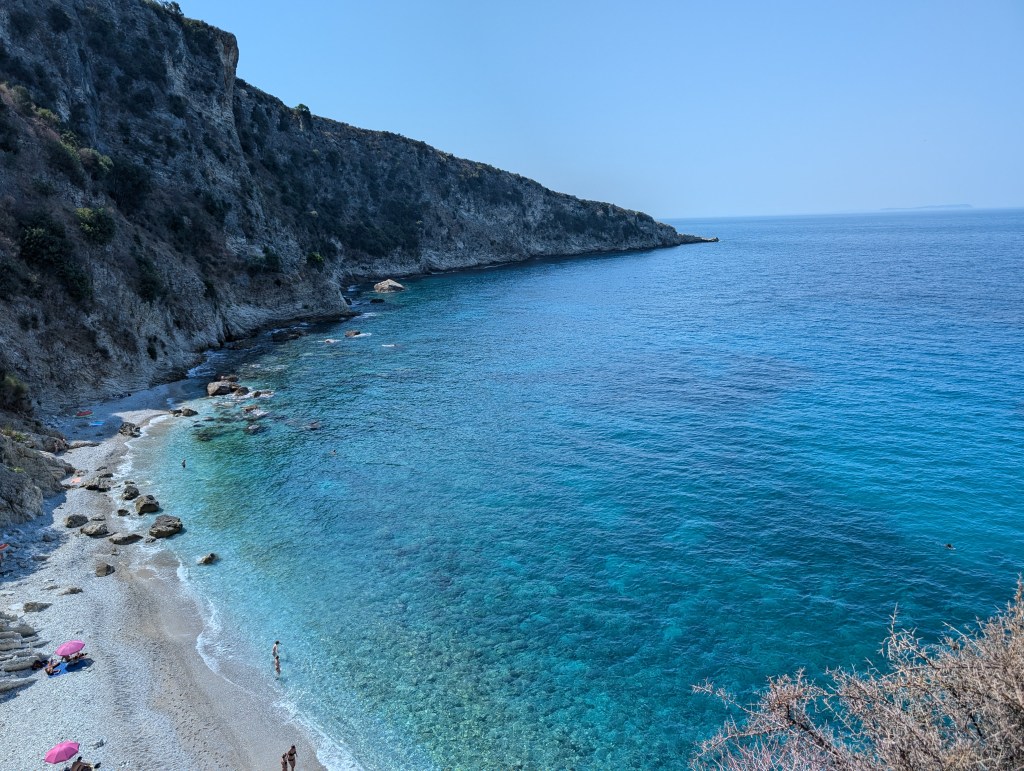
As much as it was a risk, we descended without incident and were quickly and richly rewarded. All around, the sheer cliffs rose up, surrounding the secluded bay and insulating it from the possibility of hosting large numbers of people. Taking my shoes off to wander into the sea, I could feel the intense heat from the warmed pebbles racing through the soles of my feet, encouraging me to dive into the deep blue water a few metres away and cool myself down.
It was extremely peaceful; besides the odd visiting boat, there was no evidence of the mechanised nature of the modern world. Reading a book under the sun, I began to understand the unhurried and serene atmosphere which helped to put this country on the tourist map in the first place. Indeed, much like in the towns we passed through on our way to Himarë, it felt as if time was standing still.
As much as it was extremely satisfying to be able to experience a slice of the Albanian coastline at its natural best, I couldn’t help but also feel that it was a shame that we had to go to such lengths to do so. Yes, it was possible but it took a lot of research, a couple of buses, a good deal of walking and a rope descent down a cliff.
Undoubtedly, it was a price worth paying. As the country further modernises and develops though, what will the price be in the future?
 Into The Elsewhere