
“It’s alright. Nothing to worry about.”
More images flashed up on the TV screen, having been switched over from a football match just moments before.
“It’ll definitely be ok. La Paz will be fine when we get back.”
Our tour guide was convinced. As the news bulletin continued, the tour group watched in collective bewilderment and fear, necks craned upwards towards the headlines emblazoned in red and white capital letters.
“‘Are you sure that isn’t a military coup?’ I asked the guide, convinced it was”
There was very little to support what sounded distinctly like a rough estimate as the tour guide tried to reassure our group. He was confident in his assertions, delivered with a blank face and a matter-of-fact tone.
Looking around the room, down at the plates full of slowly cooling, untouched meals that had long been overlooked by their owners, it was clear that the message hadn’t landed. As much as the group remained calm, there was a sense of rising dread and the pervasive inevitability that things would be different from now on.
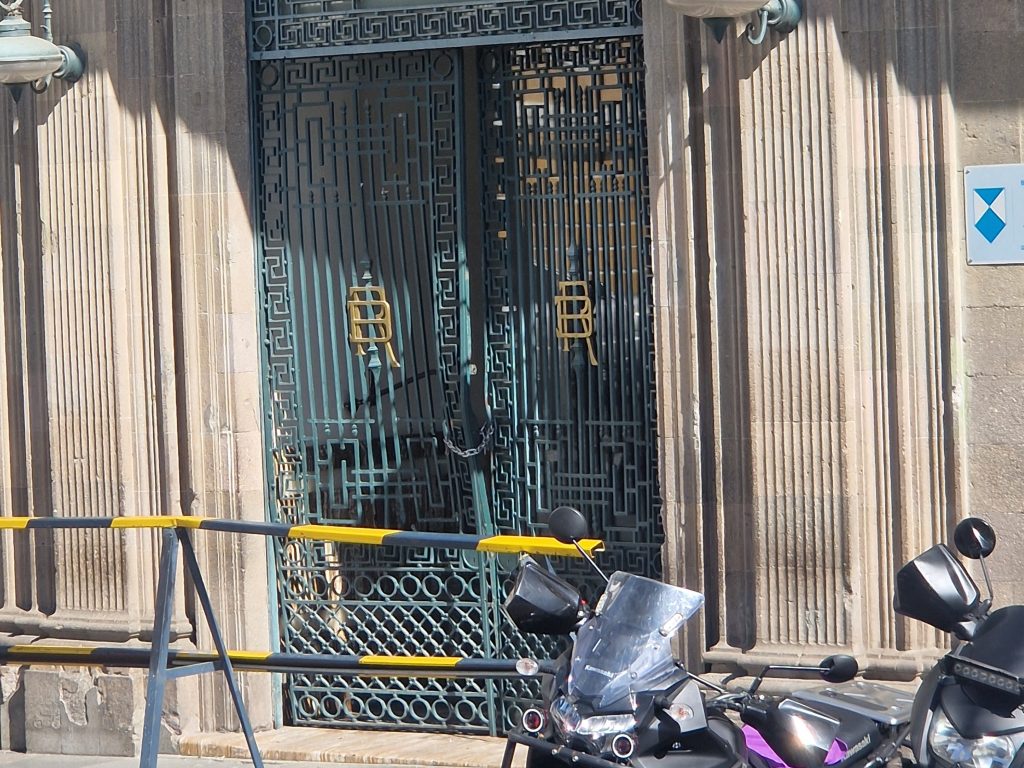
More images were broadcast on the TV. First, large crowds could be seen gathering around various public squares in Bolivia’s de facto capital city, their paths blocked by large numbers of heavily armed soldiers. The feed then cut to the gates of the Presidential Palace being rammed open with an armoured vehicle.
I stretched out a grubby hand, slowly pointing at the screen. “Are you sure that isn’t a military coup?” I asked the guide, convinced it was.
“No, just the military showing their strength to the president,” was the reply.
I took a second to take in what I had just heard, mentally tallying the differences between what I was watching, a coup and the military “showing their strength”. It then occurred to me that mountain biking down the infamous “Death Road” from La Paz to Coroico may actually be the second most dangerous thing I would do that day.
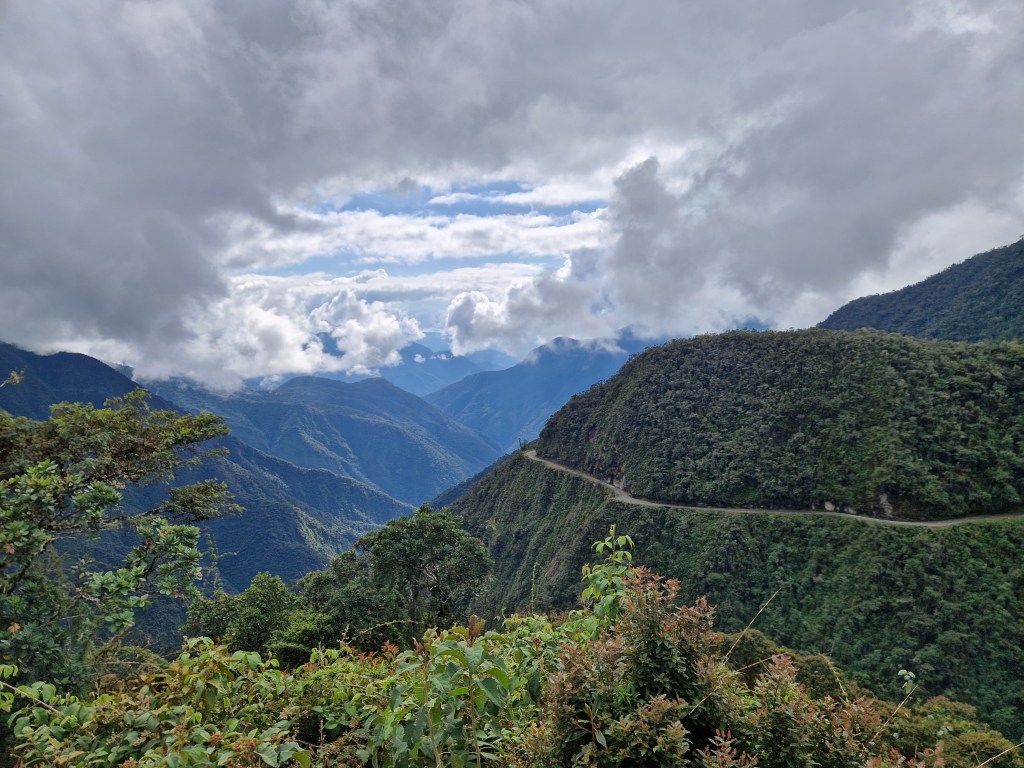
The images continued to flash on the screen, showing tear gas canisters being fired and troops entering the palace. Nobody wanted to move, as hushed discussions took place between a few of the group. There was no internet in the restaurant at the bottom of the road; no way of getting information in English or booking a route out of the country.
Stuck at the bottom of a valley, the only way out was back through La Paz and nobody was keen to embark on the four-hour minibus ride.
Still, a dull sense of inevitability permeated the room. Each of us knew that, even if escape was possible another way, all of our belongings, including passports and anything else necessary to enact a dash for a border, were locked up in various hostels across the city. To get out, we quite simply had to return first and face up to the new reality playing out on the TV screen in front of us.
While the room’s focus remained on the sole TV screen, an engine coughed, spluttered and then roared into life outside. Our guide casually wandered into the room, still unfazed by the news, and beckoned for us to leave.
Slowly, the faces, once glued to the screen, turned and faced the man. There was no panic, just a steady reluctance and overall resignation.
Grabbing a seat towards the back of the battered and wheezing minibus, I settled in for what promised to be a long journey, though I wished it could be longer still. Glancing at my phone, an exclamation mark still occupied the top right corner of the screen, cutting me off from the outside world.
Scanning the bus, I could see the rest of the group taking their seats and going through the same checks as me, either to contact loved ones or find a way out. The door slid and then slammed shut as the engine roared yet again to signal our departure and ascent back to Bolivia’s largest city.
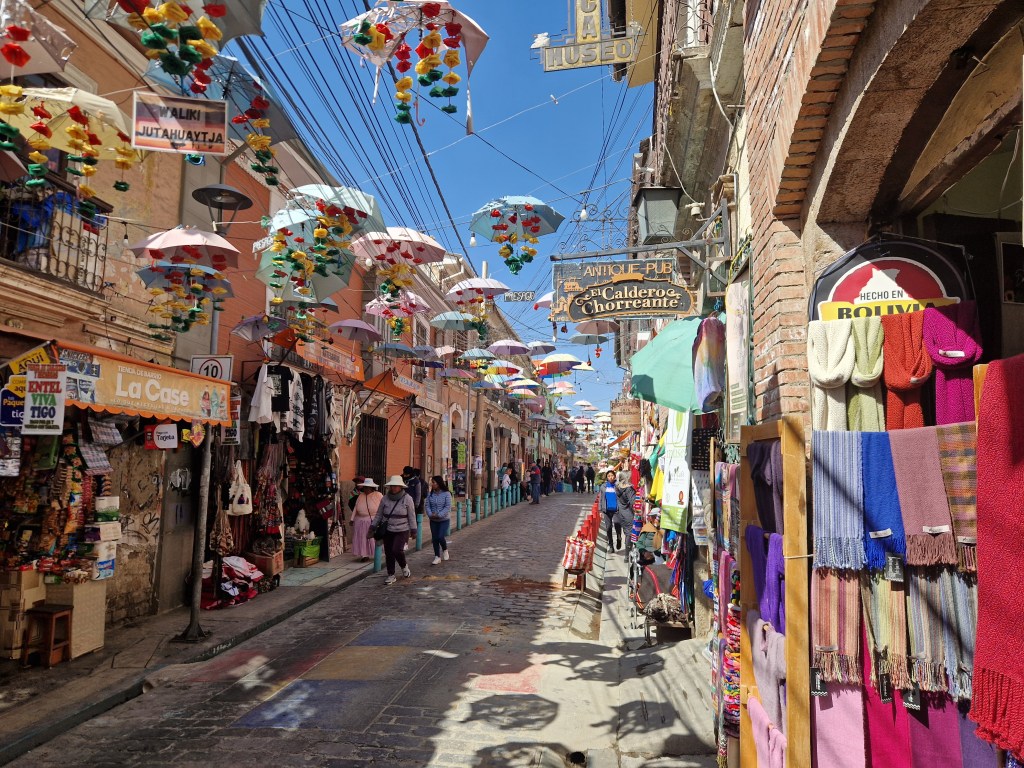
We careered up the twisting mountain road as the bus leaned impossibly from left to right. I gripped the outer edge of my narrow seat in an effort to prevent myself from tumbling into the aisle—something which would doubtless have been painful without a seatbelt to arrest my fall.
Outside, the world grew foggier as our driver raced through the layers of cloud forest on the thankfully paved road. Even so, the visibility became progressively worse until little could be seen of cars in front of us as we screeched past them round blind bends. The other side of the valley was entirely invisible, cloaked in a grey, watery shroud.
With little distraction out of the increasingly misted windows, the buzz of my phone coming to life in my pocket was a welcome break from mentally running through the countless different scenarios I may have to deal with in the coming hours. Almost instantaneously, my heart skipped a beat as I was once again connected to the world beyond the winding road between Coroico and La Paz. I pulled it out of my pocket, the screen glaring up at me through the gloom of the bus.
“It slowly dawned upon me: there was no playbook for this”
It felt like an unfair text to send but I knew that something had to be said.
“I don’t mean to alarm you but there seems to be a coup,” was the message I tapped out on my screen, pressing send and waiting to see if the weak signal would actually send it halfway across the world to my girlfriend.
Neck craned over my glowing phone, I began to quickly feel ill—the tilting bus and twisting roads demanding that I refocused my attention on what little could be seen out of the window. Still, I knew I needed to get something out before the whole thing was reported in the British press and inevitably caused more panic when combined with my silence.
After one or two more corners taken at a speed entirely inappropriate for the creaking minibus, a tick finally appeared beside the WhatsApp message. Though it was obvious there was nothing anyone back home could do to help, I pressed send on a similar message to my mum.
Almost immediately after that, my thoughts turned to how I should try and get out of the country. I faced my fellow passengers, all by now deep in a moody silence, either buried in their own phones or staring grimly into the foggy mass ahead.
“What are we thinking about on how to get out of here then?” I asked Marius, a German sitting next to me. Greeted simply with a shrug, it slowly dawned upon me: there was no playbook for this. No tourist sits down at the beginning of a day knowing that they’ll have to deal with a country’s military marching upon its own Parliament by the end of it. There was no internet guide on “how to survive a Bolivian military coup”.
My only idea was to see if the British Foreign Office had issued any advice on what was unfolding over the pages of every major international news agency. To my slight surprise, there wasn’t even an acknowledgement of the situation. The best information on what was happening was through the odd Bolivian news site and Reuters or the New York Times. Having checked social media, it was more concerned about a conspiracy theory that the coup was being carried out by the USA in return for the country’s mineral wealth.
I refreshed the Foreign Office page again, sure that a bulletin would be released and shepherd me to safer shores. Thoughts of registering my presence in the country and evacuation flights back home swirled through my head. Instead, the internet connection dropped out and I was again cut off.
Wiping the condensation off the inside of the window, I stared out to see if I could get a view of the cloud forest covering the valley. However, the fog remained just as thick. The only things that were visible were the cars we were racing past, the majority of which were dark green military trucks and vans, all cumbersomely climbing their way up the mountain to La Paz.
Visible in each of them were soldiers, grizzled from months in the jungles of Bolivia’s north. Which side had ordered them to travel to La Paz was unclear, though it was obvious from the quantity of trucks belching black diesel fumes that this was no ordinary movement.
My stomach knotted as we passed each of them; this was the first real indication beyond the TV or my phone that something was really off.
The phone in my pocket buzzed again as it reconnected to the internet. Once again drawing it out, it was obvious that the news was starting to spread—I not only had replies to the texts I had sent but also a few from some of my more observant friends who had realised what was happening. The concern was universal and elicited a guilty feeling, as if I had chosen to get caught up in this mess to begin with.
My parents, avid watchers of the news, were among the most worried having seen a few of the clips themselves online. Their message was the clearest so far: get out.
Due to the patchiness of the internet at the bottom of the valley, this was something which I’d had little time to consider up until now. As we ascended, though, the mobile signal became stronger, the fog weaker and the internet more reliable.
Skyscanner loaded fairly quickly after a few attempts though it was immediately clear that flying out of La Paz that day would be impossible. Continuing my search, I found one-way flights to either Lima or Santiago for upwards of $250 for the following afternoon.
Uncertainty crept into my mind. What if the guide had been right in the restaurant at the bottom of the valley and this was all over nothing? Beginning to doubt myself, the prices suddenly were prohibitively expensive for a simple two- or three-hour hop, especially as there was no guarantee that they would actually operate the following day either.
In the end, as the ramshackle red brick and concrete buildings which signalled the outskirts of La Paz began to appear out of the window, I booked myself a significantly cheaper bus ticket to Puno, just across the border in Peru. There was still no guarantee that this would actually work but it felt in the moment like some sort of safety net, relaxing me as I glanced out towards the now cleared sky, with wispy clouds set ablaze by the sun as dusk set in.
All that lay ahead was uncertain. As much as I had a bus ticket, by no means did I want to leave the country which over the past week had enchanted me with its harsh yet often serene nature. If nothing else, this was the purest expression of the rougher, nerve-shredding side of Bolivia. Even so, there was so much more to see which would paint the country in a much better light; things which, if missed, would inevitably lead to regret for years to come.
Before I knew it, the bus ground to a halt not far from my hostel. Asking the guide one last time whether things would be alright, I received a reply similar in its deadpan nature to the one all the way back in Coroico. Pressing a few US dollars into his hand and wondering silently if he would be alright while hoping he was correct, I stepped through the minibus’ sliding door and out into the La Paz evening.
 Into The Elsewhere