It was the scale of Istanbul which hit me first. Sure, I had seen Ottoman-style towns across countries which were formerly part of the sprawling empire centred on Türkiye’s largest city. I had also been to mosques across the Muslim world. Nothing like this though.
Walking out into the grassy area somewhere between a square and park, I was surrounded by the spoils of empire.
“The utterance of the name Hagia Sofia evokes a sense of ancient, storied and varied history”
To my left was the Blue Mosque, complete with its six minarets piercing high into the sky. These were constructed and, at the time, even rivalled the architecture in Mecca; something which was previously (and still is) unthinkable throughout Islam. At least that was for everyone apart from the Sultan who actually went and got it built.
The effects of such a building reverberated around the world – this was a mosque designed to displace one of the world’s most established religious centres after all. In time, Mecca’s Grand Mosque quickly sprouted a seventh minaret to stay ahead.
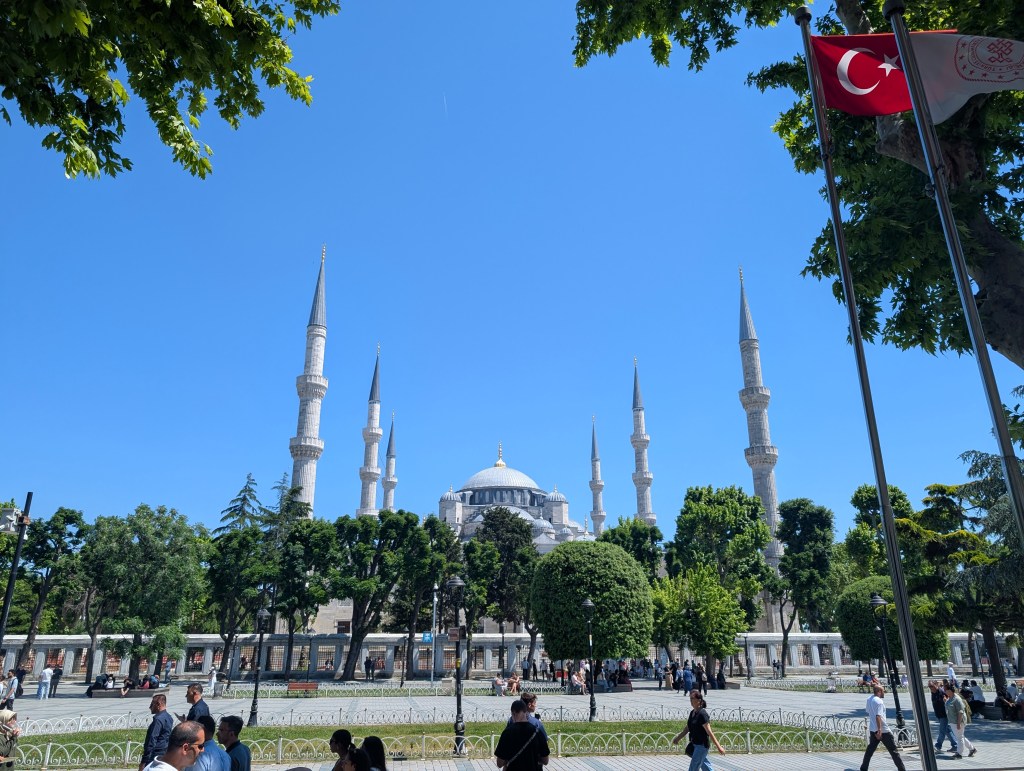
Still, this was arguably only the second most significant building within the park area which I found myself standing within.
The utterance of the name Hagia Sofia evokes a sense of ancient, storied and varied history as it is spoken. As far as landmarks are concerned, it goes without saying that it’s among the best-known in the world today and its enormous stature is no less than it was when it was first established back in the days of the Roman Empire.
As I stood there, my gaze shifting from the many minarets of the Blue Mosque to the scaffold-clad, clay-coloured exterior of Hagia Sofia, it was easy to see how the building had maintained its status.
Even through the scaffold, the monumental features – thick buttresses propping up an enormous, shallow dome; the surrounding, smaller buildings, big enough to serve as a mosque in their own right in many other places and the sheer scale and solidity of the structure – all were plain to see. This was a building designed to dominate for an exceedingly long period of time.
Standing there, head turning from one to the other, looking out over the ships sailing down the Bosphorus into the Mediterranean through the gap between them, was an almost overwhelming experience. Even so, it was one which invited me in and requested that I explore further.
More than happy to oblige, I stepped forward, first towards the Blue Mosque.
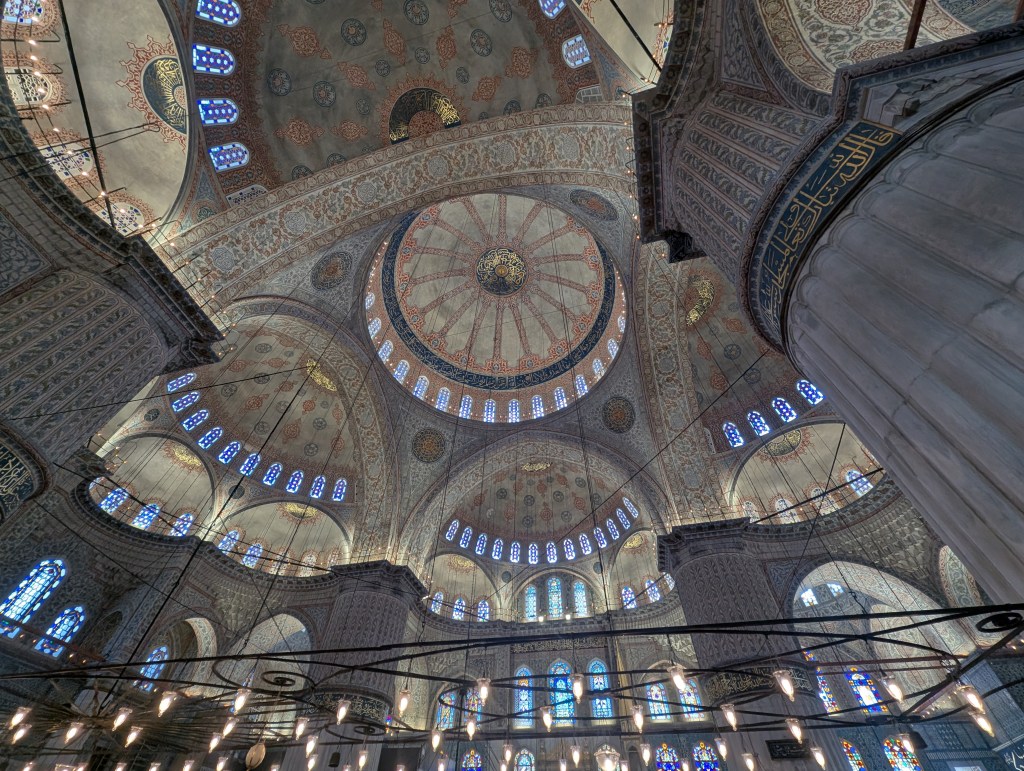
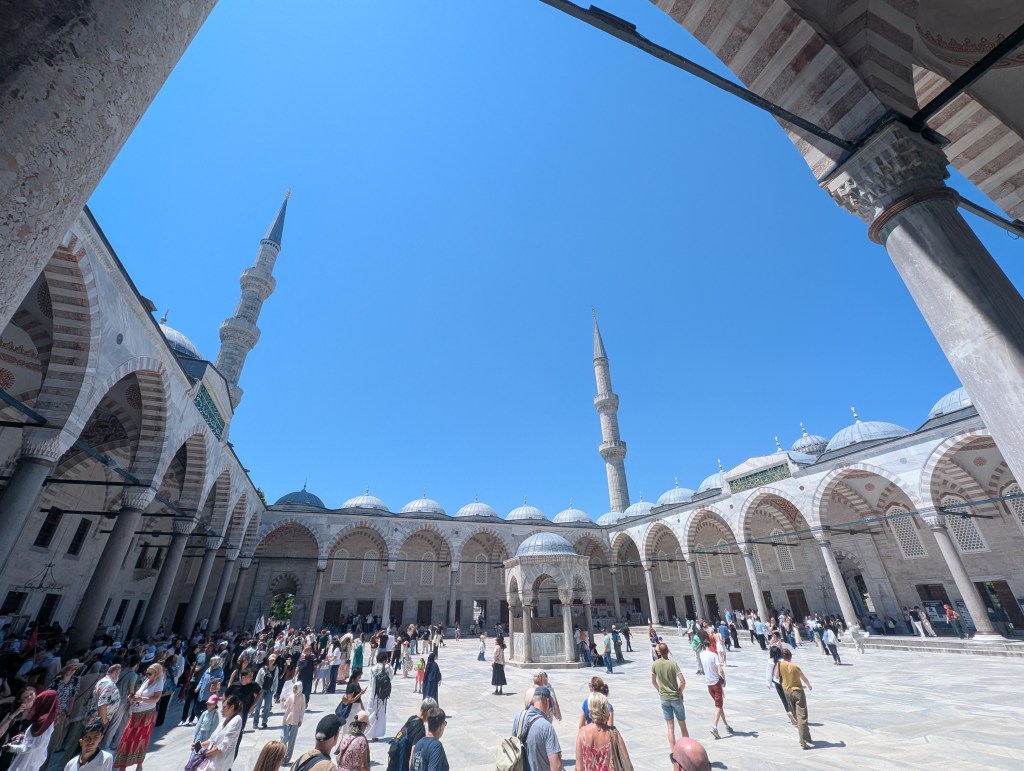
The interior was no less impressive, with swirling colours surrounding me as I stepped inside the main building from one of the many surrounding, pristine courtyards. Like so many religious buildings of its type, it urged me to look upwards to the heavens at the earliest opportunity, as I wandered barefoot across its carpeted floor.
The many painted domes were lit up beautifully so that their painted interiors shimmered and all the intricacies of the fine craftsmanship were clear to even the most casual viewer. Indeed, the sight of it was so mesmeric that it was difficult to avoid bumping into the mosque’s other visitors as I walked across the floor, neck strained upwards and not looking at where I was going.
This set of experiences was almost entirely typical of visiting Istanbul. The grandeur and riches of empire were all around in a manner only seen in a few cities worldwide. However, my experience visiting the Blue Mosque also exposed the flip side of visiting a city with such a rich history as Istanbul.
When a place has so many sights, it’s understandable that people want to see them. What truly is then a measure of the place in question is how that’s handled. In the case of Istanbul, it was with an industrial response.
“This was mine forever, should I wish to keep it. I very much didn’t as I pulled it over my head”
The reason why I was prone to bumping into people in the Blue Mosque was because of the small-ish area which all visitors were confined to. Understandably, this was to allow others to pray in peace yet it gave it a surprisingly claustrophobic feeling for such a cavernous space.
Yes, this was a mosque much grander than any I had (or maybe ever will) visit yet, at the same time, the robe which was thrust into my hands by a silent attendant at the entrance to cover my knees inside the building, the loud and jarring announcements for all visitors to vacate for prayers to take place and the sheer number of people inside the building made the whole experience feel a touch impersonal.
It is not because I disagree with any of these things in principle; quite the opposite. The whole experience was just very different from what I had experienced at smaller, less visited Islamic sites.
Take, for example, the main mosque in the centre of Sarajevo, Bosnia and Herzegovina. Of course, that building doesn’t even compare to what I saw in Istanbul. In fact, I would hazard a guess that you’d be able to fit the whole Sarajevo mosque complex inside the main building of the Blue Mosque.
The mosque in Sarajevo was also much less ornate and, honestly, also far less spectacular. Even so, it invited me in and encouraged me to remain there for far longer than I stayed in the Blue Mosque. It was a peaceful space, with tourists largely coexisting with those going to pray.
Crossing the square having left the Blue Mosque, I hoped for a different experience at the far better-known Hagia Sofia, a must-visit destination in Istanbul and perhaps one of the few buildings which anyone should try and visit at least once in their lifetime. I wasn’t so naïve, though, to know that I would likely be disappointed.
All hope ended at the ticket kiosk before I even crossed the threshold into the monumental structure. From behind a glass screen, the beady eyes of the ticket salesperson cast their way over my body and quickly focussed in on my bare knees. Seeing where this was heading, I quickly admitted that I would need to cover them – this was a working mosque after all.
“Go to the counter at the end,” I was told and dutifully, I went in the direction of the final window, expecting to be handed another unattractive cloth robe like before.
“200 lira please,” said the next person, sliding a card machine through the narrow slot at the bottom of the window, alongside a dark blue, plasticky robe, which barely covered my knees anyway due to my height. This was mine forever, should I wish to keep it. I very much didn’t as I pulled it over my head.
Yes, the interior of Hagia Sofia was spectacular, the history oozing from each corner whether it was through Viking graffiti, old, previously covered up mosaics from when it was a church or some of the Islamic motifs hung from some of the walls.
As much as the white scaffolding towers, which were inside the building as well as outside it, did have some impact on the overall ambiance, it was still a stunning place to visit as I wandered around the balcony above the main floor where people were coming in to pray below.
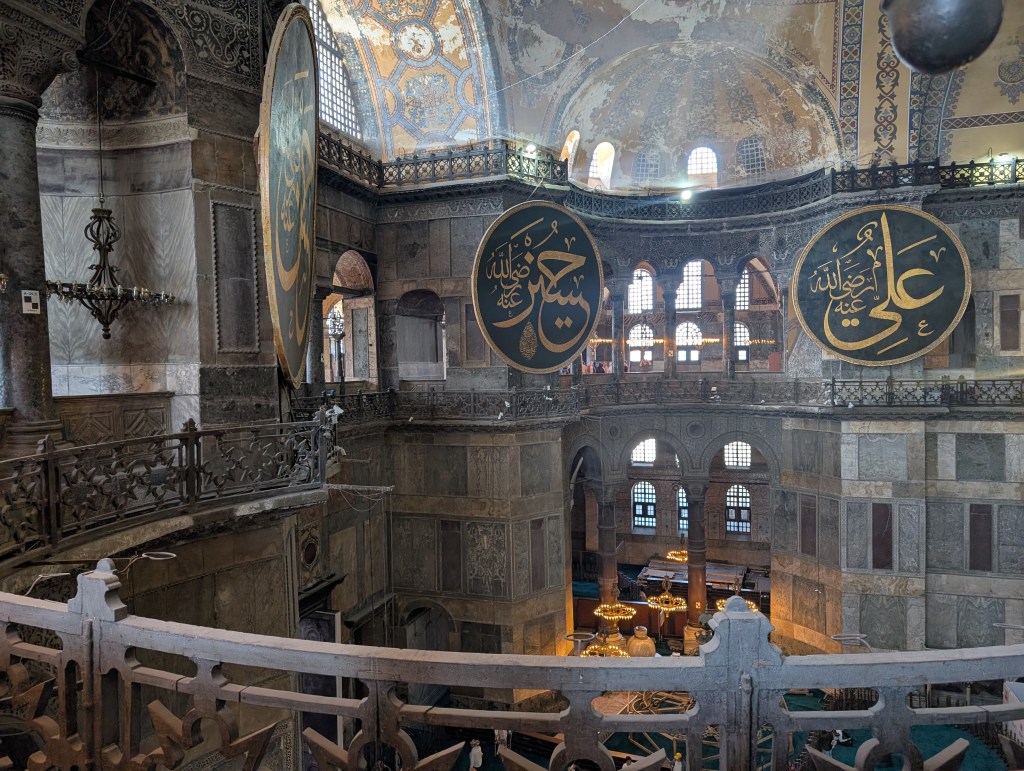
That said, not being able to get down onto the main floor apart from to pray was something which I found somewhat frustrating during my visit. Much like in the Blue Mosque, tourists were confined to only a small part of the building, out of the way and dealt with impersonally and on an industrial scale.
The same was true of the audioguide, which did provide some interesting information and pointed out the main things to see in Hagia Sofia. However, it failed somehow to bring such a storied building to life.
I felt like I had only half visited as I walked out through the exit. The true, monumental nature and history of Hagia Sofia had escaped me.
This was by no means because the buildings somehow hadn’t lived up to their (admittedly impressive) reputations. It was clear that, in the cases of the Blue Mosque and Hagia Sofia, these were places which were impressive on a scale which was beyond the wildest dreams of most cities – they were true and lasting monuments to the success of the Ottoman Empire and all of the history which predated even that.
Their issue was that they hadn’t been adapted well to the inevitable influx of tourism which had fallen through their doors. Where, before the advent of cheap flights and an increasingly small and globalised world, a visitor may have expected to be able to enter these places similarly to a local, it was now impossible and obviously so.
Even the illusion of an authentic experience had been stripped away as tourists were penned back and prevented from seeing the best or even the entirety of two of Istanbul’s most famous structures.
Some of it is understandable, of course. Other bits are a religious necessity, which must be respected. None of it prevented me from leaving either place with a bit of a shrug.
 Into The Elsewhere